Learning Techniques: Science-Backed Methods for Retention
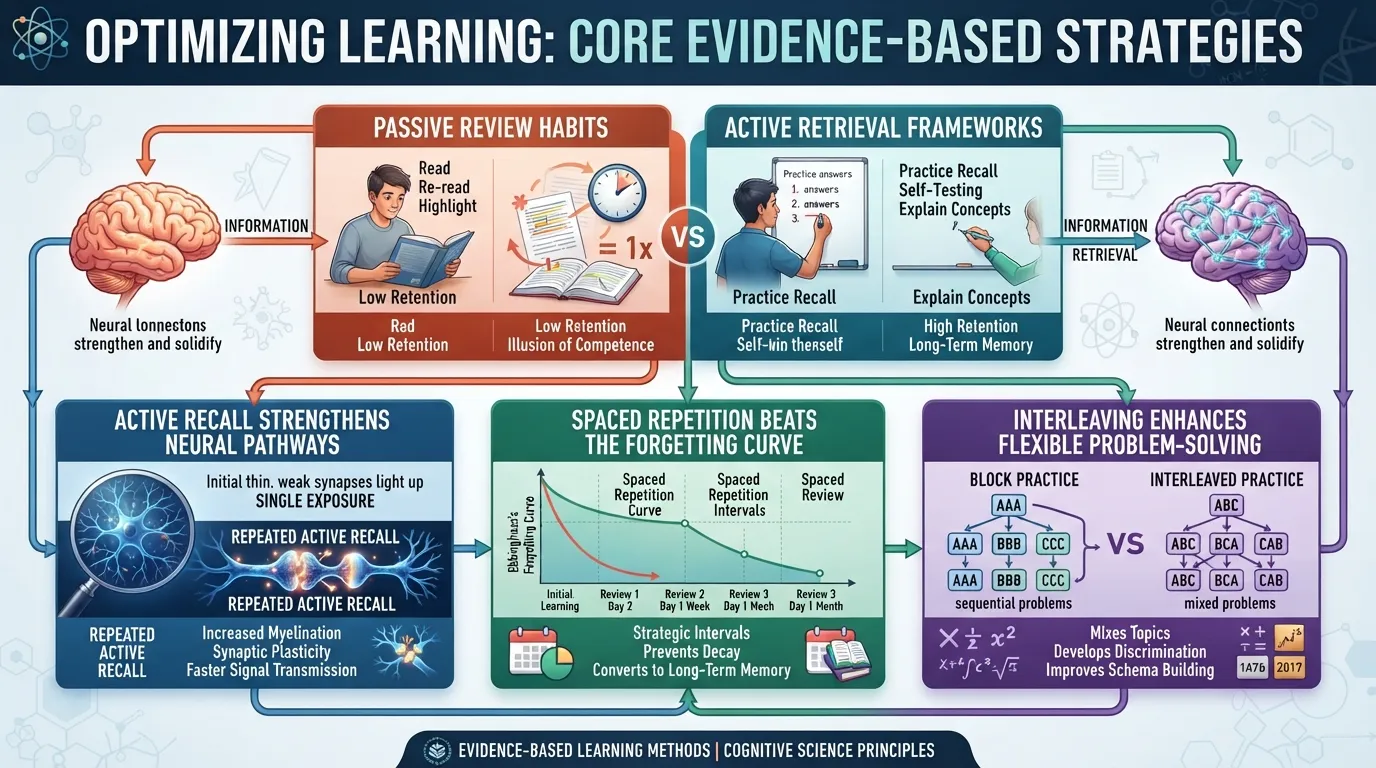
Why Your Current Study Method Isn't Working
Studying for hours on end only to blank out during an exam is a universal academic frustration that usually stems from flawed cognitive strategies rather than a lack of effort. When you rely on traditional habits like re-reading textbooks or highlighting passages, you create a false sense of mastery without building durable memory traces in the brain. Transitioning to evidence-based approaches requires moving away from comfortable routines and embracing cognitively demanding strategies that force your brain to struggle, encode, and retrieve information effectively.
Relying on time-spent studying rather than cognitive output leads to poor long-term retention.
Traditional review methods trick your brain into recognizing information rather than actually recalling it.
True academic performance depends on aligning your study habits with cognitive psychology and how the brain stores memory.
What Are Learning Techniques? (Quick Definition)
Learning techniques are structured, evidence-based cognitive strategies and study methodologies designed to maximize information acquisition, long-term retention, and conceptual comprehension. Unlike passive reading, these systematic frameworks actively engage neural pathways, transforming short-term exposure into deeply encoded, accessible knowledge.
They act as deliberate roadmaps for how the brain processes, organizes, and retrieves new data.
Effective methods optimize cognitive load to prevent mental fatigue while accelerating mastery.
They bridge the gap between temporary memorization and true conceptual understanding.
Why Most Students Study Hard But Still Forget Everything
Most students fall into the trap of passive review, spending hours re-reading notes or passively watching lecture recordings without challenging their brains. This approach relies on the illusion of competence, where familiar text feels learned simply because it is in front of you, but the neural connections dissolve rapidly once the book is closed. Without active engagement and systematic memory retrieval, your brain naturally discards the information as low-priority noise within 24 to 48 hours.
The Illusion of Competence: Recognizing a concept on a page is entirely different from being able to recall and explain it from scratch.
The Forgetting Curve: Without structured intervention, human memory decays exponentially shortly after initial exposure.
Lack of Active Engagement: Passive reading bypasses the cognitive friction required to cement long-term neural pathways.
Ineffective Study Habits You Need to Stop Using
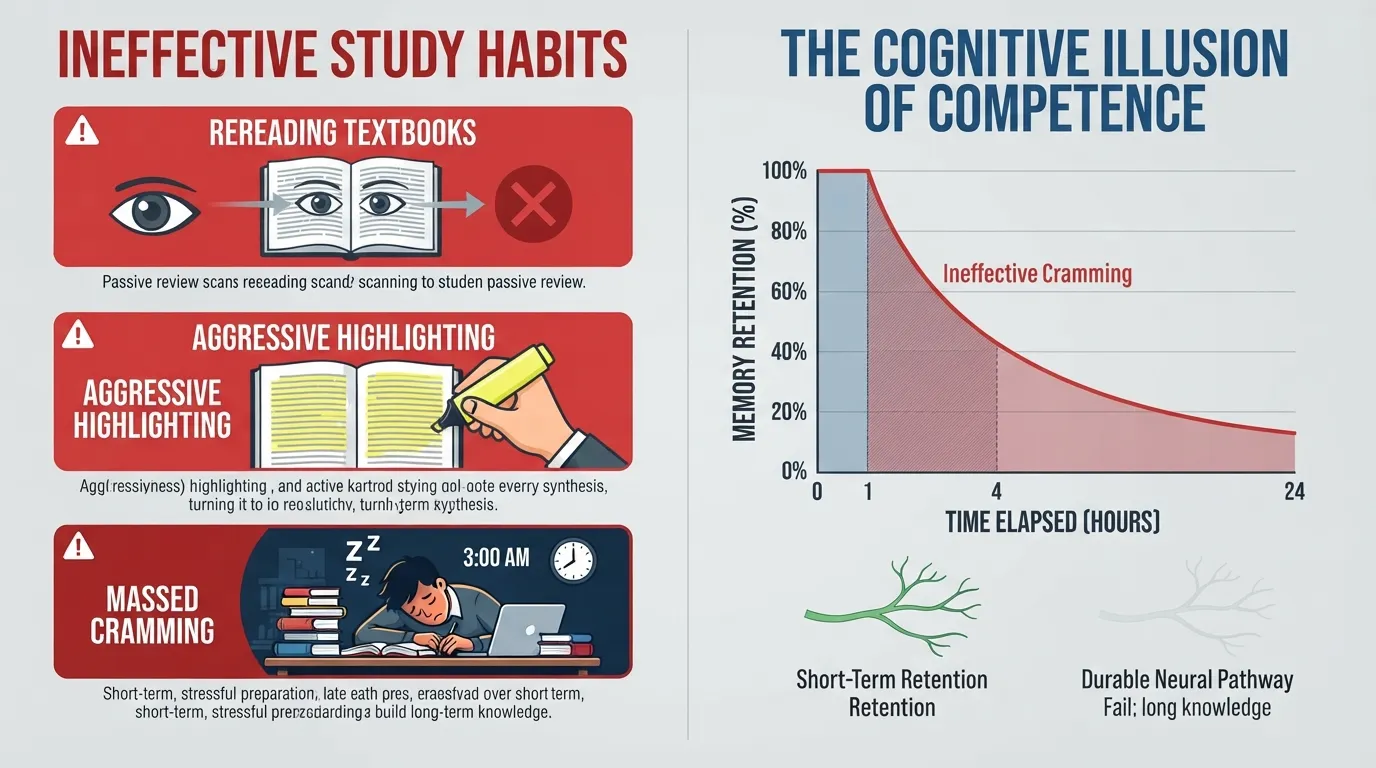
Eliminating counterproductive habits is the fastest way to instantly reclaim your study time and boost your information retention. Many common study routines feel productive in the moment, but they actually exploit cognitive biases that trick your brain into believing you know material you will soon forget.
The Productivity Trap: Spending hours with textbooks open often masks fundamentally flawed processing methods.
Cognitive Shortcuts: Traditional habits rely heavily on recognition rather than true memory retrieval.
Immediate Correction: Swapping these outdated methods for targeted strategies yields exponential gains in exam performance.
Rereading and Highlighting: The Illusion of Knowing
Rereading chapters and aggressively highlighting textbook pages create a dangerous false sense of knowing by making the text increasingly familiar with every pass. Because your eyes glide over words you have already seen, your brain mistakes passive recognition for actual mastery, leaving you completely unprepared when faced with unprompted application questions.
Highlighting feels like active work, but it rarely forces the brain to build durable neural pathways.
Familiarity breeds complacency; seeing a highlighted sentence triggers memory cues that vanish on a blank test paper.
Moving away from text-marking requires replacing visual tracking with self-testing and summarization.
Cramming: Why It Only Works Short-Term
Cramming relies on massed practice to overload your short-term working memory just long enough to scrape by on an imminent exam or quiz. While this frantic burst of effort can produce temporary recognition, it completely bypasses the biological consolidation process required to transfer information into long-term memory.
Information absorbed through overnight cramming decays rapidly, often disappearing within days or even hours.
High stress and sleep deprivation during cram sessions actively impair the brain’s ability to encode new knowledge.
Sustainable academic success requires replacing last-minute panics with predictable, distributed study schedules.
Blocked Practice: One Topic for Hours Isn’t Learning
Blocked practice involves spending hours studying a single topic or problem type until you feel like you have mastered it before moving on to the next chapter. Although this creates a satisfying sense of momentum, it stunts your ability to adapt because your brain never has to figure out which strategy to apply to a mixed set of challenges.
Sticking to one isolated concept eliminates the cognitive friction necessary for deep, flexible learning.
Real-world exams feature randomized questions, meaning blocked practice leaves you vulnerable to context-dependent failure.
Interleaving different topics forces the brain to constantly evaluate problems and select appropriate solutions.
Science-Backed Learning Techniques That Actually Work
Transforming academic performance requires replacing passive habits with proven, cognitive-psychology frameworks evaluated extensively in educational research, such as the landmark analysis on learning strategies by Dunlosky et al.. These science-backed methodologies force your brain to actively struggle, encode, and retrieve information, dramatically increasing long-term retention and reducing study time.
Evidence-based methods align your study habits directly with how the human brain processes and stores memory.
Transitioning from passive review to active engagement eliminates the false sense of competence.
Systematic integration of these techniques ensures sustainable academic success across diverse subjects.
Active Recall (Retrieval Practice): Force Your Brain to Work
Active recall, or retrieval practice, is the process of deliberately forcing your brain to retrieve information from memory without looking at your notes or textbook. Instead of passively reviewing material, you test yourself on concepts, transforming learning from a passive absorption task into an active mental workout that strengthens neural pathways.
Effortful Retrieval: Struggling to remember an answer activates relevant knowledge networks and reinforces long-term memory traces.
Error Correction: Getting answers wrong is actually beneficial, as correcting mistakes bridges knowledge gaps permanently.
Superior Encoding: Testing yourself provides an accurate gauge of true mastery compared to re-reading text [02:18].
Spaced Repetition (Spaced/Distributed Practice): Beat the Forgetting Curve
Spaced repetition involves spreading your study sessions over increasing intervals of time rather than cramming all at once [03:49]. By reviewing material just as your brain is about to forget it, you reset the forgetting curve and signal to your brain that the information is critical for long-term storage.
Distributed Sessions: Spacing out practice allows essential neurological consolidation and sleep-dependent memory integration to occur [03:56].
Long-Term Efficiency: Reviewing over weeks yields significantly higher retention rates than massed practice in a single day [04:20].
Algorithmic Flashcards: Digital tools utilizing spaced repetition automate optimal review intervals for maximum efficiency.
The Feynman Technique: Teach It Like You’re Explaining to a Beginner
The Feynman Technique breaks down complex information by requiring you to explain a concept in simple, plain language as if teaching a complete beginner. If you stumble, stutter, or rely on technical jargon, you immediately highlight exact gaps in your comprehension that need review.
Simplification Test: Stripping away complex terminology forces you to truly understand the core mechanics of a topic.
Targeted Gap Analysis: Identifying where your explanation breaks down tells you precisely what to study next.
Mental Clarity: Translating abstract ideas into conversational analogies cements deep conceptual understanding.
Interleaving: Mixing Subjects for Deeper Understanding
Interleaving involves mixing different topics, problem types, or subjects within a single study session instead of focusing on just one topic for hours [03:14]. This technique forces your brain to continually switch strategies, heightening discrimination between concepts and improving flexible problem-solving skills.
Dynamic Adaptation: Cycling through varied challenges prevents the false fluency associated with blocked practice [03:30].
Enhanced Contrast: Comparing different subjects side-by-side helps clarify subtle differences and overlapping principles [03:38].
Improved Transfer: Mixed practice prepares you effectively for randomized exam formats.
Elaborative Interrogation: Asking “Why” and “How” Questions
Elaborative interrogation stimulates learning by prompting you to generate explanations for why explicit facts or statements are true. By connecting new information to background knowledge you already possess, you create a rich web of semantic meaning rather than isolated memorization points.
Causal Reasoning: Asking “why” forces you to dig beneath surface-level facts into underlying mechanisms.
Prior Knowledge Integration: Linking new concepts to familiar ideas anchors memory securely.
Critical Thinking: This method transforms dry lists of facts into logically coherent mental models.
Dual Coding: Combining Visuals With Words
Dual coding leverages the brain’s separate information-processing channels for visual and verbal data by combining text with diagrams, charts, or infographics. When you process information through both channels simultaneously, you create duplicate mental representations that make the memory much easier to retrieve.
Multi-Channel Processing: Engaging both visual and verbal systems reduces cognitive overload on any single pathway.
Information Mapping: Converting complex text descriptions into flowcharts or sketches clarifies relationships.
Stronger Cues: Dual-coded memories offer multiple distinct retrieval pathways during exams.
Concept Mapping: Visualizing Connections Between Ideas
Concept mapping is the practice of creating graphical diagrams that organize hierarchical relationships between core concepts, sub-topics, and overarching themes. This visual layout helps you see the big picture while tracking how individual details support the central subject.
Hierarchical Structure: Grouping main ideas with supporting branches organizes messy notes into structured frameworks.
Relationship Tracking: Drawing connecting lines explicitly defines how different concepts interact.
Macro Perspective: Maps prevent you from getting lost in details by keeping the overarching thematic framework visible.
Practice Testing: Simulating Real Exam Conditions
Practice testing involves taking complete, timed practice exams under strict closed-book conditions to replicate the exact pressure of a real test environment. This builds psychological resilience, enhances retrieval under stress, and exposes remaining knowledge gaps before they impact your grade.
Exam Simulation: Training under strict constraints eliminates test-day anxiety and time-management panic.
Diagnostic Accuracy: Unbiased testing reveals true readiness without the safety net of open notes.
Output Conditioning: Practicing the exact format of expected assessments trains your brain for high-stakes performance.
Summarization: Condensing Information Into Key Points
Summarization requires distilling extensive lecture notes or textbook chapters into concise, high-yield summary paragraphs or bullet lists. By filtering out fluff and capturing only essential arguments, you engage in active synthesis that clarifies core takeaways.
Signal-to-Noise Filtering: Stripping away minor details forces you to identify primary arguments.
Synthesis Exercise: Rewriting concepts in your own words prevents passive copying.
Review Efficiency: Concise summaries serve as high-value reference sheets for future spaced repetition cycles.
What Are the 4 Types of Learning Styles? (VARK Model)
The VARK model categorizes how individuals prefer to absorb and process information into four distinct sensory preferences: Visual, Auditory, Reading/Writing, and Kinesthetic. Understanding these categories helps you tailor your study approach, though modern cognitive science shows that adapting techniques based on the actual nature of the material matters far more than sticking rigidly to one label.
Sensory Preferences: The VARK framework identifies whether your brain favors visual diagrams, spoken discussions, text descriptions, or hands-on practice.
Flexibility: Successful learners utilize multiple modalities rather than limiting themselves to just one preferred sensory style.
Beyond Labels: Aligning your strategy with evidence-based techniques is more critical for long-term retention than identifying with a single learning style.
Visual Learners
Visual learners absorb information best when it is presented in charts, diagrams, flowcharts, spatial layouts, and color-coded notes. Rather than relying on plain text paragraphs, these learners map out relationships visually to grasp complex structures and overarching systems at a glance.
Diagrammatic Processing: Transforming dense text into mind maps and schematics drastically accelerates comprehension.
Spatial Organization: Using colors and spatial grouping helps organize hierarchical information cleanly.
Visual Recall: Remembering the physical layout of notes or charts acts as a powerful retrieval cue during exams.
Auditory Learners
Auditory learners thrive when information is spoken aloud, discussed in groups, or delivered via lectures and audio recordings. They process and retain spoken nuances, rhythm, and verbal explanations exceptionally well compared to silent reading.
Verbal Reinforcement: Reading notes out loud or explaining concepts to a study partner cements understanding.
Audio Integration: Listening to podcasts, lectures, or recorded summaries optimizes retention for spoken content.
Discussion-Based Review: Participating in study groups allows auditory learners to process ideas through verbal debate.
Reading/Writing Learners
Reading/writing learners prefer text-based input and output, gravitating toward lists, dictionaries, textbooks, essays, and extensive note-taking. They solidify their understanding by translating abstract ideas into structured written explanations and bulleted summaries.
Text-Based Mastery: Information is best absorbed through traditional reading and comprehensive written notes.
Written Synthesis: Rewriting textbook concepts into clear lists and definitions clarifies complex arguments.
Structured Output: Creating detailed outlines provides a reliable foundation for future review sessions.
Kinesthetic Learners
Kinesthetic learners process information most effectively through physical engagement, hands-on practice, real-world simulations, and bodily movement. They struggle with prolonged passive sitting and benefit immensely from experiential learning and active physical interaction with study material.
Hands-On Practice: Building physical models, conducting lab experiments, or role-playing concepts drives engagement.
Movement-Based Study: Pacing while reviewing flashcards or using physical objects helps maintain focus.
Experiential Anchoring: Connecting abstract theories to physical movements creates durable motor and sensory memories.
Do Learning Styles Actually Matter? (Balanced, Evidence-Based Take)
While the VARK model helps identify your preferred sensory modality for taking in information, rigorous cognitive research shows that matching instruction strictly to a supposed “learning style” does not actually improve academic performance. Instead, every student learns best when study techniques match the specific content being taught—such as using dual coding for anatomy or practice testing for math—regardless of their preferred style label.
Preference vs. Capability: Enjoying visual diagrams does not mean you cannot or should not learn effectively through text or audio.
Content-Driven Methods: The optimal study technique is determined by the subject matter, not an immutable personality profile.
Multimodal Flexibility: Combining visual, auditory, and kinesthetic strategies produces superior retention compared to relying on a single learning preference.
Which Technique Works Best for Your Subject?
Choosing the right study technique depends heavily on the specific subject matter and your ultimate academic goals, as a method that excels in mathematics may fail in language-heavy disciplines. Matching your cognitive strategy to the exact demands of the material ensures that you invest your time efficiently while maximizing both short-term exam performance and long-term retention.
Subject-Specific Alignment: Different academic disciplines require distinct cognitive operations, ranging from algorithmic problem-solving to conceptual synthesis.
Goal-Oriented Planning: Preparing for a high-stakes exam requires different execution timelines than building lifelong mastery of a subject.
Strategic Versatility: High-performing students combine multiple evidence-based methods tailored to the unique structure of each course.
Best Techniques for STEM Subjects (Math, Science)
STEM disciplines like mathematics, physics, and chemistry require procedural fluency, formula application, and deep structural understanding rather than rote memorization. Success in these subjects depends on deliberate practice and actively working through complex problem sets under varied conditions.
Practice Testing & Interleaving: Solving mixed problem sets prevents formula memorization without understanding, training your brain to select the right mathematical approach.
Active Recall & Feynman Technique: Breaking down complex biological pathways or physics formulas into simple components exposes exact gaps in your logic.
Dual Coding: Visualizing abstract processes, chemical structures, and anatomical systems through diagrams anchors technical data securely.
Best Techniques for Humanities & Language-Heavy Subjects
Humanities, history, literature, and foreign languages demand extensive conceptual comprehension, thematic synthesis, and vocabulary acquisition. These subjects reward deep verbal engagement, contextual connections, and structured narrative mapping over mechanical repetition.
Elaborative Interrogation: Asking “why” historical events unfolded or how literary themes connect builds robust, meaningful semantic networks.
Spaced Repetition & Flashcards: Memorizing foreign language vocabulary, historical dates, and literary terms requires consistent distributed review.
Summarization & Mind Mapping: Condensing sprawling textbook chapters into core arguments and mapping overarching themes clarifies complex historical narratives.
Best Techniques for Exam/Test Prep vs Long-Term Mastery
Your study strategy must adapt depending on whether you are rushing to clear an imminent evaluation or investing in durable, lifelong knowledge. While short-term prep prioritizes high-yield diagnostic testing, true long-term mastery relies on foundational spacing and structural integration.
Exam Prep Focus: Prioritize timed practice testing, error correction, and high-yield active recall to optimize score performance under pressure.
Long-Term Mastery Focus: Implement extended spaced repetition schedules, interleaving, and concept mapping to prevent memory decay over months and years.
Balancing Both: Combining intensive practice testing with distributed review bridges the gap between passing tomorrow’s test and retaining the knowledge for life.
Comparison Table: Technique, Best For, Time Required
| Study Technique | Best Suited For | Time Required & Efficiency |
| Active Recall | Conceptual subjects, definitions, and theory | Medium time investment; extremely high retention return |
| Spaced Repetition | Vocabulary, long-term mastery, and heavy fact retention | Low daily time commitment distributed across weeks |
| Feynman Technique | Complex theories, confusing concepts, and technical processes | Medium-to-high time investment; fast identification of knowledge gaps |
| Interleaving | STEM problem sets, mixed exam prep, and skill discrimination | Low-to-medium time investment; high cognitive friction |
| Elaborative Interrogation | History, literature, and understanding causal mechanisms | Medium time investment; high conceptual durability |
| Dual Coding | Anatomy, geography, flowcharts, and visual data | Low time investment once diagrams or maps are created |
| Practice Testing | Final exam simulation, pacing, and stress reduction | High time investment (full test blocks); critical for score accuracy |
Tools and Apps to Apply These Techniques
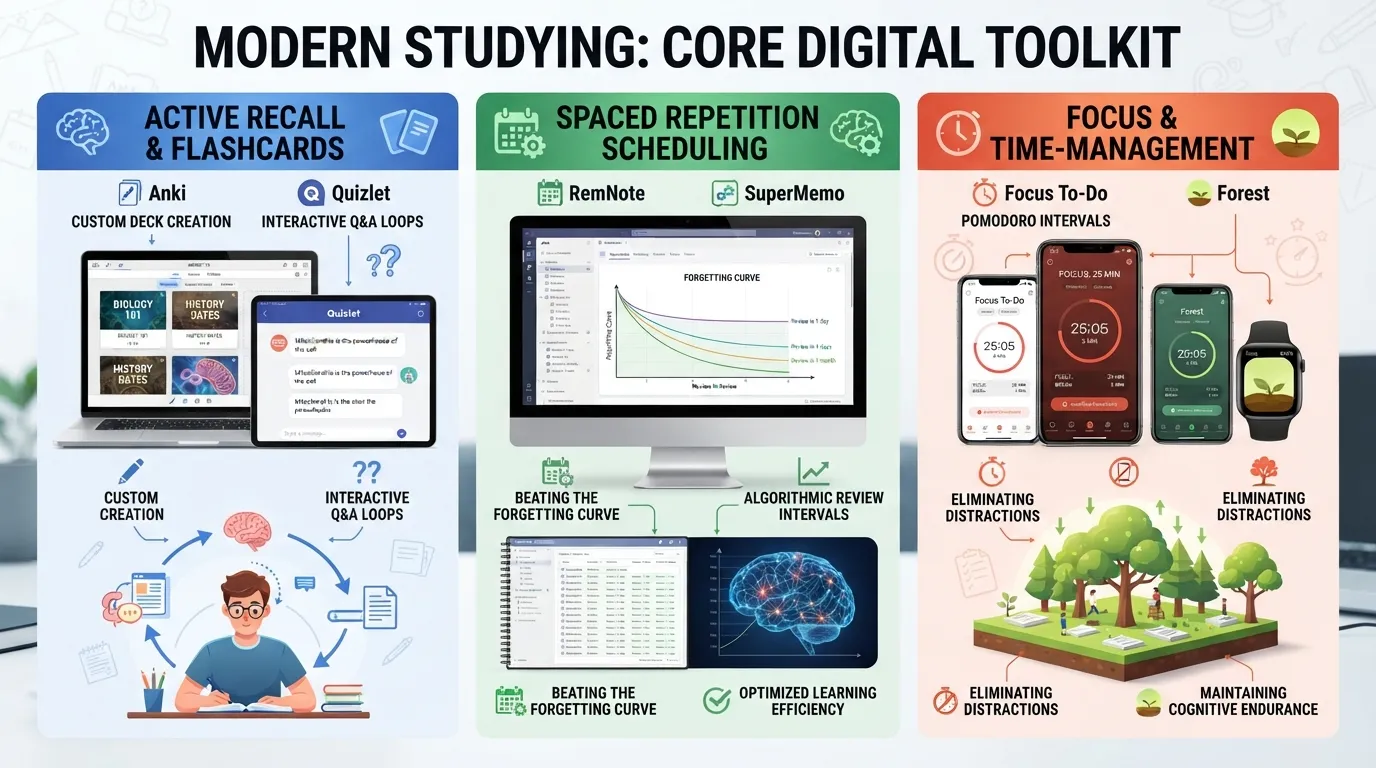
Leveraging modern digital tools automates the logistical friction of scheduling and organizing, allowing you to focus your cognitive energy entirely on learning. Integrating purpose-built software into your routine transforms complex evidence-based strategies—such as active recall and spaced repetition—into seamless, daily habits.
Automation: Digital platforms handle the complex tracking required for spaced repetition schedules without manual calendar management.
Accessibility: Cloud-syncing applications ensure your flashcards, notes, and study decks are available across all your devices.
Efficiency: Purpose-built software maximizes retention return on investment by optimizing review intervals and study sessions.
Best Apps for Active Recall & Flashcards (Anki, Quizlet)
Flashcard applications digitize active recall by prompting you to test your memory before revealing the answer, turning passive reading into interactive retrieval. Platforms like Anki and Quizlet allow you to build custom decks, share community-created study sets, and practice anywhere.
Anki: Utilizes open-source flexibility and powerful desktop-mobile syncing to power intensive, customized flashcard decks.
Quizlet: Offers user-friendly study modes, pre-made community decks, and interactive games designed for quick concept testing.
Active Testing Loop: Every card flip forces an immediate judgment of recall accuracy, strengthening memory traces instantly.
Spaced Repetition Scheduling Apps
Spaced repetition algorithms remove the guesswork from studying by automatically calculating when you are about to forget a piece of information and scheduling a review. Applications dedicated to this workflow adjust review intervals dynamically based on how easily you recall each card.
RemNote: Combines note-taking with built-in spaced repetition flashcards generated directly from your daily notes.
SuperMemo: Features advanced algorithmic scheduling pioneered by cognitive science researchers to maximize long-term retention.
Optimized Scheduling: Eliminates wasted study time by prioritizing only the specific concepts your brain is currently at risk of forgetting.
Focus & Time-Management Tools (Pomodoro-Based Apps)
Maintaining deep focus during intensive study sessions requires structured breaks to prevent mental fatigue and cognitive overload. Pomodoro-based time-management applications divide study periods into focused intervals paired with mandatory rest periods to sustain high productivity.
Focus To-Do: Integrates task management with the classic Pomodoro timer to track study productivity across different subjects.
Forest: Gamifies focus time by growing a virtual tree while you study, discouraging phone distractions during work intervals.
Cognitive Endurance: Structured 25-to-50-minute focus blocks prevent burnout and maintain optimal mental sharpness throughout long study days.
How to Build Your Own Study Technique Plan (Practical Framework)
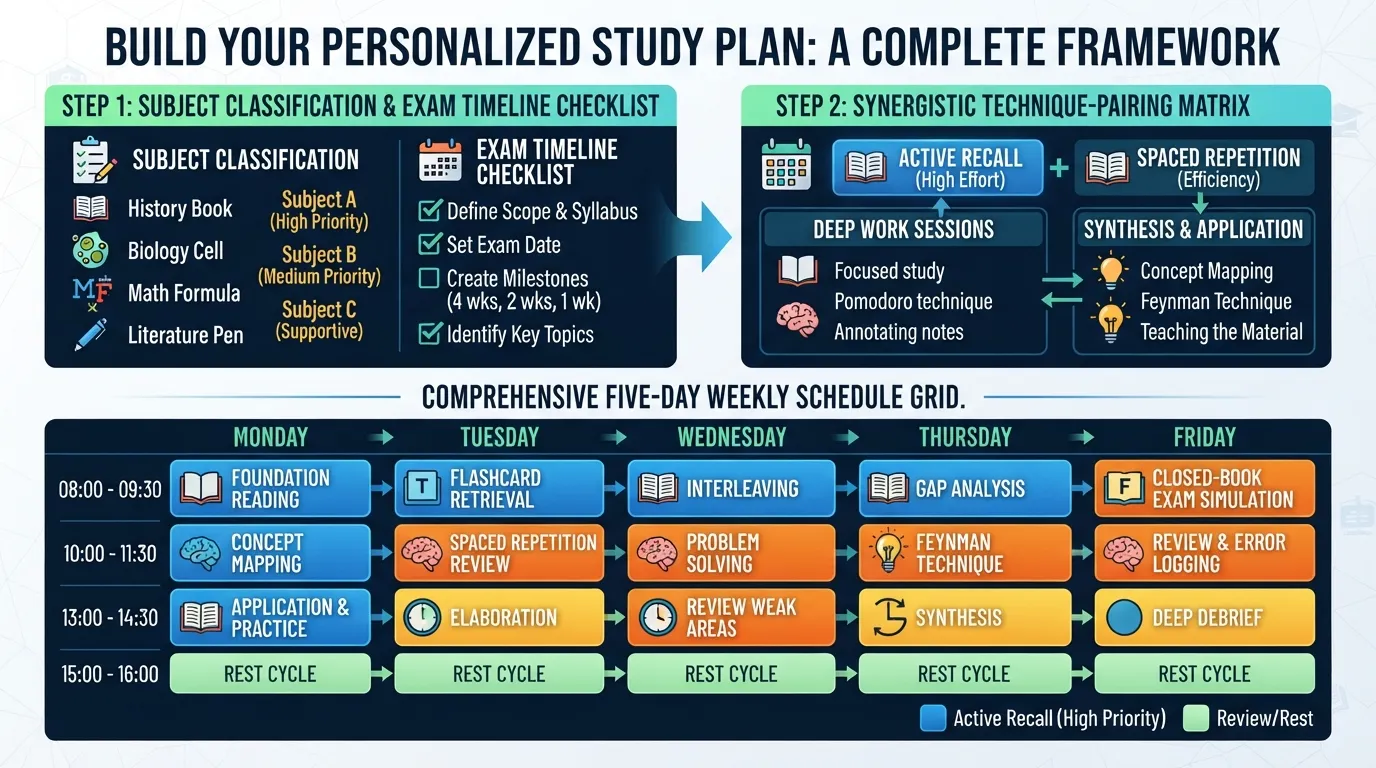
Constructing an effective study plan requires moving away from random, reactive reading and assembling a structured framework tailored to your exam timeline and subject matter. Combining complementary methods—such as pairing active recall with distributed spacing—maximizes study efficiency and ensures long-term retention without burnout.
Targeted Design: A personalized study plan aligns your daily review tasks with your specific deadlines and academic goals.
Synergistic Pairing: Combining multiple evidence-based techniques prevents the blind spots inherent in relying on a single method.
Predictable Execution: Establishing a repeatable weekly schedule removes daily decision fatigue and builds consistent momentum.
Step 1: Identify Your Subject Type and Exam Timeline
Before assigning study techniques, evaluate the nature of your coursework and the exact timeframe remaining before your evaluation. Heavy conceptual or problem-solving subjects require early interleaving and practice testing, whereas vocabulary-heavy subjects demand immediate integration of spaced repetition algorithms.
Assess Deadlines: Count the weeks or days remaining to establish a sustainable spaced repetition schedule and prevent last-minute cramming.
Categorize Material: Determine whether your subject relies on technical problem-solving, factual memorization, or narrative synthesis.
Allocate Resources: Assign high-intensity active recall to weak areas while reserving lighter review slots for well-understood topics.
Step 2: Combine 2-3 Techniques (Not Just One)
Relying on a single study habit limits your academic performance because different cognitive strategies target distinct phases of memory encoding and retrieval. Building a powerful routine involves pairing complementary methods, such as using flashcards for active recall alongside mind mapping for macro-level structural understanding.
Core Retrieval Loop: Use active recall or flashcards daily to test retention of discrete facts and definitions [04:12].
Structural Integration: Periodically construct concept maps or use the Feynman Technique to connect isolated facts into coherent mental models [06:06].
Dynamic Testing: Introduce mixed practice or simulated exams weekly to test your ability to apply knowledge under pressure.
Sample Weekly Study Schedule Using Active Recall + Spaced Repetition
Implementing a balanced weekly study plan ensures consistent cognitive engagement while leveraging the forgetting curve to your advantage. Below is a structured template combining active recall, spaced repetition, and practice testing across a standard five-day preparation cycle.
Monday (Foundation & Input): Read core material, build custom flashcard decks, and construct initial concept maps to outline overarching themes.
Tuesday (Active Retrieval): Complete scheduled spaced repetition flashcard reviews and use the Feynman Technique to explain complex Tuesday topics out loud [06:06].
Wednesday (Interleaving & Testing): Mix problem sets from different chapters or subjects to challenge your brain’s ability to switch strategies dynamically.
Thursday (Gap Analysis & Refinement): Review missed flashcards, rewrite troubled definitions, and test yourself on weak spots identified earlier in the week.
Friday (Simulated Exam & Review): Take a timed, closed-book practice test under strict exam conditions to evaluate pacing, stress management, and final readiness.
Frequently Asked Questions
What are the 7 learning techniques?
The seven core evidence-based learning techniques include active recall, spaced repetition, the Feynman Technique, interleaving, elaborative interrogation, dual coding, and practice testing. These strategies replace passive habits like re-reading with cognitive frameworks designed to maximize long-term retention.
Active recall forces memory retrieval instead of passive review.
Spaced repetition distributes study sessions over time to beat the forgetting curve.
Practice testing simulates exam conditions to build high-stakes performance resilience.
What are the four types of learning methods?
The four primary learning styles within the VARK model are visual, auditory, reading/writing, and kinesthetic preferences. While these sensory modalities describe how individuals prefer to take in information, academic success ultimately depends on matching your study method to the specific subject matter.
Visual learners rely on diagrams, charts, and spatial maps.
Auditory learners thrive on spoken explanations and group discussions.
Reading/writing learners excel with text-based summaries and lists.
Kinesthetic learners require hands-on practice and physical movement.
What are examples of learning techniques?
Common examples of effective learning techniques include flashcard self-testing, mind mapping, summarizing textbook chapters in your own words, and teaching concepts to a beginner. Each example requires active mental engagement rather than superficial review.
Flashcards stimulate cued active recall for discrete definitions.
Mind maps organize hierarchical relationships and macro-level themes.
Summarization filters out fluff to isolate core arguments.
What are the best learning techniques?
The best learning techniques are those grounded in cognitive psychology that require effortful mental processing, such as retrieval practice and distributed spacing. These approaches consistently outperform passive habits across diverse academic disciplines.
Evidence-based methods align directly with how the human brain encodes memory.
High-performing students combine retrieval practice with systematic review intervals.
Avoiding passive techniques like highlighting prevents the illusion of competence.
Which is the most powerful learning technique?
Active recall paired with spaced repetition is widely considered the most powerful learning technique combination in cognitive science. This duo forces the brain to retrieve stored data while capitalizing on natural neurological consolidation intervals.
Retrieval practice strengthens neural pathways through effortful recall.
Spaced intervals prevent rapid memory decay over weeks and months.
Together, they maximize long-term retention while minimizing study time.
What are 10 effective learning strategies?
Ten highly effective learning strategies include active recall, spaced repetition, the Feynman Technique, interleaving, elaborative interrogation, dual coding, concept mapping, practice testing, summarization, and scheduled focus blocks. Implementing these methods creates a comprehensive system for academic mastery.
Combining multiple techniques prevents blind spots in your study routine.
Structured frameworks eliminate the inefficiency of random reading.
Consistent execution builds durable conceptual schemas.
What are the 5 best study techniques?
The top five study techniques for maximizing academic performance are active recall, spaced repetition, interleaving, practice testing, and the Feynman Technique. Focusing your schedule around these five methods guarantees high-yield results.
Active recall and spaced repetition form the bedrock of memory retention.
Interleaving and practice testing prepare you for flexible, randomized exam formats.
The Feynman Technique ensures deep conceptual comprehension.
What is a good learning method?
A good learning method is any structured cognitive strategy that forces active mental processing, error correction, and schema building rather than passive review. Effective methods require you to struggle productively with the material.
Good methods eliminate the false sense of knowing created by re-reading notes.
They prioritize long-term neural encoding over temporary short-term cramming.
They provide clear feedback on what you do and do not understand.
What are the 10 best study techniques?
The ten best study techniques integrate cognitive science principles to optimize encoding, retention, and application across complex subjects. These range from digital flashcard decks to hand-drawn concept maps and peer teaching.
Utilizing spaced flashcard apps automates optimal review schedules.
Constructing concept maps clarifies big-picture relationships between ideas.
Practicing under timed exam conditions eliminates test-day anxiety.
What is the fastest method to learn?
The fastest method to learn efficiently is active recall combined with targeted gap analysis, which quickly identifies what you do not know so you can focus exclusively on weak spots. Bypassing mastered material saves hours of wasted study time.
High-yield retrieval practice exposes knowledge gaps faster than re-reading chapters.
Focusing exclusively on missed concepts accelerates overall mastery.
Digital spaced repetition tools streamline the review process automatically.
What are some unusual but effective study techniques?
Unusual yet highly effective study techniques include taking intentional 30-second neural rest pauses during study blocks, utilizing AI-assisted Feynman explanations, and practicing blurting (unprompted brain dumps) [08:51]. These methods leverage neuroplasticity and rapid feedback loops to enhance focus.
Neural Rest Pauses: Taking brief, 30-second silent breaks allows the hippocampus to replay and consolidate new information rapidly [08:51].
AI-Assisted Feynman Technique: Explaining complex topics to an AI chatbot provides instant, expert-level feedback on conceptual gaps [10:36].
Blurting Sessions: Writing everything you remember from a chapter on a blank sheet of paper highlights immediate memory failures.
How do top students study?
Top-performing students structure their study habits around rigorous cognitive science, strict distraction management, and consistent routines. Research shows that successful learners avoid passive review in favor of deliberate, high-effort systems [00:40].
Scheduled Deep Work: Top students set aside dedicated daily study blocks in isolation, keeping phones away and eliminating distractions [00:59].
Peer Teaching: Explaining difficult concepts to classmates and peers solidifies mastery and exposes remaining blind spots [07:51].
Consistent Timing: Entraining the nervous system by studying at the exact same times daily accelerates focus and mental readiness [02:10].
Key Takeaways
Mastering how to learn is the single most valuable skill you can develop, transforming studying from an exhausting chore into a predictable, high-yield system. By permanently abandoning passive habits like re-reading and highlighting in favor of cognitive-science frameworks like active recall, spaced repetition, and interleaving, you dramatically accelerate information retention and long-term academic success.
Shifting from passive review to active engagement eliminates the illusion of competence.
Aligning your study techniques with your specific subject matter ensures optimal time efficiency.
Building a structured, personalized weekly plan creates lasting momentum without burnout.
Techniques to Use vs Techniques to Avoid
Transforming your academic performance requires ruthlessly cutting counterproductive habits and replacing them with scientifically proven strategies that force the brain to encode and retrieve memory effectively.
Techniques to Avoid: Rereading chapters, mindless highlighting, massed cramming sessions, and blocked practice on a single topic.
Techniques to Use: Active recall, spaced repetition, the Feynman Technique, interleaving, dual coding, and simulated practice testing.
The Core Rule: If a study method feels effortless in the moment, it is likely building false confidence rather than durable neural pathways.
Next Step
Now that you have mapped out the most powerful evidence-based learning strategies, the next step is applying these frameworks directly to your daily academic routine. Continue exploring our comprehensive study guide series to learn how to build unbreakable study discipline and optimize your workflow for long-term mastery.