Jump to:
ToggleOral Reprimand: Definition, Examples, and Progressive Discipline Steps
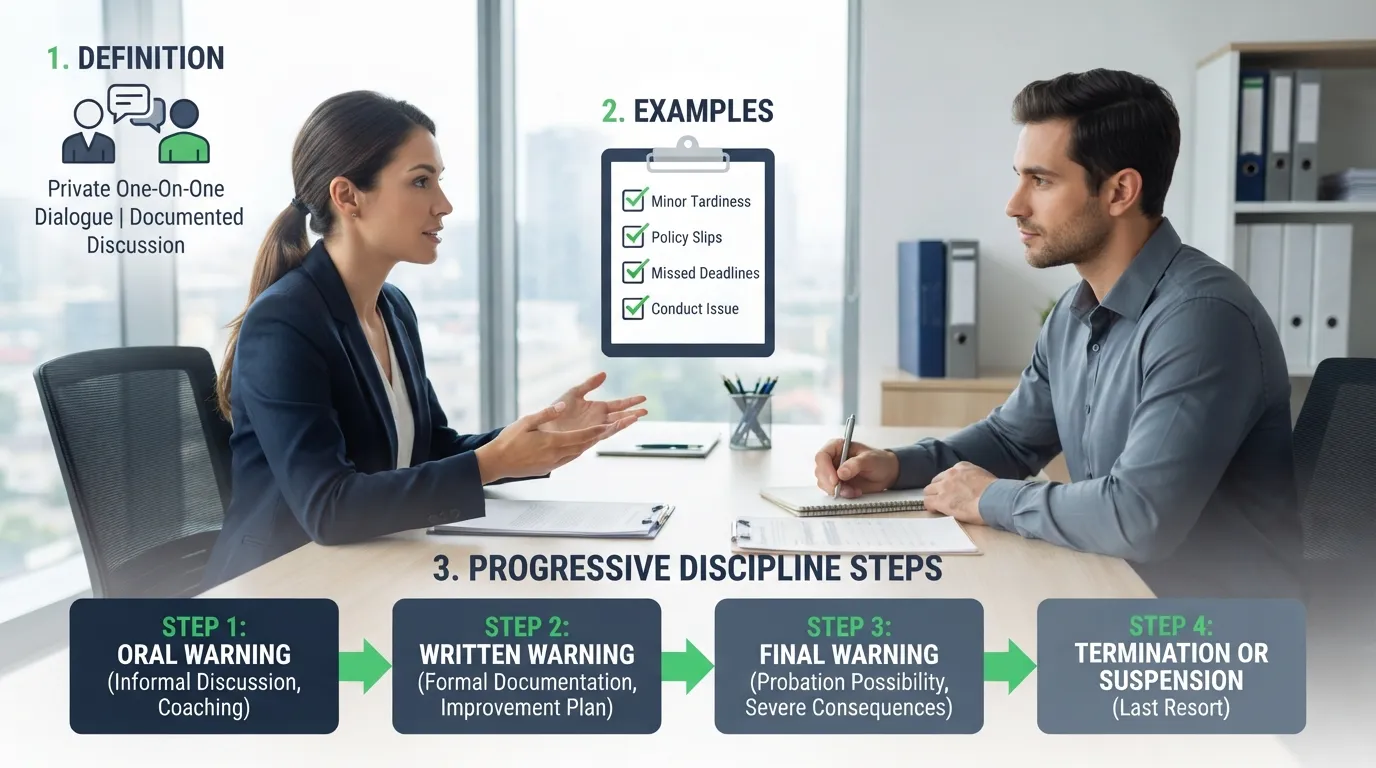
What Is an Oral Reprimand?
An oral reprimand is an informal, face-to-face disciplinary action initiated by a manager or supervisor to address minor performance issues or workplace infractions. It serves as an initial corrective measure designed to correct behavior privately before formal disciplinary processes, such as written warnings or suspensions, become necessary.
Oral Reprimand: Quick Definition
An oral reprimand is a documented or undocumented verbal communication that explicitly informs an employee about unacceptable conduct or policy violations. Unlike casual feedback, it carries a formal weight indicating that a specific workplace rule was breached, yet it remains distinct from official administrative penalties.
Primary Purpose: Correct minor infractions early through direct communication.
Delivery Method: Conducted exclusively in a private one-on-one conversation between the supervisor and the employee.
Escalation Trigger: Failure to improve following this step typically leads to progressive discipline, such as written reprimands.
Key Characteristics of an Oral Reprimand
Understanding the structural boundaries of an oral reprimand helps organizations maintain fair labor practices and ensures managers apply progressive discipline accurately.
Informal Nature: Executed outside of formal HR disciplinary hearings, relying on direct supervisory dialogue rather than rigid legalistic procedures.
Private Setting: Always delivered behind closed doors to protect employee dignity, maintain confidentiality, and prevent workplace gossip.
Absence of Permanent Records: By default, it is not permanently logged in the employee’s official personnel file, though supervisors often keep personal notes for tracking purposes.
First-Step Intervention: Positioned as the lowest tier in a progressive discipline framework, prioritizing coaching and guidance over punishment.
Is an Oral Reprimand the Same as a Verbal Warning?
While these terms are frequently used interchangeably in everyday management, their administrative implications can differ significantly depending on company policy and employment law.
Terminology Nuance: “Oral reprimand” often implies a stricter, more explicit administrative rebuke for a specific rule violation, whereas a “verbal warning” can sometimes lean toward general coaching or guidance.
Documentation Standards: A verbal warning is sometimes documented in supervisory notes or HR logs with a requirement that the employee acknowledges it, whereas a strict oral reprimand may leave zero paper trail.
Legal and Policy Impact: Both terms generally hold the same weight under standard progressive discipline policies, acting as the mandatory foundation before escalating to formal written warnings.
Oral Reprimand vs Written Reprimand: Key Differences
An oral reprimand is an informal, unrecorded verbal caution, whereas a written reprimand is a formal, documented disciplinary action entered directly into an employee’s personnel file. While both address policy violations or performance failures, the threshold for escalation depends on disciplinary severity and the frequency of the infraction.
Documentation: Oral warnings leave no permanent paper trail, while written reprimands require a physical or digital letter of reprimand signed by management and retained for review.
Escalation Level: Oral reprimands represent the first-tier response for minor issues, whereas written reprimands are deployed for repeated infractions or more severe policy breaches.
Administrative Impact: Written notices actively influence future promotion decisions, annual performance reviews, and potential termination proceedings.
What Is a Public Reprimand — and Why It’s Different
A public reprimand is a formal disciplinary penalty delivered openly in front of peers, team members, or the public, serving as both a correction and an explicit deterrent. Unlike private oral or written discussions designed to protect employee privacy, public reprimands are rarely utilized in standard corporate human resources due to legal liabilities, psychological safety concerns, and morale damage.
Target Audience: Delivered in a group setting, departmental meeting, or published officially depending on organizational or regulatory bylaws.
Psychological & Cultural Impact: Often damages team trust and employee engagement, making it an obsolete practice in modern progressive management models.
Regulatory Context: More commonly seen in professional governance, public office, or legal disciplinary committees rather than standard employer-employee relations.
Comparison Table: Oral vs Written vs Public Reprimand
| Reprimand Type | Severity Level | Documentation Status | Record Duration | Appeal Rights |
| Oral Reprimand | Low | None (Optional supervisor notes) | None (Transient) | Informal discussion / none |
| Written Reprimand | Moderate | Formal letter of reprimand | Permanent or semi-permanent in personnel record | Formal HR grievance process |
| Public Reprimand | High | Publicly recorded or witnessed | Permanent public or institutional record | Formal administrative or legal appeal |
What Is Progressive Discipline? (Brief System Overview)
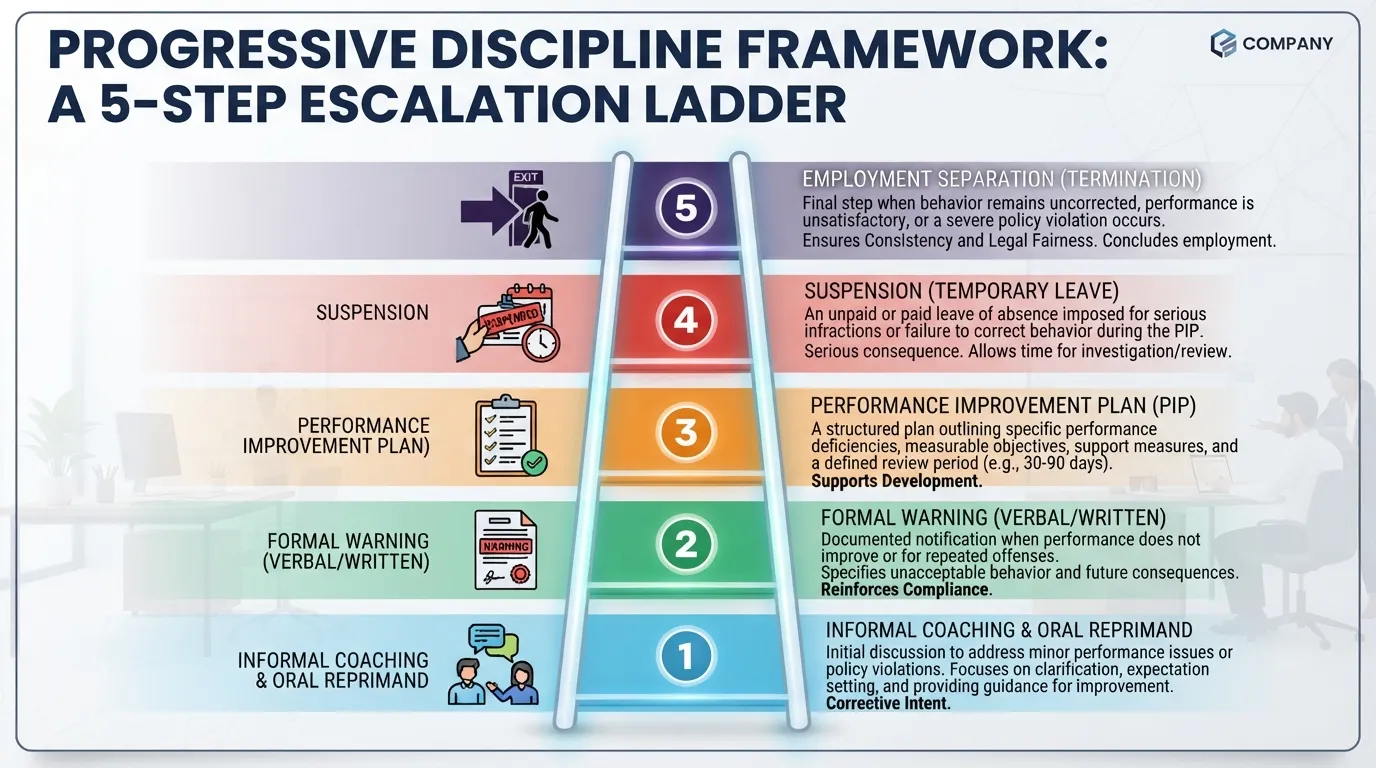
Progressive discipline is a structured human resources framework designed to correct employee performance or behavioral issues through increasingly formal steps. The system ensures fairness, protects organizations from legal liability, and gives employees clear opportunities to improve before facing severe penalties.
Core Objective: Correct behavior rather than punish, prioritizing coaching and rehabilitation at early stages.
Consistency: Ensures managers apply rules uniformly across all team members, reducing bias and favoritism claims.
Documentation Trail: Builds a clear evidentiary record justifying major actions like termination if performance fails to improve.
The 5 Typical Steps of Progressive Discipline
Most organizational disciplinary ladders follow a predictable escalation path moving from informal coaching to formal separation. Understanding each tier helps supervisors apply proportionate responses to workplace infractions.
Step 1: Informal Coaching / Oral Reprimand: A private, verbal conversation addressing minor first-time infractions without creating a permanent personnel record.
Step 2: Formal Verbal or Written Warning: A documented warning outlining specific policy breaches and expected behavioral changes, often placed in the employee file.
Step 3: Final Written Warning or PIP: A high-stakes notice accompanied by a structured performance improvement plan (PIP) detailing strict timelines for remediation.
Step 4: Suspension: A temporary, unpaid or paid leave of absence serving as a final wake-up call before permanent separation.
Step 5: Termination: The final employment separation executed when all prior interventions fail to produce the required behavioral correction.
Why Oral Reprimand Is Usually Step 1 or 2
An oral reprimand sits at the very foundation of the disciplinary ladder because it addresses minor issues before they compound into systemic performance failures. Starting with an informal conversation minimizes defensiveness and encourages open communication between managers and employees.
Low Friction Correction: Resolves simple oversights, tardiness, or minor communication errors swiftly without demoralizing the staff member.
Preserving Trust: Protects psychological safety by keeping initial mistakes private and out of official records.
Legal and Policy Compliance: Establishes a documented baseline of awareness, ensuring employees cannot claim they were never informed of company expectations if issues escalate to a written warning or suspension.
Minor Infractions

An oral reprimand is best deployed for isolated or mildly repetitive minor infractions that disrupt workplace norms but do not cause operational harm. Handling these issues immediately through an informal coaching conversation prevents bad habits from becoming entrenched team culture.
Target Behaviors: Minor tardiness, casual dress code oversights, personal phone use during working hours, or minor missed deadlines.
Managerial Approach: Address the behavior within 24 hours of occurrence in a private setting to reinforce immediate awareness without escalating anxiety.
Expected Outcome: Clear mutual understanding of expectations and an immediate, self-corrected return to standard compliance.
Performance Lapses After Initial Coaching
When an employee experiences a sudden performance lapse immediately following standard training or casual check-ins, an oral reprimand establishes formal boundaries. It signals that casual guidance has concluded and that adherence to basic performance metrics is mandatory.
Target Behaviors: Repeated failure to log data accurately, dropping communication standards with clients, or overlooking routine administrative checklists.
Managerial Approach: Connect the performance drop directly to team impact while offering brief support resources.
Expected Outcome: Heightened accountability and stabilization of daily output without needing an official HR intervention.
Safety Protocol Slips (No Major Harm Caused)
Minor safety violations that carry low immediate risk but violate operational guidelines require immediate correction via an oral reprimand. When no injury or equipment damage occurs, this approach balances accountability with proportional discipline.
Target Behaviors: Forgetting to wear non-slip shoes in a warehouse aisle, skipping a quick pre-shift machinery check, or failing to latch a storage gate.
Managerial Approach: Emphasize why the protocol exists to protect physical well-being rather than focusing solely on rule adherence.
Expected Outcome: Immediate voluntary compliance and heightened situational awareness among team members.
Example Scenario: How a Real Manager Handled Each Case
Real-world application requires balancing empathy with firm boundaries across different operational contexts. The following scenario illustrates how a supervisor addresses each of these thresholds effectively.
The Tardiness Case: Sarah arrived 15 minutes late three times in one week. Her manager pulled her aside for a private two-minute chat, noting the pattern and clarifying start-time expectations; Sarah adjusted her commute and solved the issue.
The Performance Case: Mark missed two consecutive weekly report deadlines despite a prior casual reminder. His supervisor issued a direct oral reprimand in a closed office, tying the delay to departmental roadblocks and setting a firm end-of-day delivery target.
The Safety Case: David forgot his protective eyewear while sweeping a debris-free zone. The shift lead issued an immediate oral reprimand on the floor, securing compliance before work resumed.
How to Deliver an Oral Reprimand (Step-by-Step Script)
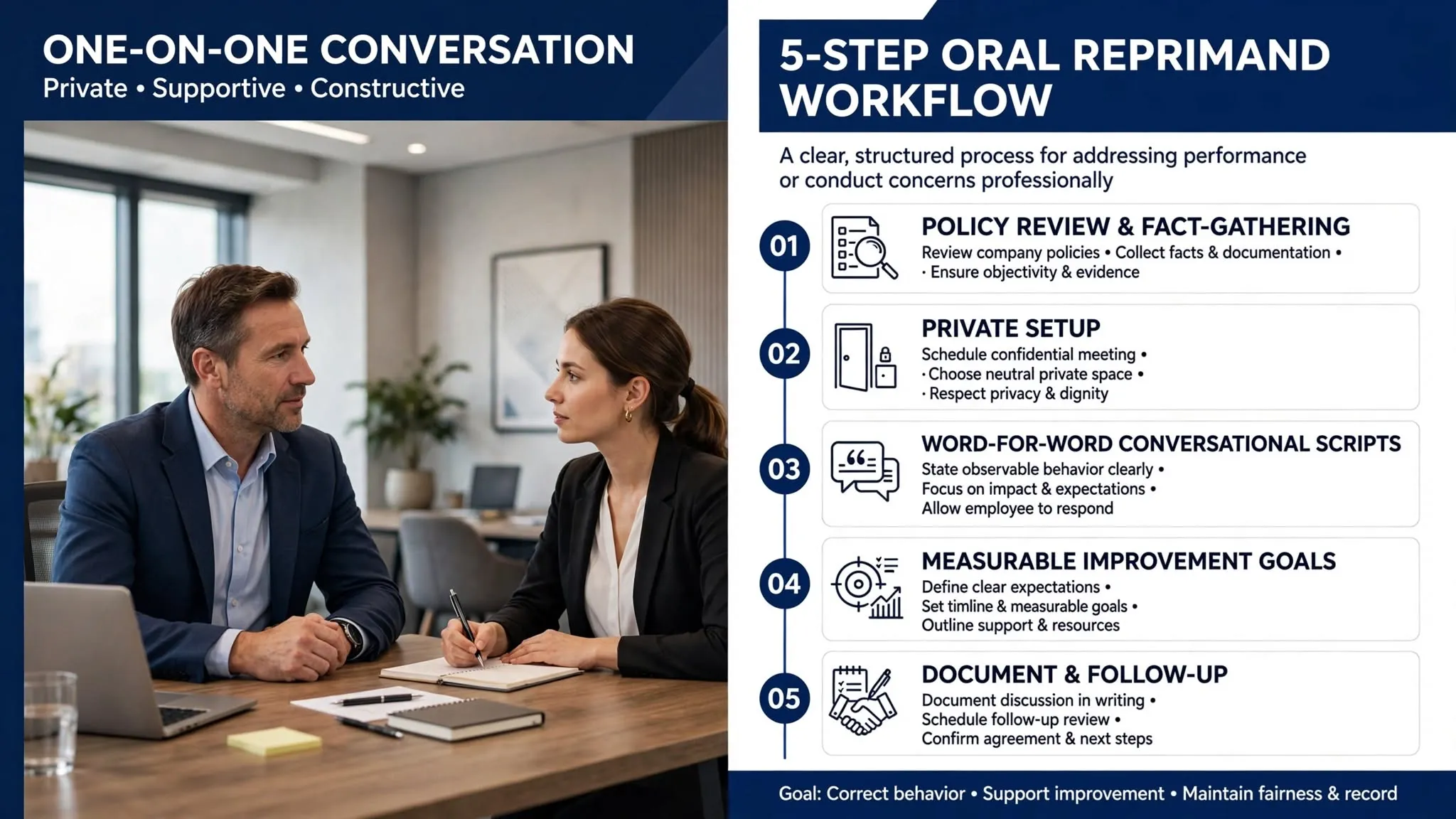
Step 1: Review Policy & Gather Facts Beforehand
Before initiating any disciplinary meeting, verify company policy and collect objective facts regarding the infraction. Clear preparation prevents emotional reactions and ensures the conversation remains focused on factual performance standards rather than subjective assumptions.
Check Internal Guidelines: Review the employee handbook to confirm that an oral reprimand aligns with standard company procedures for first-time infractions.
Gather Specific Data: Note exact dates, times, and instances of the behavior to maintain absolute objectivity during the discussion.
Determine the Objective: Establish the exact behavioral change required so you can guide the conversation with clarity.
Step 2: Set Up a Private Meeting
Deliver the reprimand strictly in a private setting to preserve confidentiality, protect the employee’s dignity, and minimize defensiveness. Avoid public corridors, open-plan office spaces, or impromptu hallway discussions.
Choose a Neutral Location: Use a closed-door office or conference room where both parties can speak freely without interruption.
Keep It Direct and Calm: Invite the employee in casually without creating panic, letting them know you want to discuss recent workflow or attendance patterns.
Consider a Witness: While optional for informal oral warnings, having an HR representative or secondary supervisor present can be helpful if escalation is anticipated.
Step 3: Sample Script — What to Say (Word-for-Word Example)
Using a direct, empathetic script helps managers deliver feedback firmly without sounding overly punitive. This word-for-word example demonstrates how to address a recurring attendance issue during a one-on-one session.
Opening the Discussion: “Thanks for sitting down with me, Alex. I wanted to touch base privately about your arrival times this week. You’ve been roughly 15 minutes late on three separate occasions.”
Stating the Impact: “Our team relies on everyone being present at 9:00 AM to handle incoming client calls. When you miss that window, it places an extra workload on your colleagues.”
Setting the Expectation: “I need you to be at your desk and ready to work by 9:00 AM moving forward. Let’s make sure this pattern stops here.”
Watch the video above for additional guidance on managing constructive conversations during a verbal warning process.
Step 4: Set a Clear, Measurable Improvement Goal
Conclude the feedback loop by establishing an unambiguous, actionable benchmark for success. Setting a concrete improvement goal ensures the employee understands how their day-to-day routine must shift.
Define Specific Parameters: Set exact timelines, such as arriving on time every day for the next two weeks.
Invite Collaborative Solutions: Ask if there are underlying obstacles—such as commute challenges or scheduling conflicts—that you can help address.
Confirm Understanding: Ask the employee to summarize the agreed-upon adjustment in their own words to guarantee complete clarity.
Step 5: Close the Conversation Professionally
End the meeting on a constructive note that reinforces trust while maintaining firm boundaries. Emphasize your confidence in their ability to course-correct without dragging out the reprimand unnecessarily.
Reiterate Support: Express confidence that this was a temporary lapse and that you value their overall contributions to the team.
Document Internally (Optional): Jot down a private personal note of the date and discussion topics for your own supervisory tracking, ensuring no formal record enters the permanent personnel record unless required by policy.
Keep the Slate Clean: Once the meeting concludes, return to normal working relationships immediately without harboring lingering frustration.
Why "Informal" Doesn't Mean "Undocumented"
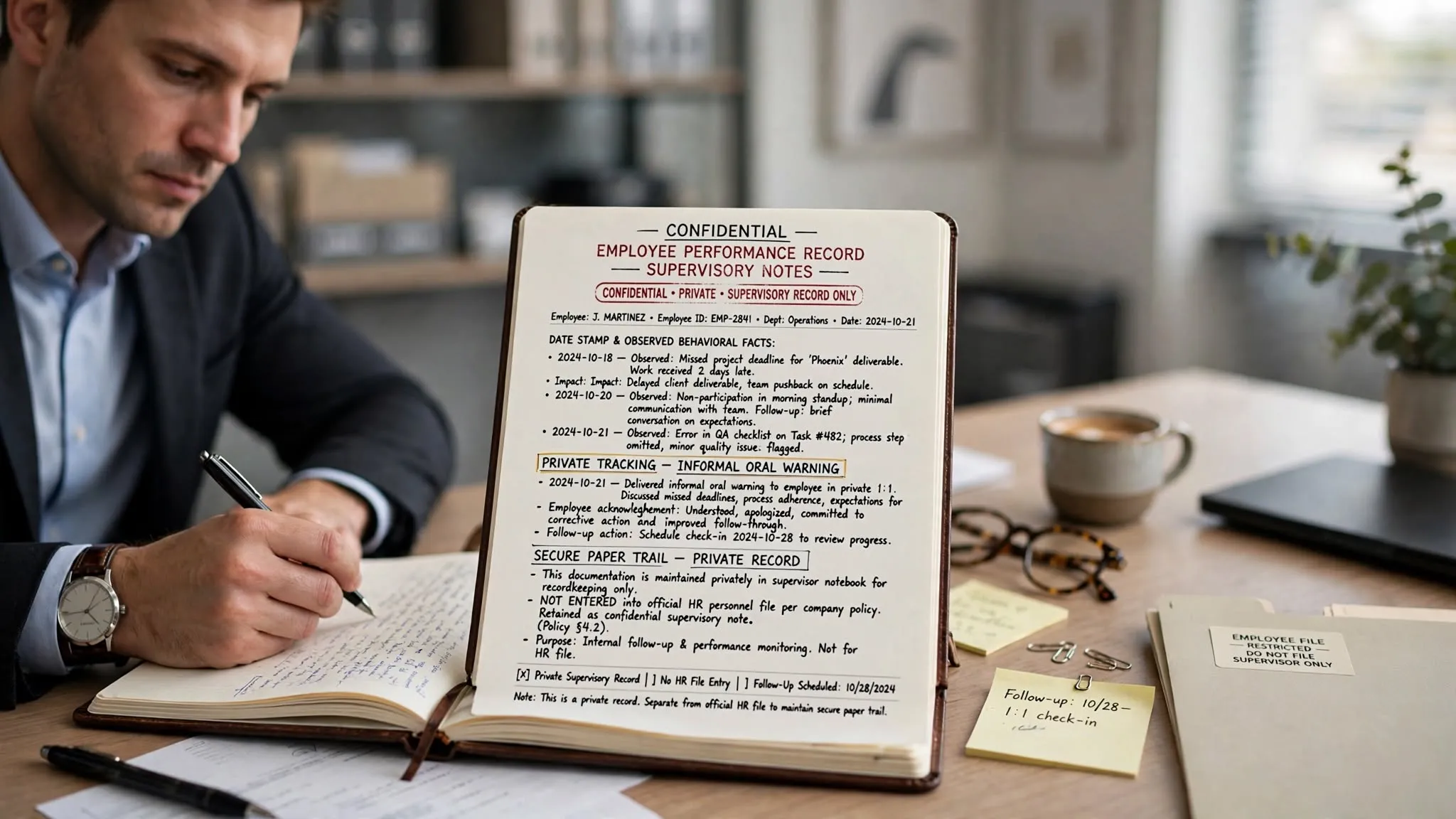
An oral reprimand is classified as an informal corrective action, but seasoned supervisors know that leaving zero trace can backfire if minor infractions escalate into systemic disciplinary problems. Maintaining private supervisory notes bridges the gap between preserving employee dignity and building a verifiable evidentiary timeline for human resources.
Preventing He-Said-Said Conflicts: Private records protect management against claims that an employee was never warned about recurring performance lapses.
Tracking Behavioral Patterns: Documenting dates helps managers identify whether an isolated incident is turning into a chronic trend requiring formal escalation.
Protecting Informal Status: These notes remain strictly in the manager’s personal working file, meaning they bypass the official personnel file and prevent unfair career branding.
What to Include in a Private Manager Note
Effective private documentation must remain objective, factual, and strictly limited to behavioral observations rather than personal opinions. Using a standardized structure ensures your records stay defensible if they ever need to be presented to HR.
Date, Time, and Setting: Record the exact timestamp and confirm the meeting occurred in a private, one-on-one environment.
Factual Description of Infraction: Outline the specific policy breached or deadline missed without emotional language or subjective judgments.
The Employee’s Response: Briefly note any context or explanation provided by the employee during the discussion.
Agreed-Upon Next Steps: Document the exact improvement goal established and the timeline set for re-evaluation.
Internal Supervisor Note Template:
Date: [Date & Time]
Employee Name: [Name]
Behavior Addressed: [Factual description of the rule violation or performance drop]
Discussion Summary: [Brief note on what was discussed and the impact explained]
Action Plan: [Agreed timeline or metric for correction]
When an Oral Reprimand Should Go Into the Official Personnel File
While oral reprimands are designed to stay out of official records, certain compliance mandates or recurring offenses require transitioning private notes into an official personnel file. Recognizing these exact thresholds keeps your organization legally protected.
Failure to Improve: If the same infraction occurs again within a short window, the prior oral reprimand forms the historical foundation for a formal written warning that enters the official record.
Zero-Tolerance Policy Breaches: Violations involving safety hazards, harassment, or regulatory compliance often mandate immediate official documentation regardless of whether the initial reprimand was verbal.
Union or Government Mandates: Certain collective bargaining agreements or public sector regulations require logging all supervisory interventions, even informal ones, to maintain due process standards.
Can You Refuse to Accept a Verbal Warning?
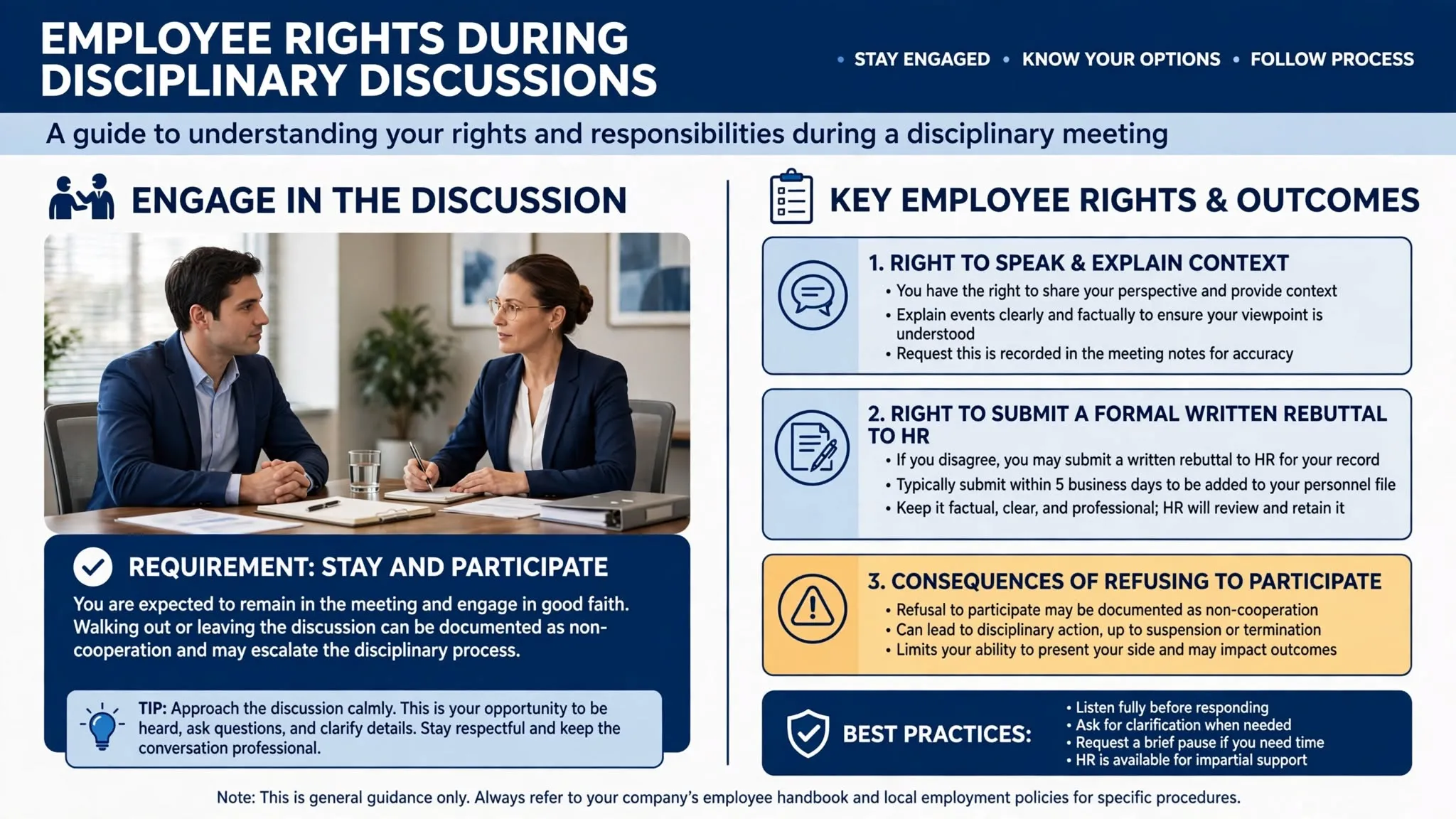
An employee cannot legally refuse to participate in an oral reprimand or walk out of a corrective meeting, but they have the right to provide their perspective and add a written response. Refusing to engage with a supervisor or dismissing feedback typically escalates an informal conversation into a formal insubordination charge.
The Right to Respond: Employees can calmly explain external factors or misunderstandings during the meeting without arguing or shouting.
Filing a Rebuttal: If an oral reprimand is improperly documented or unjustly issued, workers can submit a written statement to Human Resources to be attached to the supervisory record.
Consequences of Refusal: Walking away or refusing to acknowledge supervisory instructions breaches standard employment duties and accelerates formal disciplinary penalties.
Can a Reprimand Be Removed From Your Record?
Whether a reprimand can be expunged depends entirely on internal company policy, labor union agreements, and the severity of the initial infraction. Because true oral reprimands are transient and rarely enter official files, formal removal requests usually apply only to written warnings.
HR Review Processes: Many progressive organizations permit employees to request record removal after a sustained period—typically six to twelve months—of spotless performance.
Union Grievances: Collective bargaining agreements often include sunset clauses that automatically invalidate older disciplinary notices after a designated timeframe.
Formal Written Petitions: Employees can submit a formal request to HR providing evidence of sustained behavioral improvement to support expungement.
How Long Does an Oral or Written Reprimand Stay on File?
The record duration varies widely by company guidelines, but informal verbal notes and formal warnings follow distinct retention timelines. Understanding these windows helps workers gauge their standing during annual reviews.
Oral Reprimands: Usually kept only in a supervisor’s private notes for a few weeks or months, disappearing entirely once performance stabilizes.
Written Reprimands: Typically remain active in an official personnel file for 6 to 12 months for standard infractions.
Severe Violations: Notices involving safety breaches, harassment, or financial misconduct can remain permanently active in personnel files to establish legal precedents for future termination.
What Are the Real Consequences of a Reprimand?
The primary consequences of a reprimand depend on whether the warning is oral or written, as well as whether subsequent performance improves. A single oral reprimand rarely impacts day-to-day employment status beyond acting as a prompt for self-correction.
Immediate Impact: Zero direct effect on pay, benefits, or hourly schedules for an isolated oral warning.
Performance Reviews: Written reprimands frequently influence annual evaluations, merit pay increases, and internal promotion eligibility.
Progressive Escalation: Repeated unaddressed infractions transition the reprimand into formal suspensions, Performance Improvement Plans (PIPs), or eventual employment separation.
If Behavior Improves: Next Steps
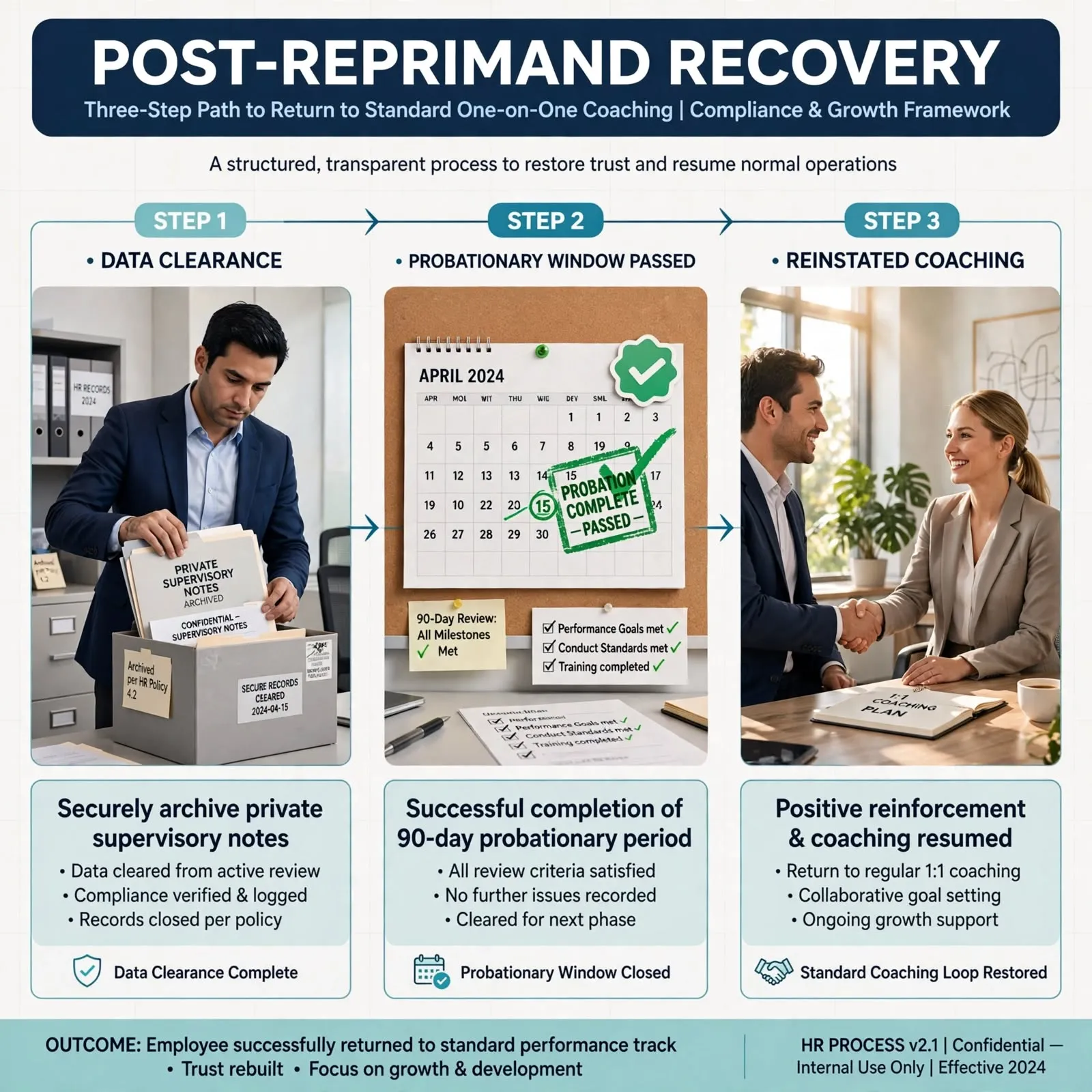
When an employee successfully corrects the targeted behavior following an oral reprimand, the disciplinary process closes without any long-term career impact. Supervisors should acknowledge the positive shift and restore normal working relations immediately.
Reverting to Standard Coaching: Resume regular one-on-one check-ins and standard performance feedback loops without lingering tension.
Clearing Private Notes: Discard or archive the private supervisory notes in accordance with company data retention guidelines once the probationary window passes.
Positive Reinforcement: Briefly validate the employee’s proactive adjustment to encourage ongoing engagement and trust.
If Behavior Doesn’t Improve: Path to Written Warning → Suspension → Termination
Failing to correct the issue triggers the next phase of escalation within the progressive discipline framework. Supervisors must transition from informal guidance to documented administrative penalties.
Stage 1: Formal Written Warning: If the infraction repeats within weeks, the manager issues a documented notice outlining specific failures, which enters the official personnel file.
Stage 2: Performance Improvement Plan (PIP) or Suspension: Chronic non-compliance leads to a structured PIP or a short-term, unpaid suspension serving as a final warning.
Stage 3: Termination: Persistent failure to meet minimum behavioral or performance standards results in permanent employment separation.
Can You Be Fired After Just One Verbal Warning?
An employee can technically be terminated after a single oral reprimand if the underlying offense involves severe, zero-tolerance infractions, though standard minor violations require a full progressive escalation. The legality depends heavily on company policy and employment contract structures.
At-Will Employment Context: Under at-will employment laws, companies can legally terminate staff at any time for almost any lawful reason, meaning formal warnings are not always legally mandatory.
Zero-Tolerance Breaches: Gross misconduct—such as theft, physical violence, harassment, or major safety endangerment—bypasses the disciplinary ladder entirely, leading to immediate termination.
Company Policy Compliance: If an employee handbook outlines a mandatory progressive discipline policy, organizations must follow their own structured steps to avoid wrongful termination claims.
How Rules Differ for Private-Sector Employees
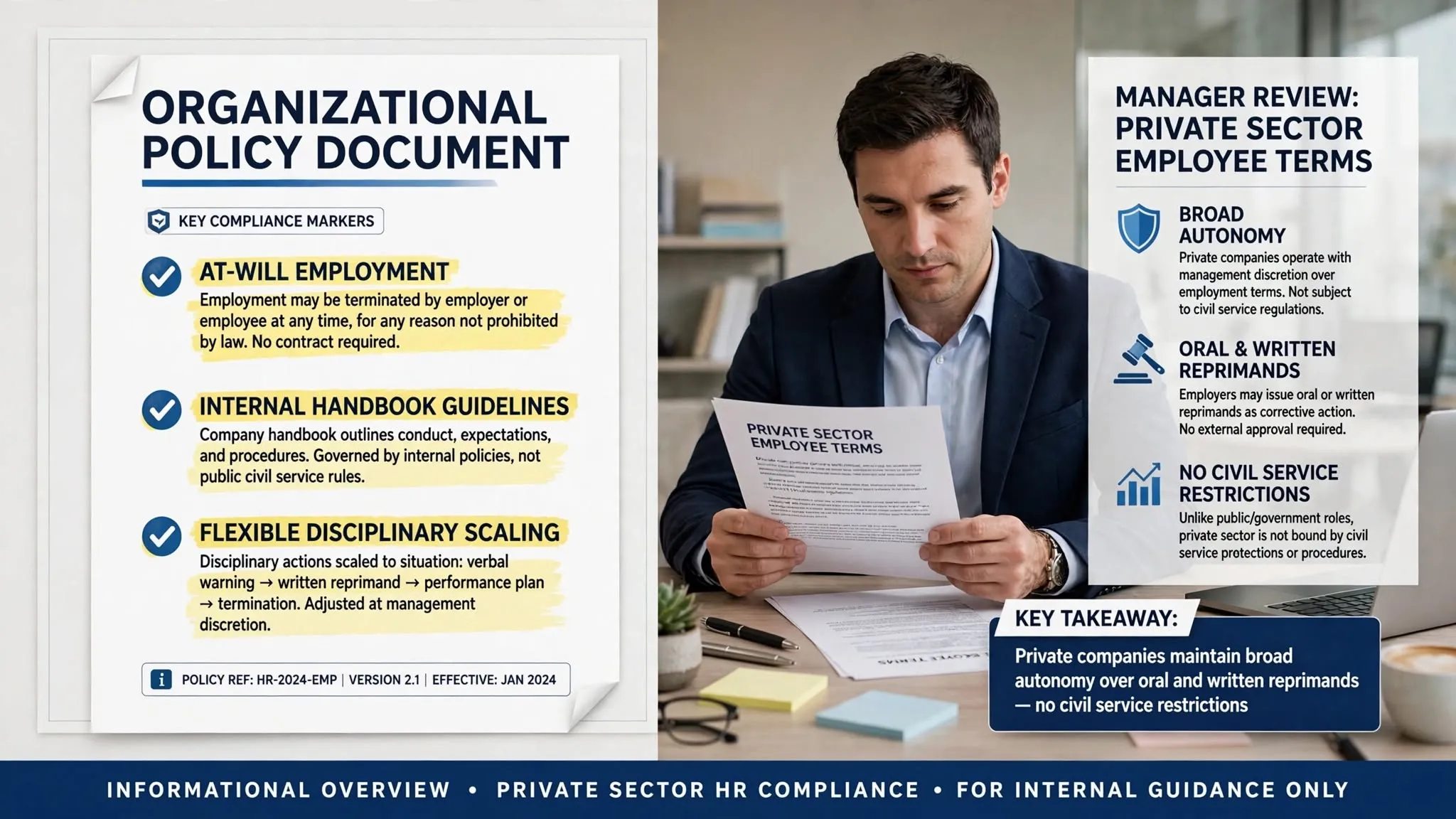
Private-sector organizations operate primarily under at-will employment guidelines, meaning management maintains broad discretion over internal disciplinary procedures. Because private companies are not bound by civil service statutes, oral reprimands are handled flexibly according to individual company policies and internal employee handbooks.
Managerial Discretion: Private employers can choose whether oral warnings require documentation or remain purely conversational.
Flexible Scaling: The progression from an oral reprimand to a formal written warning or termination can be executed rapidly depending on business needs.
Limited Statutory Appeal: Unlike public sector workers, private employees typically lack statutory administrative boards to appeal minor disciplinary actions.
How Government and Union Employees Are Treated Differently
Public sector agencies and unionized workforces operate under strict statutory regulations, administrative codes, and binding collective bargaining agreements. In these environments, even an informal oral reprimand is tightly regulated by due process requirements.
Mandated Documentation: Public sector guidelines often mandate that even an oral reprimand be officially logged using specific agency forms and placed into personnel records [Refer to administrative guidance via Cornell Law School’s Legal Information Institute for statutory public agency frameworks].
Strict Procedural Rights: Employees are guaranteed formal notification, the right to union representation during meetings, and structured paths to file a union grievance if a reprimand is issued unfairly.
Just Cause Standards: Civil service protections usually require documented proof of progressive discipline before any major penalty or dismissal can occur.
When to Consult HR or Legal Counsel
Knowing when to escalate an issue to Human Resources or an employment attorney protects both managers and workers from regulatory violations. Certain flags demand professional review outside of standard supervisory channels.
For Managers: Consult HR before moving an oral reprimand into a formal written warning if the employee claims medical leave, discrimination, or protected whistleblowing activity.
For Employees: Seek guidance from a union representative or legal counsel if an oral reprimand feels retaliatory or violates specific clauses in your employment contract.
Documentation Review: Ensure all internal steps align strictly with company policy guidelines to minimize legal liabilities and wrongful termination risks.
Frequently Asked Questions (FAQ Schema Target)
What Is an Example of a Verbal Reprimand?
A verbal reprimand example typically involves a manager addressing a specific, isolated rule violation during a private one-on-one discussion. For instance, a supervisor might pull an employee aside to address a missed project deadline or unexcused tardiness.
The Setup: A private conversation held in a closed-door office to maintain confidentiality.
The Message: “We noticed you missed yesterday’s client update deadline without notice. Our standard requires team members to communicate delays in advance so we can manage workloads.”
The Resolution: Setting a clear expectation for future accountability without issuing a formal written notice or creating a permanent file entry.
What Should an Employer Never Say to an Employee?
During a disciplinary discussion, an employer must maintain professional boundaries to avoid creating legal liabilities, discrimination claims, or hostile work environments. Crossing verbal lines can instantly undermine the validity of a reprimand.
Discriminatory Remarks: Never reference protected characteristics such as race, gender, religion, age, disability, or sexual orientation.
Personal Insults: Avoid attacking an individual’s character, intelligence, or personality instead of focusing strictly on objective work behaviors.
Empty Threats: Refrain from making exaggerated threats of immediate termination or pay cuts unless backed by verified company policy and HR approval.
How Serious Is a Written Reprimand (Compared to Oral)?
The written reprimand severity is significantly higher than an oral warning because it introduces a formal, permanent administrative penalty into an employee’s official file. While oral reprimands act as soft, corrective coaching tools, written reprimands serve as formal legal evidence.
Personnel Record Impact: Written warnings are actively reviewed during annual performance appraisals, promotion cycles, and internal transfer evaluations.
Disciplinary Escalation: A written notice moves the employee one step closer to suspension, demotion, or termination if performance fails to improve.
Legal Weight: Written documentation provides organizations with a defensible paper trail to justify future employment separations if legal or unemployment claims arise.
Can You Terminate an Employee for Being Disrespectful?
An organization can legally terminate an employee for disrespectful conduct, particularly if the behavior violates company codes of conduct, safety policies, or anti-harassment rules. The speed of termination depends on the severity of the disrespect and the governing employment framework.
At-Will Flexibility: Under at-will employment regulations, private-sector companies can separate employees for severe disrespect—such as insubordination, abusive language, or threatening behavior—without prior progressive steps.
Progressive Discipline Requirements: In unionized or public sector environments, even severe disrespect typically requires documented prior warnings, an official investigation, and adherence to due process before termination is permitted.
Standard Thresholds: Mild rudeness usually requires progressive coaching or an oral reprimand first, whereas aggressive or insubordinate behavior can justify immediate suspension or firing.
Key Takeaways / Conclusion
Oral Reprimand in One Paragraph
An oral reprimand functions as the foundational first step in a progressive discipline framework, designed to correct minor performance issues or workplace infractions privately and swiftly. By utilizing a one-on-one conversation rather than an official written notice, managers can address early disciplinary problems without creating permanent records, preserving both employee dignity and trust while maintaining clear performance standards.
Manager’s Checklist Before Issuing One
Executing a fair and legally sound oral reprimand requires preparation and adherence to objective operational standards. Supervisors should review this quick checklist before initiating a corrective conversation:
Verify Company Policy: Confirm that your employee handbook permits an oral reprimand for the specific infraction.
Gather Objective Facts: Document exact dates, times, and measurable details regarding the behavioral lapse.
Secure Private Space: Ensure the discussion occurs behind closed doors to maintain confidentiality and psychological safety.
Focus on Behavior: Address the specific action and its workplace impact rather than attacking personal character.
Define Next Steps: Establish a clear, measurable improvement goal and determine whether private supervisor notes are needed for your personal tracking file.
Kittisak Wattanakul
Kittisak Wattanakul is the Discipline Editor at Holistic Wellbeing Living. He writes about routines, focus, consistency, and practical follow-through. With nine years of experience creating personal-growth content, Kittisak helps readers build realistic systems for steady progress without extreme productivity pressure.