Student Success Habits: The Definitive Guide to Better Grades and Focus
What Is a Successful Student?
A successful student is an individual who balances academic achievement with personal growth, physical well-being, and mental resilience. True success extends far beyond simply chasing high test scores; it encompasses the development of lifelong learning habits, effective time management, and a deep, active engagement with the material.
Holistic Growth: Blending academic performance with emotional intelligence and self-care.
Process-Oriented: Focusing on skill mastery and cognitive development rather than superficial validation.
Adaptability: Maintaining resilience and adaptability when facing complex academic and personal challenges.
The Real Definition (Beyond Just Grades)
Traditional education systems often measure success solely through a letter grade or a GPA. However, an elite academic profile requires a balanced foundation of discipline and sustainable habits that foster continuous improvement over time.
Consistent Routines: Establishing structured daily habits that reduce decision fatigue and prioritize deep work.
Active Learning: Engaging critically with course materials through questioning, teaching concepts to peers, and practical application rather than passive memorization.
Personal Well-Being: Recognizing that adequate sleep, mental health maintenance, and physical health are non-negotiable pillars of long-term academic success.
Successful Student vs. “Good” Student — What’s the Difference?
While a “good” student typically focuses on compliance, pleasing instructors, and checking off assignment boxes, a truly successful student takes full ownership of their educational journey. This distinction shifts the focus from external approval to intrinsic motivation.
The “Good” Student: Relies heavily on rote memorization, follows instructions rigidly, and experiences high anxiety over minor drops in performance.
The Successful Student: Employs strategic time management, views failures as vital feedback, and pursues mastery for personal enrichment and career readiness.
Mindset Shift: Moving from compliance-driven learning to curiosity-driven problem solving and independent inquiry.
What Makes a Successful Student? (Core Traits & Qualities)
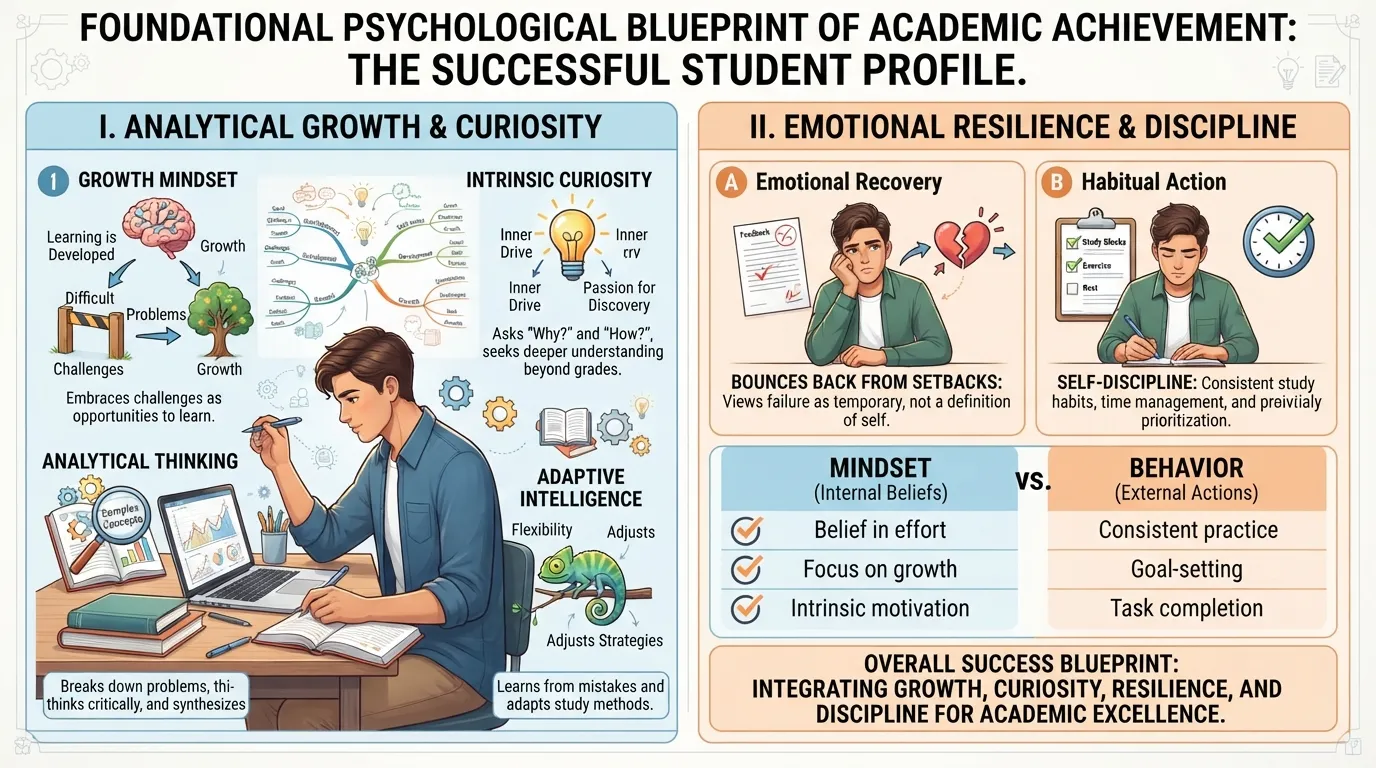
A successful student is defined by an internal blend of character traits, psychological frameworks, and cognitive patterns that drive continuous growth. Separating core personal qualities from daily actions clarifies that achievement is not just about working hard, but about cultivating the right mindset and emotional resilience.
Intrinsic Drive: Operating from a deep-seated desire to learn rather than seeking external rewards.
Emotional Resilience: Bouncing back swiftly from poor exam grades or complex academic setbacks.
Adaptive Intelligence: Shifting strategies when initial learning methods fail to produce results.
Core Qualities of High-Achieving Students
High-achieving students possess a specific psychological blueprint that allows them to navigate rigorous academic environments without burning out. These foundational traits form the backbone of sustained scholarly excellence.
Growth Mindset: Embracing challenges as opportunities to strengthen cognitive ability rather than viewing intelligence as a fixed trait.
Curiosity: Asking probing questions beyond the mandatory syllabus and seeking genuine conceptual understanding.
Discipline: Showing up consistently to study sessions even when motivation is entirely absent.
Self-Motivation: Setting personal milestones and holding oneself accountable without requiring constant supervision from instructors or parents.
Mindset vs. Behavior: Why Traits Alone Aren’t Enough
Possessing positive traits like curiosity or a growth mindset is only half the battle; these internal qualities must translate into actionable habits. Relying solely on character without pairing it with tactical execution leads to stagnation.
The Trait vs. Habit Gap: Having discipline as a trait means valuing order, but establishing consistency requires building daily, repeatable study routines.
Operationalizing Motivation: Turning abstract self-motivation into concrete actions, such as blocking uninterrupted focus hours and tracking assignment completion.
Execution Over Intention: Transforming theoretical resilience into active post-exam reviews where mistakes are systematically analyzed and corrected.
Core Student Success Habits (The Main List)
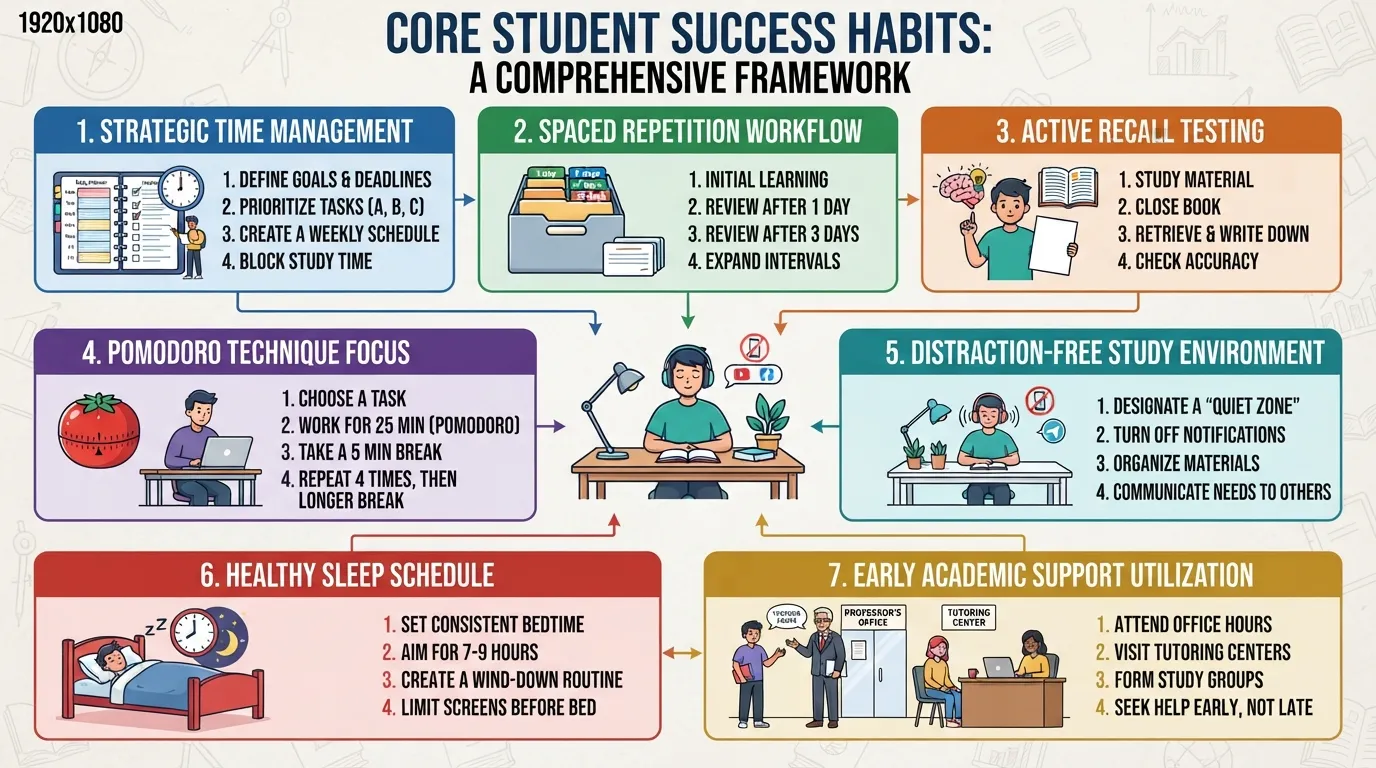
Student success habits are actionable, daily execution frameworks that bridge the gap between abstract talent and top-tier academic performance. Transforming high-level strategies into repeatable workflows ensures long-term consistency, better knowledge retention, and lower stress levels throughout the semester.
Systematic Execution: Replacing sporadic cramming with structured, predictable study sessions.
Cognitive Efficiency: Utilizing neuroscience-backed learning techniques to maximize study hours.
Resource Utilization: Proactively leveraging tools, technology, and support systems before academic gaps widen.
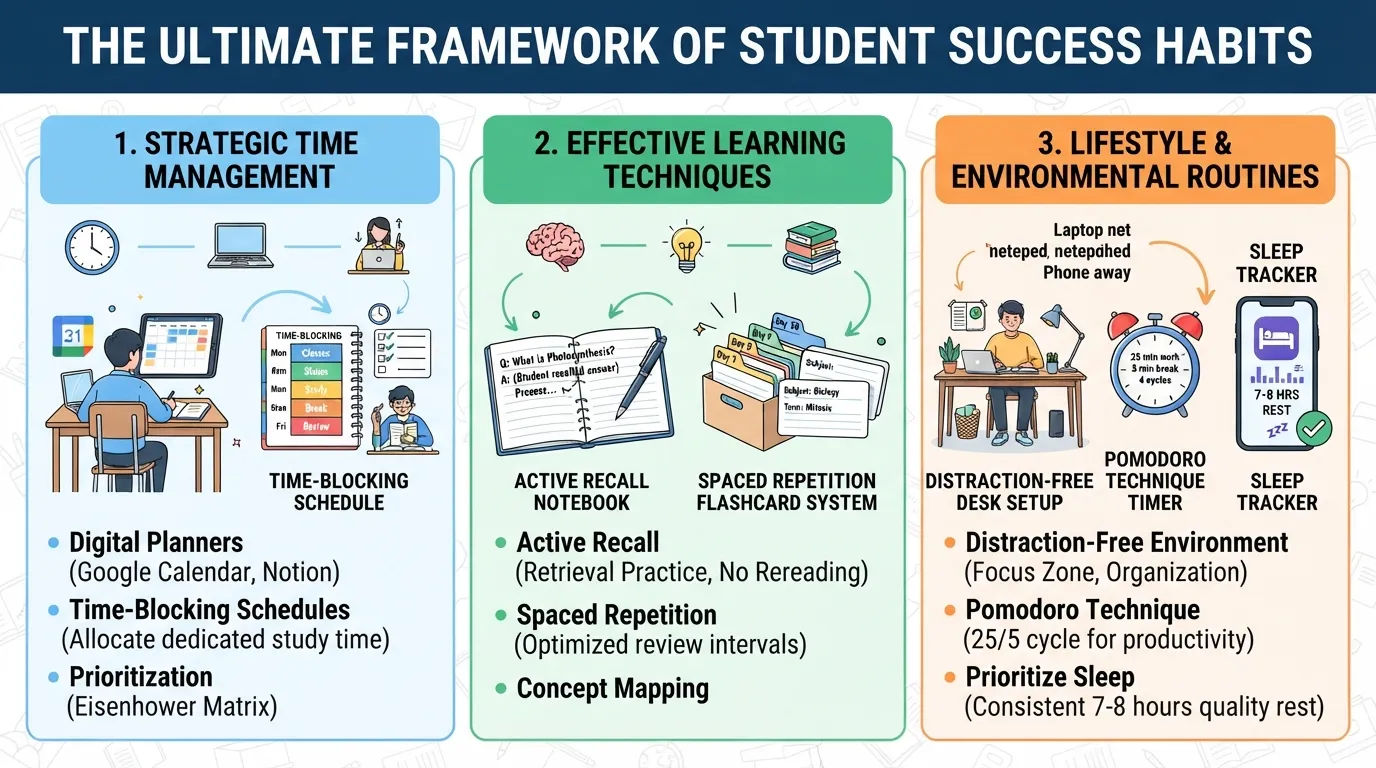
Manage Your Time With a Planner System
Time management is the ultimate anchor of academic productivity, preventing last-minute panic and deadline overlap. Relying on mental memory for assignments and exams is a primary driver of burnout and forgotten tasks.
Digital or Analog Integration: Utilize a dedicated daily planner—whether Google Calendar, Notion, or a physical notebook—to map out all obligations.
Time Blocking: Assign explicit time slots for classes, study sessions, extracurriculars, and rest to eliminate decision fatigue.
Weekly Audits: Review the upcoming week every Sunday evening to identify heavy workloads and distribute tasks evenly across days.
Space Out Your Studying (Spaced Repetition)
Cramming creates an illusion of competence, loading information only into short-term memory where it quickly decays before the exam. Spaced repetition forces the brain to retrieve information at increasing intervals, strengthening long-term synaptic connections.
Leitner System or Flashcards: Use apps like Anki or physical flashcard boxes to review core concepts over expanding intervals (e.g., 1 day, 3 days, 1 week).
Pre-Planning Reviews: Schedule micro-review sessions for older topics while actively learning new chapter modules.
Compound Learning: Build cumulative study blocks so that foundational knowledge remains sharp throughout the entire academic term.
Practice Active Recall Instead of Re-Reading
Passive re-reading of textbooks and highlighting notes creates false familiarity while leaving actual gaps in comprehension. Active recall forces the brain to reconstruct knowledge from scratch, mirroring the exact mental retrieval required during tests.
The Blank Sheet Method: Read a section, close the book, and write down every key concept or formula from memory on a blank page.
Self-Testing Formulation: Turn every lecture heading into a direct question and answer it out loud before checking your notes.
Error Correction: Immediately highlight missing details or incorrect assumptions in a distinct color to reinforce correct neural pathways.
Use the Pomodoro Technique to Stay Focused
Sustaining deep, uninterrupted concentration for hours at a time is neurologically impossible for most students without cognitive fatigue setting in. The Pomodoro Technique breaks complex study blocks into high-intensity sprints followed by mandatory rest.
Standard Timed Sprints: Work with absolute focus on a single task for 25 minutes, free from notifications or multitasking.
Intentional Breaks: Take a strict 5-minute break to stretch, hydrate, or step away from the desk before the next cycle.
Cycle Scaling: After completing four cycles, take an extended 15 to 30-minute break to restore cognitive bandwidth.
Eliminate Distractions From Your Study Space
Environmental friction is the silent killer of deep work and sustained academic performance. Every notification, visible smartphone, or cluttered desk fragments attention and resets cognitive focus duration.
Digital Quarantine: Put smartphones in another room or use strict blocking software (such as Freedom or Forest) during study blocks.
Workspace Optimization: Clear desks of non-essential items so that only course materials for the current task are visible.
Auditory Control: Use noise-canceling headphones playing brown or white noise to drown out unpredictable environmental sounds.
Prioritize 7–8 Hours of Sleep
Sleep is not passive downtime, but the critical window during which the brain consolidates memories, clears metabolic waste, and reinforces learning. Sacrificing sleep for extra study hours consistently yields diminishing returns on exam performance.
Consolidation Cycles: Deep and REM sleep stages actively transfer temporary learning patterns into permanent cortical storage.
Circadian Alignment: Maintain consistent sleep and wake times, even on weekends, to regulate biological rhythms and baseline alertness.
Scientific Backing: Neuroscientific research highlights that chronic sleep deprivation impairs prefrontal cortex function, executive decision-making, and memory retrieval. For a detailed breakdown of how rest impacts cognitive capacity, explore the principles discussed in Andrew Huberman’s insights on neuroplasticity and learning{rel=”nofollow”}.
Ask for Help Early (Professors, Tutors, Advisors)
Waiting until just before finals week to resolve confusion traps students in a cycle of overwhelming remediation. High-achieving students treat assistance as an active tool rather than a sign of personal failure.
Office Hours Utilization: Visit professors early in the semester to clarify complex concepts and build professional mentorship relationships.
Peer & Campus Support: Book appointments at university tutoring centers or writing labs at the first sign of falling behind on a module.
Proactive Problem-Solving: Address minor grade slips or conceptual misunderstandings within 48 hours rather than letting them compound across units.
Why Different Sources List Different Numbers of Habits
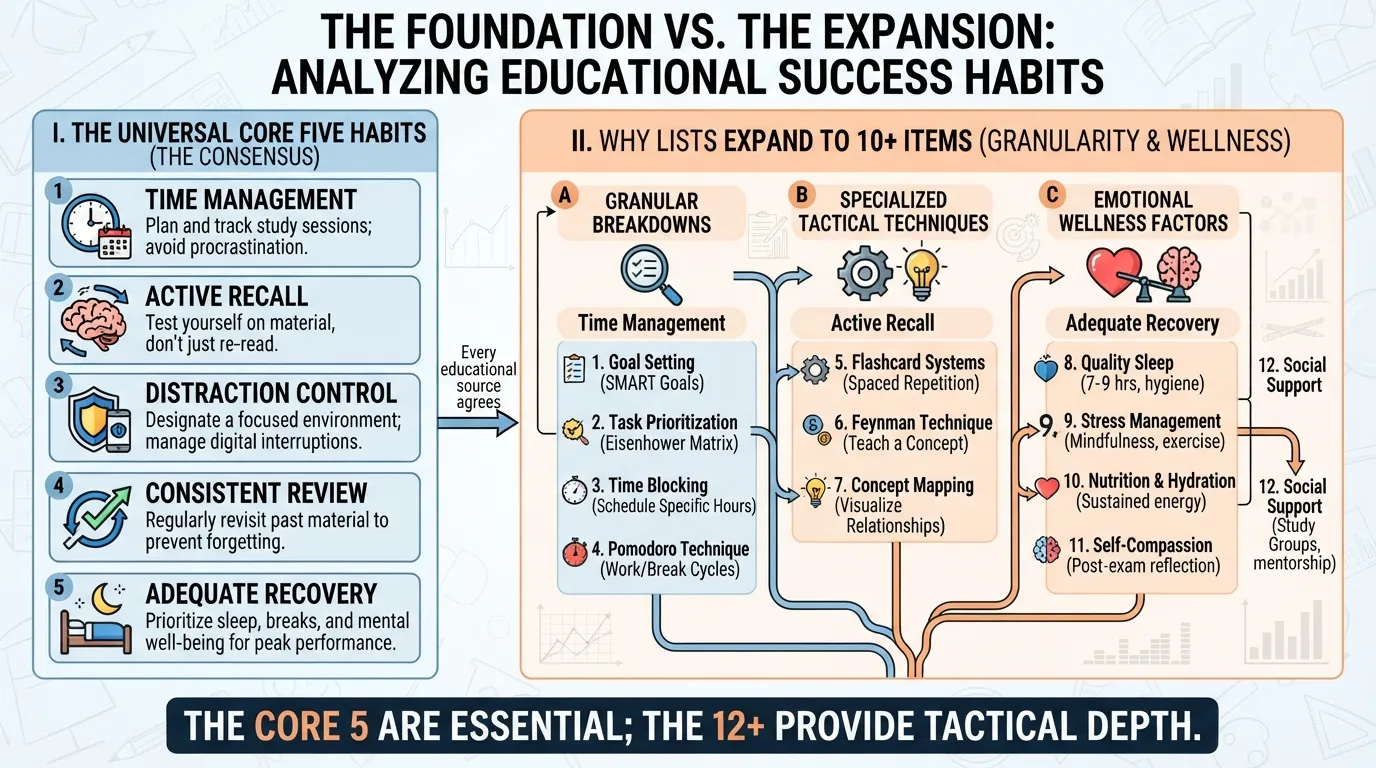
Educational blogs, research papers, and productivity guides frequently list varying quantities of study habits variations, ranging from five core behaviors up to twelve distinct routines. This discrepancy stems from how different authors categorize foundational principles versus specialized tactical techniques.
Categorization Variance: Some lists group broader principles together, while others break every micro-action down into separate items.
Target Audience Scope: Guides tailored for high school students often focus on basic foundational routines, whereas university-level resources incorporate advanced cognitive strategies.
Thematic Focus: Content prioritizing mental health highlights lifestyle routines, whereas productivity-centric guides emphasize strict execution systems.
The Core 5 Habits Everyone Agrees On
Regardless of whether an article lists five or fifteen items, high-performing students universally rely on a foundational set of universal core habits. Educational psychologists consistently point to these five baseline practices as non-negotiable for academic survival.
Time Management: Mapping out schedules and deadlines to prevent last-minute cramming.
Active Engagement: Interacting directly with learning material rather than passively reading text.
Distraction Control: Managing environmental and digital friction during deep work sessions.
Consistent Review: Spacing out practice over time to foster long-term memory retention.
Adequate Recovery: Prioritizing proper rest, nutrition, and physical health to maintain cognitive performance.
Why Some Lists Expand to 10 or 12
Comprehensive guides expand beyond the absolute baseline to provide granular, tactical execution steps. These extended breakdowns help students fine-tune specific weak points in their academic workflows.
Granular Breakdown: Splitting a broad category like “reviewing material” into specific methods like active recall, spaced repetition, and the Leitner flashcard system.
Psychological and Emotional Factors: Adding soft skills and mindset adjustments, such as stress management, self-advocacy, and leveraging campus tutoring resources.
Actionable Specialization: Offering multiple choices for effective study habits so students can customize a routine that fits their personal learning style and schedule constraints.
Bad Habits Successful Students Avoid
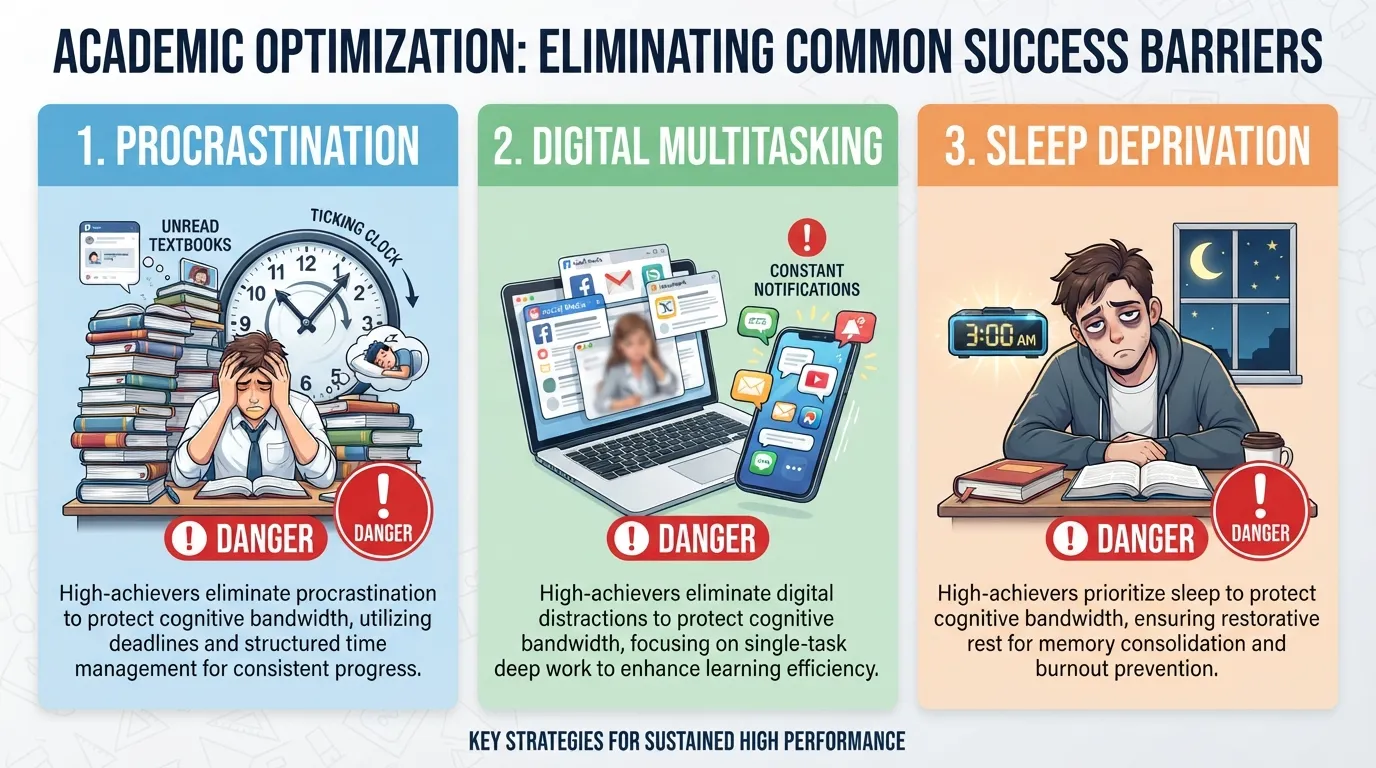
Avoiding counterproductive behaviors is just as important for academic success as implementing positive daily routines. High-performing students actively eliminate self-sabotaging patterns that drain cognitive energy, waste precious hours, and severely limit long-term knowledge retention.
Energy Management: Protecting cognitive bandwidth from activities that yield diminishing or negative returns.
Systemic Prevention: Designing environments and schedules that make self-sabotaging shortcuts difficult to execute.
Quality over Quantity: Recognizing that time spent studying is useless if the execution method is fundamentally flawed.
Procrastination and Last-Minute Cramming
Delaying assignments until hours before the deadline forces the brain into survival mode, triggering intense stress and superficial processing. While cramming might occasionally secure a passing grade on a single test, it guarantees that information vanishes from memory within days.
The Illusion of Competence: Mistaking the adrenaline rush of a night-long study session for genuine mastery of the course material.
Exponential Stress Spikes: Creating chronic anxiety cycles that spill over into physical illness and emotional burnout.
The Alternative: Breaking major projects down into tiny, manageable milestones weeks in advance to neutralize the urge to delay.
Multitasking While Studying
Studying with a smartphone next to the notebook, a messaging app open on the desktop, and a television playing in the background is a recipe for cognitive fragmentation. Human brains are neurologically incapable of processing multiple complex streams of information simultaneously.
Task-Switching Penalties: Every time attention shifts to a notification, the brain spends several minutes trying to regain deep focus.
Shallow Encoding: Information processed while multitasking fails to transfer into long-term memory storage.
The Alternative: Enforcing strict digital boundaries by utilizing airplane mode and dedicated focus windows during every study session.
Skipping Sleep for “Extra” Study Time
Trading sleep for extra hours of night-time studying is a counterproductive trade-off that damages the exact cognitive functions needed for exams. Sleep deprivation directly impairs working memory, creative problem-solving, and emotional regulation.
The Memory Deficit: Skipping rest prevents the brain from consolidating the day’s lessons during deep and REM sleep cycles.
Diminishing Returns: Staying awake 24 hours creates cognitive impairment equivalent to legal intoxication, ruining test-taking accuracy.
The Alternative: Treating sleep as a critical non-negotiable component of a study plan, ensuring 7 to 8 hours of rest every single night to combat sleep deprivation.
How Can I Be a Successful Student? (Step-by-Step Action Plan)
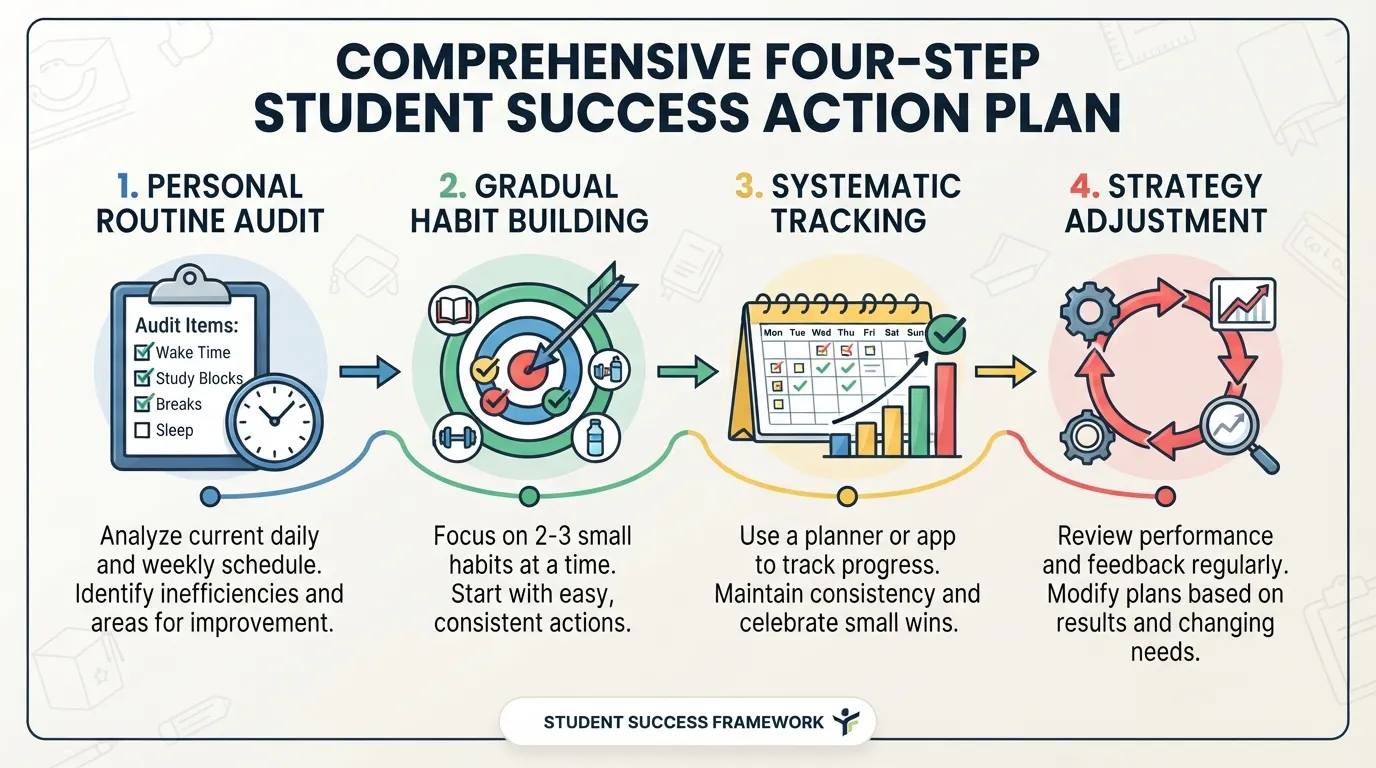
Transitioning from wishing for better grades to actually achieving them requires a structured, step-by-step implementation plan. Attempting to overhaul your entire academic lifestyle overnight invariably leads to overwhelm and abandonment of new routines.
Systematic Execution: Moving from passive intention to a predictable, repeatable daily framework.
Sustainable Momentum: Focusing on gradual habit building to prevent decision fatigue and burnout.
Data-Driven Adjustments: Using regular performance metrics to refine and optimize your workflow over time.
Step 1: Audit Your Current Routine
Before implementing new strategies, conduct an honest self-assessment of how you currently spend your time, energy, and focus during the week. Pinpointing exact friction points—such as evening procrastination or unstructured study blocks—reveals where your academic energy is leaking.
Time Tracking: Log your activities for three consecutive days to see how many hours are genuinely spent on deep study versus digital distraction.
Bottleneck Identification: Locate specific weak spots, such as rushing through assignments the night before or consistently skipping challenging textbook chapters.
Baseline Establishment: Use these findings as your starting point so you can measure future improvements objectively.
Step 2: Pick 2–3 Habits to Start With (Not All at Once)
Trying to adopt ten different productivity hacks simultaneously is the fastest way to fail. Select just two or three foundational behaviors—such as time blocking with a planner and switching to active recall—to focus on during your first two weeks.
Micro-Commitments: Choose manageable habits that require minimal willpower to execute consistently every day.
Habit Stacking: Anchor your new study habits onto existing daily routines, like reviewing flashcards immediately after your morning coffee.
Reduced Friction: Clear away environmental barriers so that executing your chosen habits feels seamless and straightforward.
Step 3: Track Progress Weekly
Without a system for accountability, old habits quickly creep back into your daily routine. Implement a dedicated habit tracking system—using a mobile app, a bullet journal, or a simple checklist—to monitor your daily adherence to your new strategies.
Visual Streaks: Mark off successful study blocks or completed routines daily to build psychological momentum.
The Weekly Review: Set aside 15 minutes every Sunday to evaluate which habits stuck and which ones fell through the cracks.
Objective Reflection: Review your weekly progress without judgment, treating missed days as data rather than personal failure.
Step 4: Adjust Based on What’s Working
Academic success is an iterative process that requires constant fine-tuning as course loads get heavier and exam formats change. Use your weekly review insights to double down on what works and ruthlessly discard strategies that drain your time without improving your grades.
Strategy Pivoting: If a specific study method like standard flashcards isn’t boosting your scores, transition to practice exams or the Feynman technique.
Workload Scaling: Gradually introduce new habits, such as spaced repetition or advanced time blocking, only after your initial routines feel automatic.
Continuous Optimization: Treat your academic system as a living framework that evolves with every semester and subject you tackle.
Success Habits by Academic Level (High School vs. College)
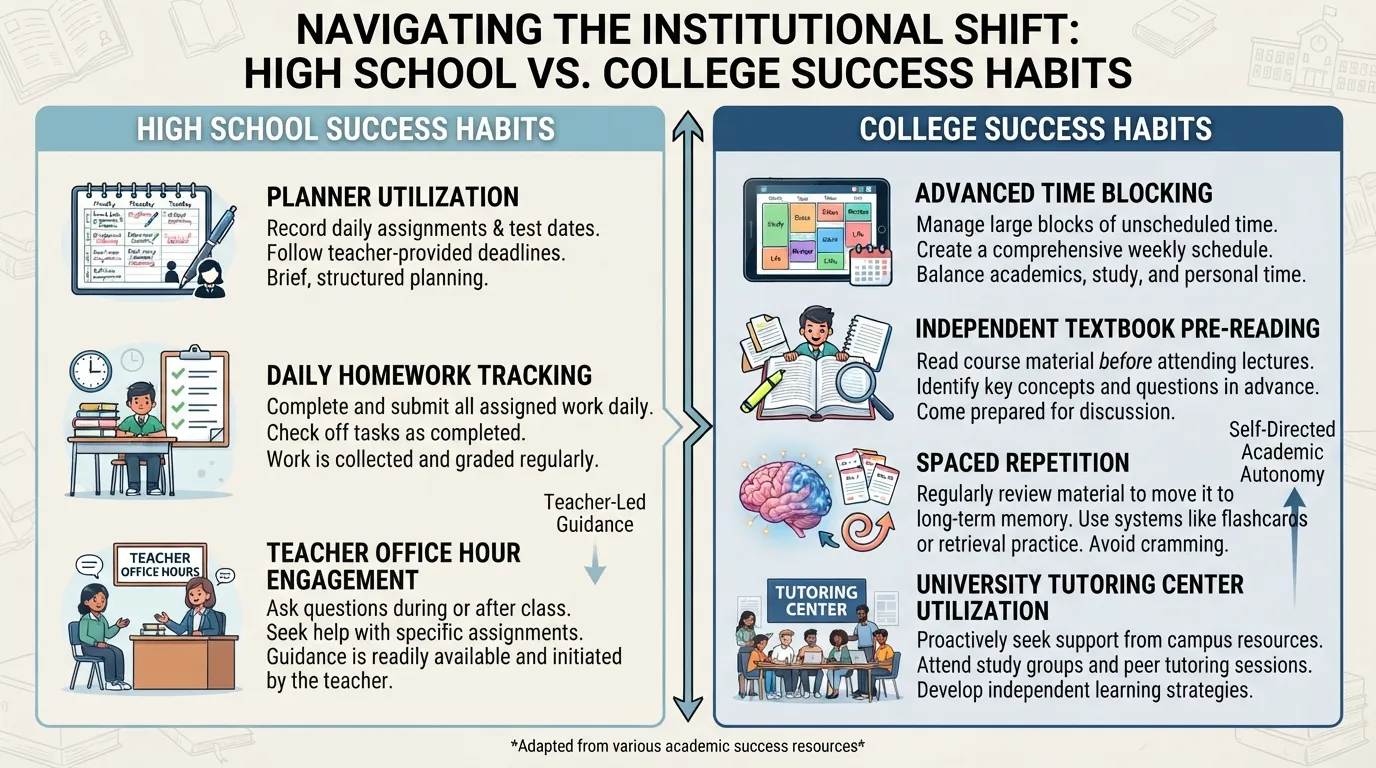
Academic expectations shift dramatically as students transition from high school to higher education, requiring a corresponding shift in execution strategies. Recognizing your specific academic level ensures you apply the exact type of discipline, time management, and self-directed study required for that educational environment.
Environmental Shift: Moving from teacher-led accountability to complete personal independence.
Cognitive Escalation: Transitioning from rote memorization and factual recall to complex synthesis and critical analysis.
Targeted Optimization: Tailoring daily routines to match the unique structural demands of your current school phase.
Habits That Matter Most in High School
In high school, academic structures are largely managed for the student by teachers, parents, and daily bell schedules. Success at this stage relies heavily on building strong foundational routines, establishing organizational systems, and learning how to plan ahead before workloads become overwhelming.
Planner Utilization: Mastering basic calendar management to track daily homework assignments, quizzes, and project deadlines across multiple classes.
Consistent Homework Habits: Setting aside a fixed afternoon time slot for assignments to prevent evening cramming before test days.
Proactive Self-Advocacy: Building the habit of asking teachers for help during class or after school the moment a concept feels confusing.
Focus Foundation: Developing basic high school study habits like clearing desks of phones and minimizing social distractions during homework blocks.
Habits That Matter Most in College
College learning introduces unstructured schedules, massive reading loads, and professors who expect students to operate entirely as autonomous adults. Success in higher education requires a pivot toward advanced cognitive techniques, self-directed research, and rigorous personal accountability.
Advanced Time Blocking: Constructing detailed weekly schedules that account for massive gaps between lectures, independent study blocks, and extracurricular responsibilities.
Independent Learning: Cultivating deep college success habits such as pre-reading complex textbook chapters, synthesizing lecture notes independently, and seeking out university writing or tutoring centers proactively.
Scientific Study Methods: Moving away from passive review and implementing high-efficiency techniques like spaced repetition, active recall, and practice testing.
Professional Networking: Regularly attending professor office hours, building academic relationships, and treating coursework as direct preparation for future career execution.
Quick Self-Check — Which Habit Should You Start With?
Determining your immediate starting point removes the paralysis of choice and turns generalized advice into a tailored action plan. Pinpointing your most pressing academic bottleneck ensures you invest your limited willpower into the exact routine that will yield the highest return on investment.
Targeted Intervention: Matching your specific current struggle with a proven behavioral solution.
Immediate Momentum: Eliminating overwhelm by focusing on just one single change to begin your journey.
Actionable Framework: Using a structured assessment to convert passive reading into immediate, real-world execution.
Simple Self-Assessment Checklist
Review the following common academic pain points to identify your primary bottleneck. Select the statement that most accurately reflects your current daily struggle to determine your immediate focus area.
Assessment Statement A: “I constantly run out of time, miss deadlines, and find myself rushing assignments at the last minute.”
Assessment Statement B: “I spend hours reading textbooks and highlighting notes, but I still forget everything when exam day arrives.”
Assessment Statement C: “I get distracted by my smartphone and notifications every few minutes while trying to study.”
Assessment Statement D: “I feel exhausted, unfocused, and constantly drained throughout my classes and study blocks.”
Match Your Weak Spot to the Right Habit
Once you have identified your primary pain point from the checklist above, locate your matching struggle in the reference guide below to find your ideal starting habit.
| Your Primary Academic Struggle | The Root Cause | Your Immediate Habit to Start With |
|---|---|---|
| Running out of time and missing deadlines | Lack of structural planning and visibility over upcoming tasks | Implement a daily planner and use weekly time-blocking. |
| Forgetting material despite studying for hours | Relying on passive re-reading instead of cognitive retrieval | Adopt active recall and scheduled spaced repetition. |
| Constant distractions and broken focus | Environmental friction and digital device temptation | Enforce strict distraction elimination (phone in another room). |
| Chronic fatigue and low concentration | Sleep deprivation and poor recovery management | Prioritize a strict 7 to 8 hours of sleep routine nightly. |
Frequently Asked Questions
Addressing common user questions clarifies nuanced concepts, targets high-intent People Also Ask (PAA) queries, and captures valuable search visibility across Google’s AI Overviews and featured snippets.
Direct Answers: Providing concise, authoritative responses to common academic queries.
Contextual Clarity: Bridging popular psychological frameworks with practical student habits.
Actionable Advice: Offering direct solutions for everyday study improvement challenges.
What are the 7 habits of a successful student?
While Stephen Covey’s famous framework focuses on general life effectiveness, the applied 7 habits of a successful student specifically target academic and cognitive productivity. These foundational behaviors ensure long-term mastery and steady grade improvement.
Systematic Time Management: Using planners and time-blocking to stay ahead of assignment deadlines.
Active Recall: Testing yourself on material instead of passively re-reading textbooks.
Spaced Repetition: Reviewing concepts over expanding intervals to build long-term memory.
Distraction Elimination: Creating a clean, phone-free workspace for deep focus.
Consistent Routines: Showing up to study blocks daily regardless of fleeting motivation.
Adequate Rest: Prioritizing 7 to 8 hours of sleep to support cognitive processing and memory consolidation.
Proactive Self-Advocacy: Asking professors for help or visiting tutoring centers early when facing difficult material.
What is Covey’s 8th habit?
In his book The 8th Habit: From Effectiveness to Greatness, Stephen Covey introduced an extension to his original productivity framework that shifts the focus from competence to personal fulfillment.
The Core Definition: Covey’s 8th habit is to “Find your voice and inspire others to find theirs.”
Application for Students: For a student, this means moving beyond just getting good grades to discovering your unique strengths, pursuing genuine passions, and collaborating with peers to elevate the entire classroom’s learning environment.
What are 10 qualities of a good student?
High-achieving students possess a blend of internal character traits and external behaviors that allow them to navigate demanding workloads successfully. These effective habits and traits form the psychological backbone of academic excellence.
Growth Mindset: Believing that intelligence and skills can be developed through hard work.
Curiosity: Asking deep questions beyond the mandatory syllabus requirements.
Discipline: Maintaining consistency even when coursework becomes tedious or difficult.
Self-Motivation: Setting personal milestones without requiring external pressure from teachers or parents.
Resilience: Recovering quickly from poor exam grades and treating mistakes as feedback.
Time Management: Organizing schedules effectively to balance school, extracurriculars, and rest.
Adaptability: Shifting learning strategies when initial study methods fail.
Attention to Detail: Reviewing work thoroughly before submission to catch careless errors.
Collaboration: Working effectively in study groups and communicating clearly with peers.
Accountability: Taking full ownership of one’s academic journey rather than blaming external factors.
How do I improve my studies? (Quora-sourced, informal phrasing)
Improving your grades and overall academic performance does not require studying harder or pulling all-nighters; it requires studying smarter using science-backed workflows. Implementing a structured approach transforms erratic study sessions into high-yield execution.
Audit Your Current Routine: Track your study hours for three days to find out where your time and focus are actually leaking.
Upgrade Your Study Methods: Ditch passive highlighting and switch immediately to active recall and spaced repetition flashcards.
Protect Your Focus: Put your phone in another room and use the Pomodoro technique (25 minutes of deep work followed by a 5-minute break) to maintain sharp concentration.
Fix Your Sleep Schedule: Aim for 7 to 8 hours of quality rest every night so your brain can consolidate what you learned during the day.
Address Gaps Early: Visit teacher office hours or campus tutoring centers within 48 hours of struggling with a new concept rather than waiting until finals week.
Conclusion — Building Habits That Stick
Achieving long-term academic excellence is not the result of an overnight transformation or sudden bursts of intense cramming. True achievement is built upon the foundation of sustainable, daily student success habits that compound over time, turning complex coursework into manageable, repeatable workflows.
Process Over Perfection: Prioritizing steady, daily execution over the pursuit of flawless execution.
Systems Thinking: Relying on structured routines—like time blocking, active recall, and proper rest—instead of fleeting motivation.
Continuous Evolution: Adapting your strategies as you move through different academic levels and encounter new intellectual challenges.
Key Takeaway: Start Small, Stay Consistent
Transformation begins the moment you stop trying to overhaul your entire life at once and commit to micro-improvements. By selecting just one or two foundational habits to integrate into your routine today, you set the stage for enduring consistency and academic freedom.
Actionable First Step: Pick a single focus area from this guide—such as setting up a digital planner or swapping passive reading for active recall—and implement it immediately.
The Power of Compounding: Trust that small, daily adjustments will compound into massive improvements in your grades, confidence, and stress levels by the end of the term.
Your Journey Forward: Treat your education as an evolving system where discipline, self-awareness, and intentional routines pave the way for long-term success.