Jump to:
ToggleStudy Habits for High School: The Ultimate Guide to Academic Success
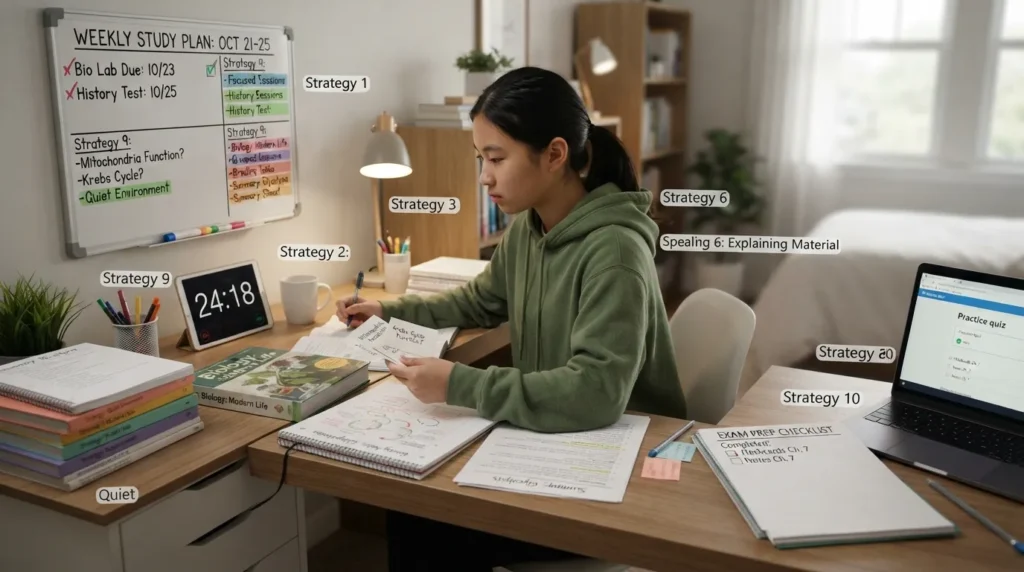
High school academics demand a massive shift in cognitive load, moving far beyond middle school memorization into deep analytical thinking, making the mastery of study habits for high school foundational for long-term academic success. Generic study tips often fail because they treat all students like clones, ignoring the unique psychological and neurological blueprints required to build true discipline.
The Personalization Deficit: One-size-fits-all advice ignores individual cognitive pacing, working memory limits, and unique attentional spans.
The Science Gap: Outdated methods like passive rereading and highlighting create an illusion of competence while yielding near-zero long-term retention.
The Strategic Shift: True academic mastery relies on active, evidence-based study skills that transform short-term cramming into sustainable, high-yield study strategies.
By combining cognitive science—such as retrieval practice and spaced repetition—with personalized habit-stacking, you can stop wasting hours at a desk and finally unlock your full academic potential.
Why Study Habits Matter More in High School
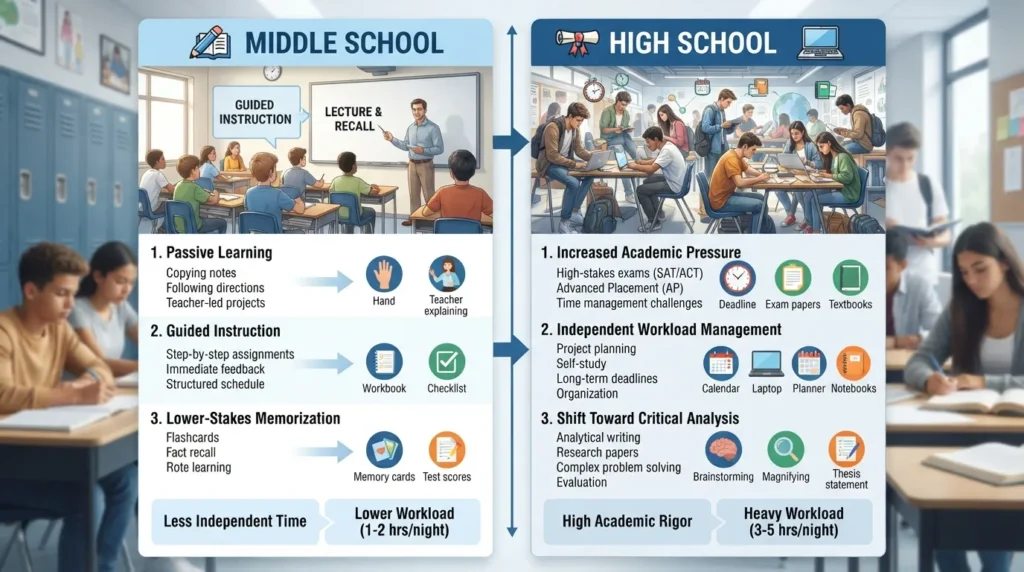
High school introduces a sudden exponential increase in academic complexity, transforming passive learners into independent managers of their own cognitive output. Navigating this critical juncture requires an immediate pivot away from last-minute cramming toward intentional, structured frameworks designed to handle rising expectations.
How High School Study Demands Differ From Middle School
The transition from middle school to high school involves a massive structural shift in how information is delivered, processed, and evaluated. Teachers no longer guide every step of the learning process, leaving students to independently manage intricate syllabi, dense reading assignments, and multi-week projects.
Autonomous Workload Management: High school requires rigorous self-regulation because students must balance concurrent advanced placement or honors courses alongside expanding extracurricular commitments.
Shift from Memorization to Application: Assessments test synthesis, critical analysis, and multi-step problem solving rather than simple factual recall.
Higher Stakes for Future Planning: First-year grades actively feed into cumulative transcripts that shape collegiate opportunities and career trajectories, elevating everyday academic pressure.
The Link Between Discipline and Consistent Study Habits
Relying solely on fleeting bursts of motivation is the primary reason high school students burn out under heavy course loads. True academic endurance is built on discipline, which bridges the gap between knowing what to study and actually executing the plan day after day.
Automation Over Willpower: Establishing fixed routines eliminates decision fatigue, turning daily study sessions into non-negotiable automatic behaviors.
The Power of Micro-Habits: Small, daily increments of focused work compound over time, preventing the overwhelming backlogs that trigger test anxiety.
Long-Term Resilience: Consistent execution trains the brain to tolerate cognitive friction, making difficult subjects manageable and predictable.
Time Management Habits That Actually Work
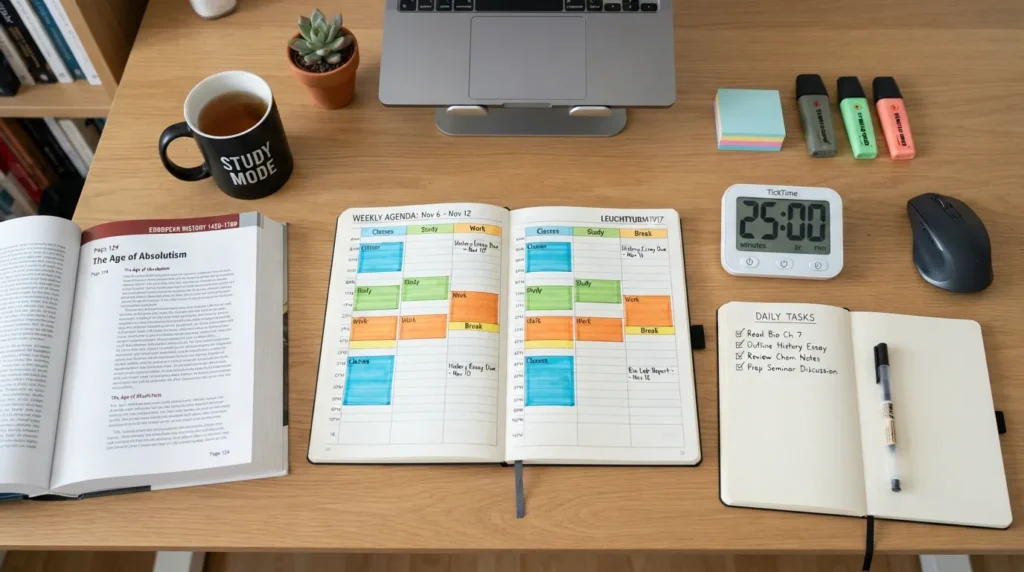
Mastering time management is the single most effective way to eliminate overwhelm and take control of your academic schedule. Transitioning from reactive firefighting to proactive time blocking ensures that every study session serves a precise, measurable purpose.
Use a Planner to Track Deadlines and Test Dates
Trying to hold all assignments, project milestones, and exam dates in your head guarantees missed deadlines and late-night panic. A centralized physical or digital planner acts as an external hard drive for your academic life, freeing up mental bandwidth for actual problem-solving.
Reverse-Engineer Big Assignments: Break major projects into weekly sub-tasks the moment they are assigned rather than waiting until the week before.
Centralize Everything: Keep track of schoolwork, sports, club meetings, and personal commitments in one unified view to prevent scheduling collisions.
Daily Action Audits: Spend five minutes every evening reviewing tomorrow’s priorities so you begin studying with immediate clarity.
Space Out Study Sessions Instead of Cramming (Spaced Practice)
Last-minute cramming creates an illusion of competence, but brain science proves that information absorbed this way evaporates within days. Spaced practice (or distributed practice) leverages the psychological spacing effect, forcing your brain to retrieve knowledge just as it begins to fade.
Distributed Intervals: Review material over increasing intervals—such as 1 day, 3 days, and 7 days after initial exposure—to cement long-term neural pathways.
Combat the Forgetting Curve: Short, regular study bursts require significantly less total time than massive, exhausting marathon sessions right before an exam.
The Pomodoro Technique — 25/5 Study-Break Cycle
The Pomodoro technique defeats procrastination and mental fatigue by structuring work into intense, highly focused sprints paired with mandatory rest. Working in short bursts prevents attention drift and keeps your cognitive energy high across extended study blocks.
The 25/5 Rhythm: Commit to 25 minutes of absolute, distraction-free focus, followed by a strict 5-minute break to rest your mind.
Protect the Break: Use the 5-minute window to step away from your desk, stretch, or grab water—avoid checking social media, which hijacks your focus.
Cycle and Reset: After completing four consecutive cycles, take a longer 15-to-30-minute break to fully recharge before the next study block.
Named Study Frameworks — 1-3-5-7 Rule & 3-2-1 Rule
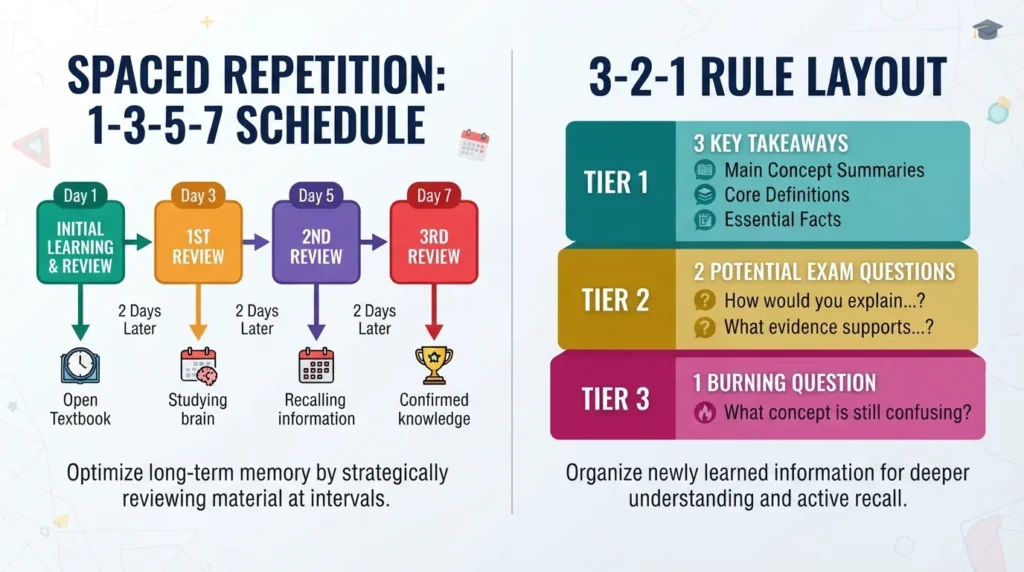
Mastering advanced study frameworks transforms random review sessions into a systematic pipeline for long-term memory consolidation. Utilizing structured mathematical schedules eliminates guesswork, giving you an exact blueprint for when and how to review complex material.
What Is the 1-3-5-7 Rule for Studying?
The 1-3-5-7 rule is a structured review schedule designed to combat the psychological forgetting curve through calculated intervals. By forcing your brain to retrieve information at progressively longer gaps, you permanently transfer concepts from short-term working memory into durable long-term storage.
Day 1 (Initial Review): Review your lecture notes or textbook chapters within 24 hours of first encountering the material to lock in baseline neural traces.
Day 3 (First Reinforcement): Revisit the core concepts and flashcards on the third day to catch early memory decay before it fades significantly.
Day 5 and Day 7 (Deep Consolidation): Test your active recall on the fifth and seventh days, cementing the data so it requires minimal effort to recall during exams.
What Is the 3-2-1 Rule for Study?
The 3-2-1 rule is a high-efficiency review protocol that streamlines massive amounts of dense reading or lecture content into compact, manageable insights. This framework prevents analysis paralysis by forcing prioritization and iterative summarization.
3 Key Takeaways: Distill an entire chapter, article, or lecture down to its three core foundational concepts or problem-solving formulas.
2 Potential Exam Questions: Draft two rigorous questions you believe a teacher or professor would ask based on the material, shifting your perspective to that of an examiner.
1 Burning Question: Identify one lingering point of confusion or knowledge gap that requires clarification from a teacher, peer, or study group.
Which Rule Should You Use — And When?
Choosing between these frameworks depends on the type of academic content you are tackling and how much time you have before an assessment. Matching the right strategy to the right subject ensures maximum academic efficiency.
Choose the 1-3-5-7 Rule for: Long-term mastery of cumulative subjects like AP Biology, chemistry formulas, or foreign languages where spaced repetition schedule intervals are vital.
Choose the 3-2-1 Rule for: Dense textbook chapters, history readings, or literature analysis where information overload is high and you need immediate comprehension.
Combine Both for Ultimate Retention: Use the 3-2-1 rule immediately after a lecture to digest the content, then plug those core takeaways into a 1-3-5-7 calendar for long-term review intervals.
Active Studying Techniques (Backed by Cognitive Science)
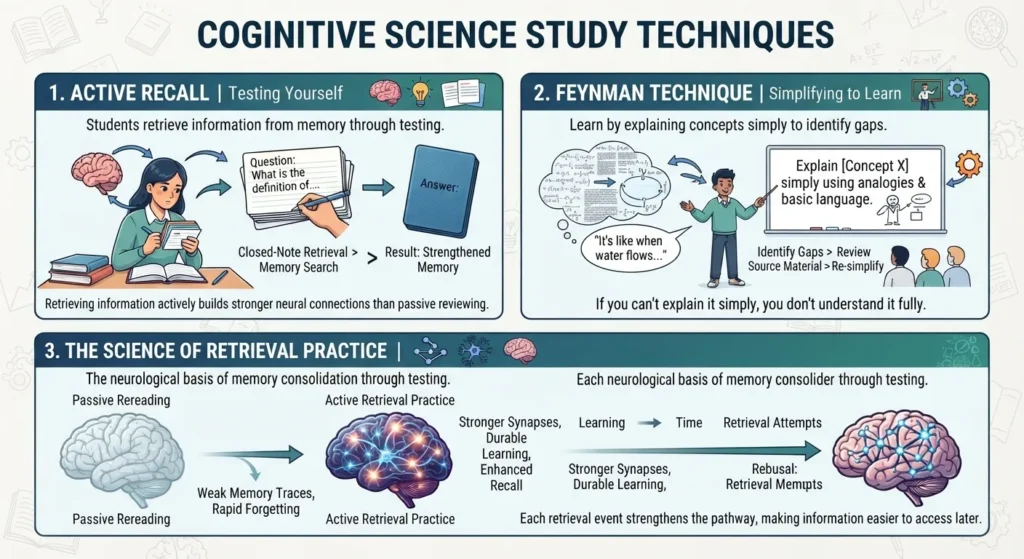
Passive studying methods—such as rereading textbooks, highlighting paragraphs, and listening to lectures on loop—create an illusion of competence while leaving neural pathways weak. Active recall and direct cognitive engagement force your brain to reconstruct information, transforming superficial familiarity into genuine mastery.
Active Recall — Testing Yourself With Flashcards & Quizzes
Active recall is the practice of actively stimulating your memory during the learning process rather than passively taking in information. Utilizing digital flashcards or custom practice quizzes forces your brain to dig for answers, strengthening synaptic connections with every successful retrieval.
Close the Book: Read a section, close your notes, and write down or say everything you can remember from memory before checking for accuracy.
Leverage Spaced Flashcards: Use apps like Anki or physical cards to test core definitions, formulas, and historical dates under timed pressure.
Embrace the Struggle: The mental friction you feel when trying hard to remember an elusive fact is the exact biological trigger that builds long-term memory.
Summarizing in Your Own Words for Deeper Comprehension
Simply copying down definitions or transcribing teacher notes bypasses deep cognitive processing and leads to fast forgetting. Rewriting complex theories, scientific processes, or historical events in your own colloquial voice forces your brain to translate data into meaningful understanding.
The Paraphrase Rule: Never write a direct sentence verbatim from a textbook; force yourself to rewrite the concept using an analogy or simplified explanation.
Synthesize Big Ideas: Condense a multi-page chapter into a single, highly structured paragraph that connects causes, effects, and core takeaways.
The Feynman Technique — Teach It to Learn It
The Feynman technique is a powerful mental model that exposes hidden knowledge gaps by stripping away complex jargon and forcing absolute clarity. Named after physicist Richard Feynman, this strategy proves that if you cannot explain a concept simply, you do not fully understand it.
Step 1 — Explain to a Novice: Write out an explanation of a tough topic as if you were teaching it to a middle school student.
Step 2 — Expose the Gaps: Notice the exact moments where you stumble, hesitate, or rely on confusing technical vocabulary to cover a misunderstanding.
Step 3 — Simplify and Refine: Return to your notes to clear up those weak spots, then rewrite your explanation using clean, everyday analogies.
Why These Methods Work (The Science of Retrieval Practice)
Retrieval practice works because every time you pull a memory out of storage, you make that memory trace stronger and easier to access next time. According to cognitive science research from institutions like Retrieval Practice Org, testing yourself alters the state of your memory, making it more stable against future forgetting.
Strengthening Neural Pathways: Each successful mental retrieval reinforces the axon-dendrite connections associated with that specific piece of information.
Breaking the Illusion of Fluency: Recognizing text on a page feels easy, but true learning requires the neurological workout of generating the answer from scratch.
Organization, Note-Taking & Study Environment
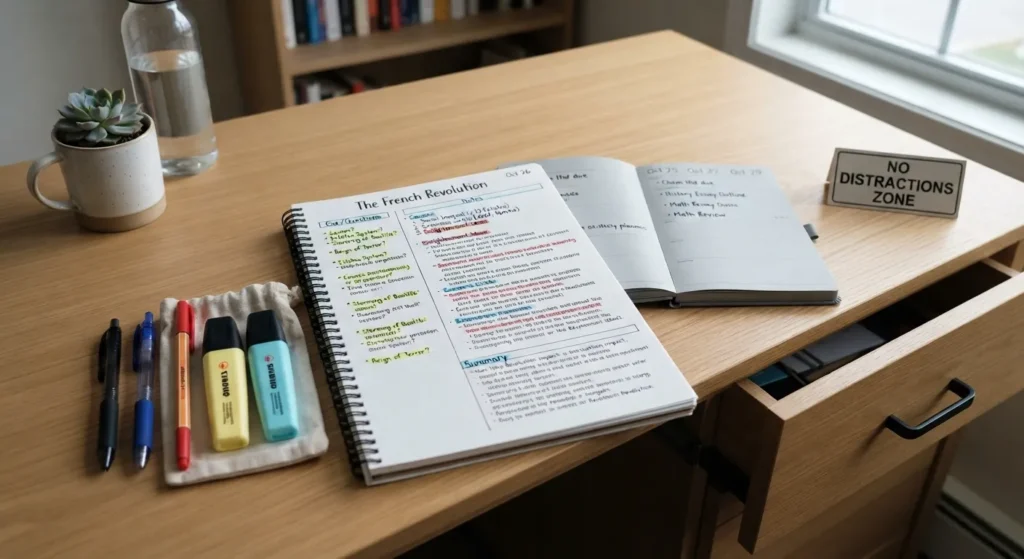
An unorganized desk, a chaotic digital file system, and a phone buzzing with notifications drain your cognitive bandwidth before you even open a textbook. Optimizing your physical study environment and note-taking frameworks preserves mental energy for deep, high-yield academic work.
The Cornell Note-Taking Method Explained
The Cornell method is a structured, time-tested framework that organizes lecture notes into distinct visual zones for rapid review and active questioning. This layout transforms passive transcription into an interactive study tool the moment you finish writing.
Divide the Page: Split your paper or document with a vertical line 2.5 inches from the left, leaving a 2-inch summary section at the bottom.
The Note-Taking Column: Capture main ideas, definitions, and important diagrams in the large right-hand column during class.
Cues and Summaries: Write trigger questions in the left column after class, and synthesize the entire page into a two-sentence summary at the bottom.
Using Shorthand & Symbols Instead of Copying Verbatim
Trying to write down every word a teacher says causes cognitive overload and ensures you miss the underlying conceptual message. Implementing a personalized system of shorthand abbreviations and visual symbols keeps your hand moving smoothly while forcing your brain to process ideas in real time.
Standardize Abbreviations: Use consistent symbols for common words, such as w/ (with), w/o (without), -> (leads to), and b/c (because).
Focus on Relationships: Use arrows, brackets, and color-coded underlines to map how concepts connect rather than writing out long explanatory sentences.
Minimizing Distractions — Phone, Notifications & Study Space Setup
Effective distraction management is less about sheer willpower and more about designing an environment where temptation is physically out of reach. A clean, dedicated study environment signals to your brain that it is time to work, drastically reducing setup friction.
Banished Devices: Place your phone in another room or inside a locked drawer on “Do Not Disturb” mode to eliminate micro-distractions.
Dedicated Work Zones: Never study on your bed, as your brain associates it with sleep and relaxation rather than high-intensity focus.
Visual Minimalism: Clear your desk of all clutter except the specific materials needed for your current task block.
Batching Similar Tasks to Build Momentum
Constantly switching between completely different subjects—like shifting from calculus to history to chemistry—triggers cognitive residue that destroys your focus. Task batching groups similar assignments together, allowing your brain to lock into a single mode of thinking and build unstoppable workflow momentum.
Group by Subject Type: Tackle all reading-heavy assignments in one block, followed by a separate block dedicated purely to problem-solving or essay drafting.
Reduce Context Switching: Completing all short homework assignments back-to-back saves time and prevents the mental fatigue of constant gear-shifting.
How Many Hours Should You Study? (Grade-by-Grade Guide)
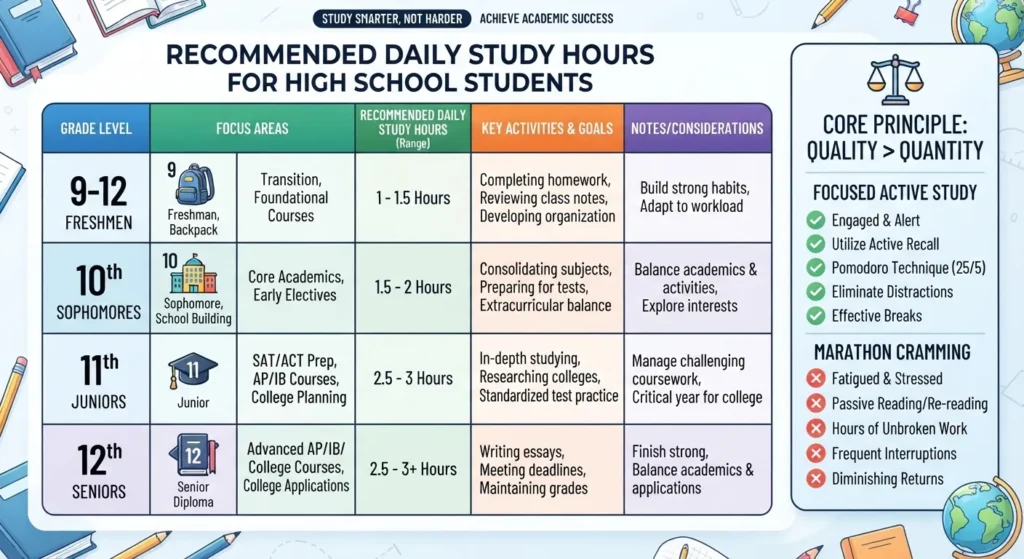
Determining the exact amount of time required for academic success depends heavily on your current grade level, course rigor, and personal efficiency. Balancing academic demands without burning out requires moving away from arbitrary time goals and focusing instead on strategic, sustainable study duration.
Is 3 Hours a Day Enough? (Realistic Benchmark)
Studying for three hours a day is more than enough for the vast majority of high school students, provided that time is spent executing high-yield strategies like active recall and spaced repetition. However, context matters: a straight-A student taking multiple Advanced Placement courses will require focused evening blocks, while a student utilizing hyper-efficient routines may achieve top marks in significantly less time.
The Efficiency Threshold: Three hours of uninterrupted, distraction-free active studying far outperforms five passive hours spent staring at open textbooks.
Course Rigor Factor: AP and Honors classes naturally demand higher daily commitments than standard grade-level coursework.
Recommended Study Time by Grade (9th–12th)
As students progress through high school, homework complexity and cumulative test preparation increase exponentially. Tailoring your daily study hours per day to your exact year in school prevents both under-preparation and unnecessary exhaustion.
9th Grade (Freshman Year): 1 to 1.5 hours daily focused on building core organization, time management, and foundational note-taking habits.
10th Grade (Sophomore Year): 1.5 to 2 hours daily to handle rising writing requirements and early honors-level coursework.
11th Grade (Junior Year): 2 to 3 hours daily to manage rigorous AP/IB classes alongside initial college entrance exam preparation.
12th Grade (Senior Year): 2 to 2.5 hours daily, balancing advanced coursework, college applications, and sustained academic consistency.
Quality vs. Quantity — Why More Hours Isn’t Always Better
Pushing past your cognitive limits leads straight into the trap of diminishing returns, where studying longer results in slower comprehension and mounting mental fatigue. The brain requires downtime to consolidate memories and synthesize complex ideas.
Cognitive Exhaustion: Attempting to study for four or five hours straight usually results in skimming text without processing meaning.
The Law of Diminishing Returns: Once mental focus breaks down, an extra hour of studying yields a fraction of the retention you would gain after a short physical or mental break.
Prioritizing Depth: Two hours of intense, structured focus with zero phone distractions beats four hours of distracted, half-hearted multitasking every single time.
Study Strategies by Subject
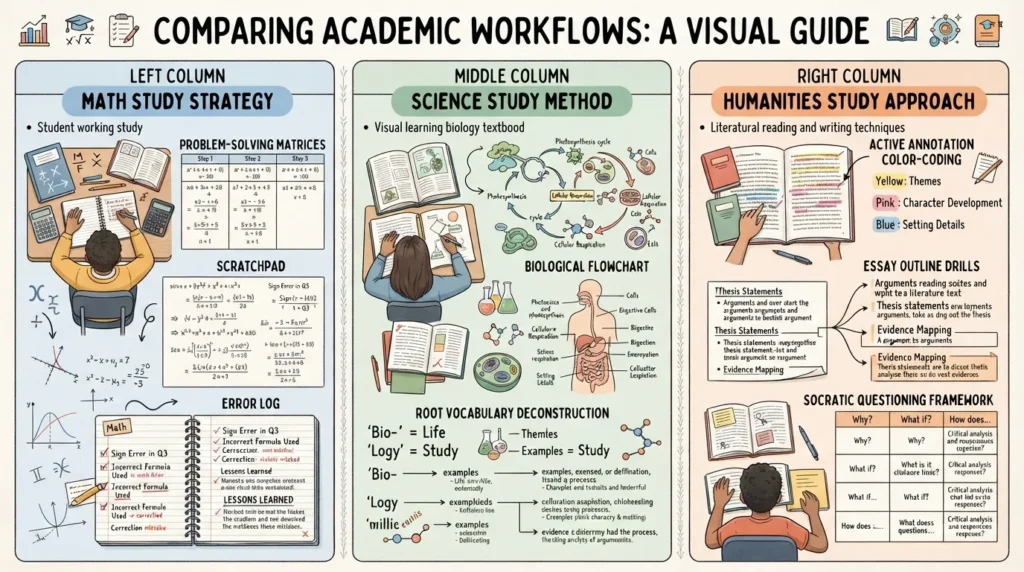
Applying a single, blanket study approach to every class is a major reason smart students hit an academic wall in high school. Implementing tailored, subject-specific study methods ensures your cognitive effort matches the unique demands of quantitative equations, scientific processes, or historical text analysis.
How to Study Math Effectively (Practice-Based Approach)
Mathematics is not a spectator sport, and reading over completed textbook examples creates a false sense of security. Mastering a robust math study strategy requires treating every concept as a physical skill that must be trained through repetition and error correction.
Never Skip the Medium-Hard Problems: Anyone can solve easy textbook warm-ups; real growth happens when you push through difficult multi-step challenge problems.
Maintain an Error Log: When you miss a problem on a quiz or practice set, write down the exact mathematical misconception that caused the error, and re-solve it 48 hours later.
Explain the Proof: Do not just memorize formulas; write out why a formula works and how derived equations connect back to foundational principles.
How to Study for Science & Memorization-Heavy Subjects
Subjects like biology, chemistry, and anatomy require balancing complex conceptual mental models with massive amounts of factual terminology. An effective science study strategy bridges the gap between rote memorization and true systemic understanding.
Draw Processes From Scratch: Close your textbook and sketch out biological cycles, cellular respiration pathways, or chemical reactions entirely from memory to test real comprehension.
Deconstruct Vocabulary Roots: Break down complex scientific terms using their Greek and Latin prefixes and suffixes rather than brute-force memorization.
Use Conceptual Flowcharts: Map out how different systems interact with each other to see the bigger picture behind isolated textbook chapters.
How to Study for English/History (Reading & Writing-Heavy Subjects)
Humanities and language arts require synthesizing massive blocks of text, evaluating authorial intent, and defending arguments with textual evidence. A specialized humanities study strategy turns passive reading into an active, analytical dialogue with the text.
The Active Annotation Framework: Highlight with purpose by establishing color codes for thesis statements, character shifts, historical turning points, and major vocabulary.
Practice Outline Drills: Instead of writing full essays for every prompt, outline the thesis, three core arguments, and counter-arguments in 10-minute sprints to build structural speed.
The Socratic Questioning Method: Challenge readings by asking probing questions: What is the author’s underlying bias, what evidence is missing, and how does this text connect to broader historical or cultural themes?
Find Your Best Study Method — Personalized Mini-Guide
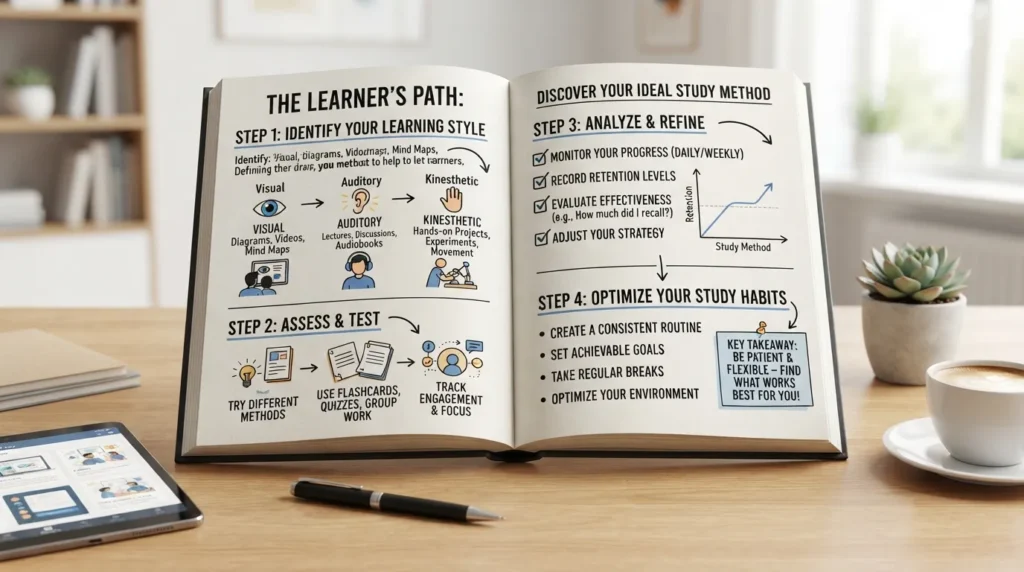
Applying a generic routine when you face specific cognitive hurdles like chronic procrastination or attention drift guarantees frustration. Building a personalized study plan starts by identifying your exact performance bottleneck and deploying targeted interventions to break the cycle.
If You Struggle With Procrastination
Procrastination is rarely a failure of time management; it is an emotional regulation problem triggered by task overwhelm, ambiguity, or fear of failure. Breaking the paralysis requires lowering the activation barrier so starting feels effortless.
The Two-Minute Rule: Commit to working on an assignment for just two minutes without stopping, giving your brain permission to quit after that window if needed (though momentum almost always keeps you going).
Deconstruct the First Step: Replace an intimidating assignment like “Write History Essay” on your calendar with micro-actions like “Write three thesis statement options.”
Remove Digital Friction Points: Place your phone in another room and open only the single browser tab required for your current task before you sit down.
If You Struggle With Cramming
Relying on last-minute exam preparation is usually a symptom of reactive scheduling and poor daily tracking. Transitioning away from the emergency cycle requires establishing strict micro-habits that force consistent engagement long before test day.
Reverse-Calendar Your Exams: The moment a test date is announced, work backward on your planner and assign specific 15-minute review blocks starting two weeks out.
The Daily Exit Ticket: Spend the final ten minutes of every school day reviewing notes from that day’s classes to eliminate the backlog that triggers weekend cramming.
Incentivize Early Completion: Finish major projects 48 hours before the deadline to give yourself a mandatory buffer against panic and sleep deprivation.
If You Struggle With Losing Focus
Attention drift during study sessions often stems from physical fatigue, environmental chaos, or attempting to tackle overly long work blocks without a break structure. Reclaiming your concentration requires training your brain through disciplined interval training.
Adopt the Pomodoro Rhythm: Use strict 25-minute work sprints paired with 5-minute physical rest breaks to force hyper-focus without mental burnout.
Audit Your Environment: Eliminate visual clutter from your desk and use noise-canceling headphones playing ambient soundscapes or brown noise to block out distractions.
Single-Task Rigor: Close all messaging apps, email tabs, and browser windows that are not directly relevant to the specific problem or chapter you are currently tackling.
Real Student Experience — What Actually Worked

Navigating high school successfully requires more than theoretical advice found in textbooks; it takes practical, battle-tested routines built from real-world firsthand experience. Examining how successful students actually manage their time, organize notes, and course-correct after academic setbacks offers a reliable blueprint for turning academic stress into sustainable success.
A Real High School Student’s Study Routine (Case Example)
A high-performing junior balancing three Advanced Placement classes and varsity sports can maintain a 4.0 GPA without pulling all-nighters by replacing chaotic cramming with a strict, repeatable daily workflow. This case study demonstrates that structure and predictability drive high achievement.
After-School Reset (3:30 PM): Takes a mandatory 30-minute break to eat, hydrate, and completely disconnect from school before starting homework.
The Evening Work Block (4:00 PM – 6:30 PM): Utilizes consecutive 25-minute Pomodoro sprints to tackle homework and problem sets, tackling the hardest subject first when cognitive energy peaks.
The 10-Minute Nightly Review (9:00 PM): Briefly flips through daily Cornell notes using the 1-3-5-7 rule schedule to lock in short-term concepts before sleep.
Common Mistakes Students Make (First-Hand Observations)
Most academic struggles do not stem from a lack of intelligence, but from falling into predictable behavioral traps that waste time and drain mental energy. Recognizing these common study mistakes early allows you to course-correct before grades suffer.
Passive Re-Reading: Spending hours highlighting textbook pages and re-reading chapters while retaining almost zero actual information for test day.
Multitasking With Technology: Keeping a smartphone next to the notebook, resulting in micro-distractions that double the time required to finish basic homework.
Waiting for Motivation: Relying on the mood to strike before studying rather than building automated daily habits that execute regardless of how you feel.
Frequently Asked Questions
What are 10 good study habits for students?
Ten essential study habits include using a centralized planner, practicing active recall with flashcards, applying spaced repetition, studying in a distraction-free environment, taking notes using the Cornell method, teaching concepts via the Feynman technique, maintaining a consistent daily schedule, batching similar tasks, prioritizing difficult subjects first, and taking regular breaks.
What are 7 effective study habits?
Seven proven study habits are spacing out review sessions instead of cramming, testing yourself with active recall, breaking complex material down with the 3-2-1 rule, organizing notes with shorthand, eliminating phone notifications during work blocks, maintaining a consistent bedtime routine for memory consolidation, and reviewing mistakes thoroughly.
What are the 5 best tips for studying?
The five best study tips focus on quality over quantity: use active recall instead of passive reading, implement spaced intervals for long-term retention, study in focused 25-minute Pomodoro blocks, eliminate all digital distractions, and explain difficult concepts aloud in your own words.
How can I focus 100% on studying?
Achieving 100% focus requires absolute environmental control. Place your phone in another room on silent, clear your desk of all non-essential items, wear noise-canceling headphones playing ambient soundscapes, work in strict time-boxed intervals, and tackle your most challenging subject when your mental energy is highest.
Which method is best for studying?
The most effective study method combines active recall and spaced repetition, such as the 1-3-5-7 review schedule paired with self-testing flashcards. Because active retrieval forces your brain to reconstruct knowledge from scratch, it dramatically outperforms passive highlighting or rereading every time.
What helps focus when studying?
Improving study focus involves setting up a dedicated workspace away from your bed, using a physical or digital timer to maintain structured work blocks, clearing digital clutter by closing unused browser tabs, and taking brief physical breaks to stretch and reset your cognitive attention span.
Conclusion & Key Takeaways
Mastering study habits in high school requires moving beyond passive memorization and reactive cramming into intentional, cognitive science-backed strategies. True academic success is built on three core pillars: proactive time management, active recall and retrieval practice, and optimized organization.
Time Management & Systems: Utilize centralized planners, spaced repetition frameworks like the 1-3-5-7 rule, and focused intervals to eliminate overwhelm.
Active Cognitive Engagement: Replace passive highlighting with self-testing, flashcards, and the Feynman technique to ensure long-term retention.
Environmental Control: Protect your focus by batching tasks, managing digital distractions, and building a dedicated workspace.
Lasting discipline does not happen overnight. By committing to small, daily acts of consistency and refining your approach subject by subject, you transform studying from a stressful chore into a reliable system for lifelong achievement.
Kittisak Wattanakul
Kittisak Wattanakul is the Discipline Editor at Holistic Wellbeing Living. He writes about routines, focus, consistency, and practical follow-through. With nine years of experience creating personal-growth content, Kittisak helps readers build realistic systems for steady progress without extreme productivity pressure.