Accountability Examples: Real-Life Scenarios for Work and Life
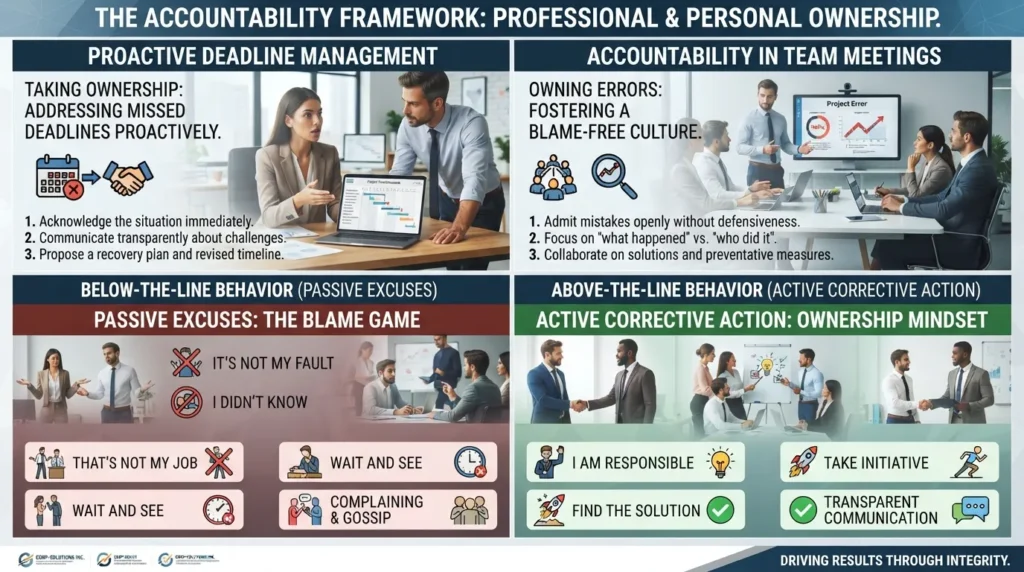
What Does "Taken Accountability" Really Mean?
Accountability means taking full ownership of your actions, decisions, and their resulting outcomes, whether positive or negative. It goes beyond simply completing a task; it requires acknowledging your role in the process without deflecting blame or making excuses.
Active Ownership: Stepping up proactively when things go wrong rather than waiting to be pointed out.
Transparent Recognition: Being completely honest about where errors occurred and why.
Corrective Action: Actively working to fix mistakes and prevent them from happening again.
Meaning of Accountability in Simple Terms
At its core, accountability is the bridge between intention and impact. It means accepting that you are responsible for the consequences of your behavior, regardless of external circumstances.
Responsibility vs. Accountability: While responsibility can be shared or assigned before a task begins, accountability is individual and evaluated after the results are in.
Behavioral Integrity: Aligning your words with your actions and standing by the outcomes they produce.
Trust Building: Demonstrating reliability by owning failures as openly as you celebrate successes.
“Take Accountability” vs. “Taken Accountability” — Which Is Grammatically Correct?
Both phrases are grammatically correct, but they serve entirely different grammatical functions depending on the tense of your sentence. Choosing the right form ensures your communication remains clear and professional.
“Take Accountability” (Base/Present/Infinitive): Use this when referring to a present action, a general rule, or an imperative command (e.g., “Leaders must take accountability for team errors”).
“Taken Accountability” (Past Participle): Use this only as part of the present or past perfect tense, usually paired with helping verbs like has, have, or had (e.g., “She has successfully taken accountability for the project delay”).
Common Pitfall: Avoid using “taken accountability” on its own as a standalone past-tense verb (e.g., writing “Yesterday, he taken accountability” is grammatically incorrect; instead, use “took”).
What Do You Call a Person Who Takes Accountability?
A person who consistently takes accountability is most commonly referred to as accountable, responsible, or an owner. In professional and leadership contexts, such individuals are praised for exhibiting strong personal integrity and maturity.
Accountable: The standard adjective for someone who reliably accepts the outcomes of their actions.
Ownership-Oriented: Someone who treats a project or problem as if the ultimate success or failure rests entirely on them.
Self-Aware: A foundational trait that allows an individual to recognize their mistakes objectively without ego interference.
Accountability vs. Responsibility — Understanding the Difference
While often used interchangeably in everyday conversation, responsibility and accountability refer to two distinct aspects of execution and management. Understanding the boundary between them is critical for setting clear workplace expectations, avoiding role confusion, and establishing true operational ownership.
The Core Distinction: Responsibility focuses on the input and execution of tasks, while accountability focuses entirely on the final results and consequences.
Timing Difference: Responsibility is usually assigned before or during a project, whereas accountability is evaluated after the outcomes are delivered.
Sharing vs. Holding: Multiple people can share responsibility for a project milestone, but ultimate accountability always rests with a single individual.
Responsibility = Tasks, Accountability = Outcomes
Responsibility is about doing the work, whereas accountability is about owning the result. You can easily delegate your daily tasks and operational duties to others, but you can never truly delegate your accountability for how those tasks turn out.
Delegating Tasks: A manager can assign the responsibility of writing a financial report to an analyst, ensuring the work gets done on time.
Owning Outcomes: If the report contains critical errors, the analyst is responsible for the drafting mistake, but the manager retains accountability for submitting inaccurate data to leadership.
The Shared vs. Single Rule: Team members share responsibility for collaborative milestones, but true accountability cannot be split; it belongs to the person who answers for the success or failure of the initiative.
A Simple Comparison Table (Responsibility vs. Accountability)
To quickly clarify how these two concepts diverge across daily workflows, examine the core differences broken down by definition, focus, and application below:
| Feature | Responsibility | Accountability |
| Primary Focus | Input, execution, and completing assigned tasks | Outcomes, consequences, and ultimate results |
| Timing | Ongoing throughout the project lifecycle | Assessed after the work is completed |
| Can it be shared? | Yes, multiple team members can share it | No, it belongs to one designated owner |
| Key Question | “Who is doing the work?” | “Who owns the success or failure?” |
| Core Action | Doing, building, and managing | Answering, owning, and taking blame or credit |
Why Accountability Is Important in the Workplace

Workplace accountability serves as the structural foundation for high-performing, psychologically safe, and resilient teams. When employees and leaders embrace ownership rather than deflecting errors, organizations minimize operational friction and maximize collective output.
The Core Driver: Accountability transforms vague organizational goals into clear, measurable individual commitments.
Psychological Safety: Cultivates a work environment where staff feel safe admitting mistakes without fear of toxic retaliation.
Strategic Execution: Aligns daily execution with big-picture company targets to prevent stalled initiatives.
Builds Trust Between Employees and Leaders
Trust is impossible to sustain in an environment where mistakes are hidden or blamed on external factors. When team members consistently take accountability for their outcomes, it establishes predictability, honesty, and deep professional reliability.
Predictable Reliability: Colleagues know they can depend on each other to follow through on critical deliverables.
Transparent Leadership: As highlighted in workforce analyses from Indeed’s Career Development Guide, when executives hold themselves accountable alongside staff, it removes hierarchy-based double standards and solidifies mutual respect.
Risk Tolerance: Mutual trust empowers employees to take calculated creative risks, knowing leadership will support them through outcomes rather than assign blame.
Improves Team Performance and Reduces Blame Culture
A toxic blame culture drains organizational energy, forcing teams to spend more time defending past actions than solving present problems. Accountability replaces finger-pointing with rapid, solution-oriented problem solving.
Streamlined Troubleshooting: Teams focus energy on fixing structural process gaps instead of investigating who caused the initial failure.
Standardized Excellence: Clear ownership sets a transparent baseline for quality work across every tier of the organization.
Reduced Operational Drag: Eliminating defensive communication accelerates project lifecycles and improves cross-functional coordination.
Strengthens Company Culture and Retention
Organizations that prioritize and reward accountability naturally foster higher levels of employee engagement and career satisfaction. When workers feel their individual contributions directly impact company success, burnout decreases and retention climbs.
Meaningful Contribution: Ownership ensures team members see the direct value of their labor, boosting intrinsic motivation.
Talent Attraction: A transparent, accountable culture acts as a powerful magnet for top-tier professionals seeking integrity-driven workplaces.
Long-Term Loyalty: Employees who experience fair performance evaluations and honest leadership support tend to remain with the organization longer.
Personal Accountability Examples (Real-Life Scenarios)
Personal accountability means proactively owning your responsibilities, acknowledging missteps without hesitation, and taking immediate corrective action. True accountability removes defensiveness and focuses entirely on solutions, integrity, and continuous self-improvement.
Proactive Ownership: Addressing performance shortfalls before managers or clients have to point them out.
Radical Honesty: Accepting that while circumstances can be difficult, your response to them remains entirely under your control [01:48].
Solution-Oriented Action: Transitioning quickly from identifying a problem to executing a reliable fix.
Example 1 — Admitting a Missed Deadline Instead of Making Excuses
Missing a project delivery date is frustrating, but compounding the error with elaborate excuses damages your professional credibility. True accountability means stepping forward immediately to communicate the delay and proposing an immediate recovery plan.
The Scenario: You realize a major client deliverable will not be finished by Friday afternoon due to poor time management earlier in the week.
Accountable Response: You message your manager or client proactively on Thursday morning, admitting the oversight clearly without blaming technical glitches or heavy workloads.
Corrective Action: You provide a revised timeline, work late to expedite completion, and outline a personal scheduling system to ensure it never happens again.
Example 2 — Owning Up to a Mistake in Front of the Team
Making an error that impacts an entire project team can feel embarrassing, but attempting to sweep it under the rug risks larger downstream failures. Owning the mistake publicly models psychological safety and invites collaborative problem-solving [01:21].
The Scenario: You included incorrect data specifications in a shared architectural document, throwing off the engineering team’s initial workflow.
Accountable Response: During the team sync, you speak up immediately to state that the data error originated from your section of the report.
Corrective Action: You apologize briefly, refrain from pointing fingers at others who proofread it, and spend your afternoon updating the dataset with verified numbers.
Example 3 — Accepting Constructive Feedback Without Defensiveness
Receiving criticism regarding your performance or communication style often triggers an instinctual defensive response. Practicing self-accountability requires listening openly, separating your ego from the feedback, and applying the guidance constructively.
The Scenario: A senior colleague pulls you aside to explain that your abrupt tone during cross-functional meetings is alienating junior staff.
Accountable Response: Instead of interrupting to justify your stress levels, you actively listen, thank them for their candor, and reflect on how your delivery impacts others.
Corrective Action: You consciously adjust your meeting communication style moving forward and follow up with affected team members to rebuild rapport.
Example 4 — Correcting an Error Before It Escalates
Self-accountability is not only about fixing mistakes after they cause damage; it also involves catching your own oversight early and taking total responsibility for fixing it before anyone else is burdened.
The Scenario: You notice a billing discrepancy in an invoice you sent to a vendor, but the error is small enough that they might not notice it immediately.
Accountable Response: Recognizing that integrity requires complete transparency, you choose not to wait for an audit to uncover the mistake.
Corrective Action: You immediately issue a corrected invoice along with a direct note acknowledging the mistake, ensuring total financial accuracy and trust.
Example 5 — Following Through on a Commitment Under Pressure
When personal circumstances get stressful or competing priorities pile up, it is tempting to let minor commitments slide quietly. Personal accountability ensures you honor your word regardless of how inconvenient the execution becomes.
The Scenario: You promised to review a peer’s proposal by end-of-day, but an unexpected crisis dominates your afternoon schedule.
Accountable Response: Rather than ignoring the commitment or missing the deadline silently, you communicate your adjusted timeline before the deadline hits.
Corrective Action: You carve out early morning time the next day to complete the review thoroughly, honoring your promise with uncompromised quality.
Formal / Workplace Accountability Examples (Employee & Leadership Level)
Formal accountability in a professional setting establishes clear operational structures, defined performance metrics, and transparent pathways for evaluating results. Organizations thrive when both individual contributors and executives operate within a formalized system of mutual ownership.
Structured Clarity: Ensures every tier of an organization understands its exact performance indicators and reporting obligations.
Two-Way Commitment: Requires employees to deliver on execution while demanding that leadership provides adequate resources and transparent oversight.
Systemic Integrity: Replaces subjective blame with objective data tracking during performance evaluations and organizational audits.
Formal Accountability Examples for Employees (Performance Reviews, Reporting Errors to a Manager, Meeting KPIs)
At the individual employee level, formal accountability means treating your key performance indicators (KPIs) and professional obligations as non-negotiable agreements with the business.
Performance Review Preparation: Compiling an objective portfolio of your quarterly wins and misses ahead of a review, rather than waiting for a manager to list your shortfalls.
Proactive Error Reporting: Discovering a financial or data discrepancy in a submitted report and formally notifying management in writing before an external audit catches it.
KPI Ownership: Tracking your metrics weekly, identifying shortfalls early, and presenting an actionable recovery plan during one-on-one check-ins if a target is at risk.
Formal Accountability Examples for Managers & Leaders (Owning Team Failures Publicly, Transparent Decision-Making)
Leadership accountability carries a heavier weight because executives and managers are formally responsible for the environment, tools, and strategic direction provided to their teams. True leadership ownership means buffering the team from misplaced blame while driving internal optimization.
Owning Team Failures Publicly: Stepping forward during executive board meetings to take full ownership of a missed product launch milestone instead of scapegoating junior staff.
Transparent Decision-Making: Communicating the underlying business data and rationale behind a difficult restructuring or budget cut, rather than hiding behind corporate ambiguity.
Resource Empowerment: Formally acknowledging when a team lacks the necessary software, training, or staffing to hit a target, and taking immediate steps to secure those resources.
Accountability in Business — A Structural Definition
Accountability in business refers to the governance framework that holds an organization, its leaders, and its employees answerable for ethical standards, operational performance, and financial stewardship. It is the structural backbone that protects stakeholder interests and maintains regulatory compliance.
Corporate Governance: Establishing independent boards, transparent auditing processes, and clear reporting lines to ensure legal and fiscal integrity.
Performance Accountability: Implementing continuous feedback systems like OKRs (Objectives and Key Results) to measure productivity objectively across departments.
Ethical Compliance: Ensuring that company leadership adheres to public safety regulations, environmental standards, and labor laws without exception.
How to Show Accountability at Work (Practical Steps)
Demonstrating accountability at work requires intentional daily habits, radical honesty, and a commitment to action over excuses. By mastering a structured, step-by-step approach to ownership, professionals can build lasting trust, accelerate their careers, and cultivate a resilient, high-performance mindset.
Proactive Engagement: Anticipate issues before they spiral and step up voluntarily to resolve them.
Radical Candor: Address missteps transparently without deflecting blame or hiding errors from management.
Continuous Growth: Treat every failure as a concrete learning opportunity to refine future professional habits.
Step 1 — Acknowledge the Situation Honestly
The foundational requirement to ensure accountability is looking at a problem objectively without sugarcoating the facts. Acknowledging reality precisely as it happened stops the cycle of denial and opens the door to effective problem-solving.
Face the Facts: Recognize precisely where performance or execution fell short of expectations.
Drop Defensive Armor: Resist the emotional urge to minimize the impact of the oversight or rationalize the delay.
Communicate Early: Bring the issue to light quickly so stakeholders can adjust strategies before the timeline is compromised.
Step 2 — Stop Making Excuses or Blaming Others
Pointing fingers at external factors, software bugs, or colleagues creates a toxic environment and stalls progress. True professional maturity means accepting that while circumstances can be difficult, your reaction and follow-through remain entirely your responsibility.
Eliminate Deflection: Purge phrases like “it wasn’t my fault” or “nobody told me” from your professional vocabulary.
Focus on Your Actions: Examine what you could have controlled differently within the given workflow.
Protect Team Cohesion: Avoid scapegoating coworkers or junior staff when collaborative projects run into roadblocks.
Step 3 — Apologize With Genuine Intent
A hollow or defensive apology damages trust faster than making the mistake itself. When an error affects clients, managers, or teammates, offer a clean, concise apology that acknowledges the specific impact of your actions.
Be Specific: Clearly state what went wrong without adding conditional qualifiers (avoid saying “I’m sorry, if my work caused an issue”).
Acknowledge Impact: Validate how the mistake inconvenienced others or disrupted team momentum.
Keep it Brief: Deliver the apology promptly and pivot immediately toward constructive solutions.
Step 4 — Take Corrective Action Immediately
Words mean little without execution; accountability demands that you lead the recovery process. Once an error is acknowledged, immediately deploy corrective measures to fix the problem and minimize downstream damage.
Build a Recovery Plan: Outline concrete steps required to correct the mistake and present them to affected parties.
Hustle to Fix It: Put in the necessary extra effort or hours to restore the project back on track.
Verify Results: Double-check your corrective work to ensure the error is completely resolved before closing the loop.
Step 5 — Reflect and Adjust Future Behavior
The final step of true self-accountability is closing the loop through systematic self-improvement. Analyze the root cause of the error so you can implement safeguards that prevent the exact same issue from happening twice.
Conduct a Personal Post-Mortem: Ask yourself what systemic habit, blind spot, or communication gap led to the initial mistake.
Implement Process Safeguards: Set up personal checklists, automated reminders, or early warning milestones to protect future workflows.
Share Learnings: Discuss insights with your team to help others avoid similar pitfalls and strengthen organizational resilience.
(Source: “What Is Responsibility & Accountability At Work?”
For a deeper dive into distinguishing duties and owning outcomes, you can explore the What Is Responsibility & Accountability At Work? discussion, which explains how role clarity drives team success.
The Three C's of Accountability
The Three C’s of accountability provide a powerful, memorable framework for understanding and executing personal and professional ownership. By breaking accountability down into three distinct operational pillars—Clarity, Commitment, and Consequence—individuals and teams can systematically eliminate ambiguity and drive reliable results.
The Framework Power: Offers a clear, actionable mental model for diagnosing where accountability breakdowns happen in projects or daily tasks.
Universal Application: Applies equally to individual contributors managing personal goals and executive leaders guiding entire organizations.
Featured Insight: Designed to instantly satisfy high-intent queries searching for structured, name-brand accountability models.
Clarity — Knowing What’s Expected
Without absolute clarity regarding roles, deadlines, and success metrics, true accountability is impossible. The first pillar requires defining expectations precisely before any work begins to ensure all parties share a unified vision of success.
Define Deliverables: Spell out exactly what the final output looks like, down to format, quality standards, and scope.
Establish Ownership: Assign a single accountable person to each initiative to prevent diffusion of responsibility across teams.
Eliminate Ambiguity: Confirm that instructions are fully understood by asking team members to restate their objectives in their own words.
Commitment — Following Through
Commitment is the psychological and active buy-in required to execute the assigned task with excellence. Once clarity is established, the second pillar demands that individuals willingly pledge their effort and focus to achieving the goal.
Active Agreement: Move beyond passive compliance to secure a genuine, verbal or written commitment from the person doing the work.
Resource Alignment: Ensure team members have the necessary tools, training, and bandwidth required to honor their commitment.
Internalized Drive: Foster intrinsic motivation so individuals care about the quality of the output rather than just checking boxes.
Consequence — Owning the Outcome
The final pillar of the framework is accepting the consequence—whether it is celebrating a successful milestone or owning the fallout of a missed target. Consequence ensures that results are evaluated honestly and lessons are applied moving forward.
Result Ownership: Accept the positive rewards of success with humility and the negative feedback of failure without making excuses.
Accountable Review: Evaluate performance metrics objectively against the original goals established during the clarity phase.
Corrective Adaptation: Use the outcomes as direct learning data to adjust strategies, refine processes, and improve future performance.
Signs of a Lack of Accountability

Recognizing the behavioral red flags associated with a lack of accountability is essential for diagnosing cultural dysfunction in teams or identifying blind spots in personal growth. When accountability is absent, organizations experience stagnation, eroding trust, and repetitive operational failures.
Behavioral Red Flags: Identifying defensive patterns early helps prevent toxic habits from infecting wider team dynamics.
Systemic Stagnation: Unaccountable environments trap teams in repeating loops of the same unresolved mistakes.
Culture of Fear: A lack of personal ownership forces individuals to hide errors, degrading psychological safety and transparency.
Constantly Blaming Others or Circumstances
The most prominent indicator of an unaccountable mindset is an instinctive reflex to shift blame away from oneself onto external variables. Whether pointing fingers at colleagues, departments, or unpredictable market conditions, the focus remains entirely on deflecting fault.
Scapegoating Coworkers: Attributing project failures to peer incompetence without examining one’s own collaborative failures or communication gaps.
Externalizing Control: Claiming that company software, economic conditions, or poor weather made success impossible, regardless of team capabilities.
Defensive Posture: Responding to constructive feedback with immediate accusations against management or supporting staff.
Avoiding Ownership of Mistakes
When mistakes occur, unaccountable individuals go to great lengths to distance themselves from the fallout. They minimize the impact of errors, hide negative data, or wait for someone else to step forward and absorb the consequences.
Sweeping Errors Under the Rug: Hoping minor oversights go unnoticed during audits or quality checks instead of reporting them proactively.
Passive Silence: Remaining quiet during team reviews when critical project discrepancies are discussed, allowing others to take the fall.
Minimizing Impact: Claiming that a serious oversight “wasn’t a big deal” to deflect pressure from management or clients.
Making Repeated Excuses Instead of Fixing Problems
An unaccountable person treats excuses as permanent solutions, recycling the same justifications whenever performance falls short. Instead of deploying corrective action, they focus their energy on manufacturing reasons why the task could not be completed.
Recycled Justifications: Using identical complaints week after week regarding workload, bandwidth, or lack of guidance without proposing changes.
Action Paralysis: Spending hours explaining why a goal failed rather than investing five minutes into brainstorming how to fix it.
Broken Promises: Committing casually to deadlines or deliverables with no genuine intention or system in place to ensure follow-through.
Why Some People Struggle to Take Accountability
Understanding why individuals resist accountability helps leaders and peers address the root psychological causes rather than just punishing the symptoms. Fear, ego, and past trauma often drive defensive, unaccountable behavior.
Fear of Punitive Consequences: Growing up or working in hyper-punitive environments where admitting a mistake led to harsh penalties or humiliation.
Ego Protection: Viewing mistakes as a direct reflection of personal self-worth rather than isolated events in a learning process.
Lack of Role Models: Having never experienced effective, accountable leadership that demonstrates how to own mistakes gracefully and constructively.
Would you like me to write the conclusion and FAQ section to round out this comprehensive guide on accountability?
How to Deal With Someone Who Can't Take Accountability

Navigating relationships with unaccountable coworkers, employees, or peers can drain team morale and stall vital projects. Managing these individuals requires moving away from emotional frustration and leaning into objective boundaries, clear documentation, and direct, data-backed communication.
Objective Focus: Ground every conversation in observable performance metrics rather than subjective personality critiques.
Preventative Boundaries: Establish clear ownership structures early to eliminate gray areas where blame-shifting thrives.
Progressive Intervention: Guide the individual toward accountability through structured feedback before escalating to formal administrative steps.
Set Clear Expectations Upfront
Many individuals fail to take accountability simply because expectations were muddy from the start. Prevent defensiveness by documenting every project scope, timeline, and deliverable clearly before work begins.
Define Specific Deliverables: Spell out precisely what success looks like, including formatting, deadlines, and individual ownership lines.
Secure Verbal and Written Buy-In: Have team members restate their goals and confirm their agreement in writing.
Eliminate Ambiguity: Ensure no tasks are left floating between team members without a designated primary owner.
Address the Behavior Privately and Directly
When someone dodges accountability, address the behavior immediately in a private one-on-one setting. Public confrontations trigger ego defenses and cause the individual to retreat further into blame-shifting.
Use Objective Examples: Point to specific instances where a deadline was missed or an excuse was made, avoiding generalized attacks on character.
Ask Open-Ended Questions: Prompt self-reflection by asking what happened and what steps they plan to take to resolve it.
Maintain Professional Calm: Keep your tone steady and focused on solutions, preventing the meeting from devolving into a emotional argument.
Document Patterns For Formal Conversations
If unaccountable behavior becomes a persistent cycle rather than a one-time slip, you must track it methodically. Detailed documentation protects team productivity and provides an objective foundation for performance reviews.
Log Dates and Details: Keep a private record of missed commitments, specific excuses used, and the downstream impact on the team.
Track Impact: Note how their lack of ownership affected project timelines, client relationships, or colleagues’ workloads.
Prepare Actionable Feedback: Use your log during formal reviews to show a pattern of behavior rather than relying on hazy memories.
Know When to Escalate
If coaching, clear boundaries, and private discussions fail to spark behavioral change, you must escalate the issue through proper organizational channels. Protecting team culture and business outcomes must always take precedence over shielding an uncooperative individual.
Involve Human Resources: Share your documented performance logs with HR to initiate formal coaching or improvement plans.
Reallocate Responsibilities: Strip critical ownership duties away from the unaccountable individual and assign them to reliable team members.
Enforce Consequences: Apply standard company policies if performance standards continue to be ignored despite repeated interventions.
Frequently Asked Questions (FAQ)
Find direct answers below to the most common questions regarding accountability, grammar rules, workplace expectations, and practical ownership.
Instant Clarity: Designed to deliver concise, authoritative answers optimized for Google Search snippets and AI Overviews.
Comprehensive Coverage: Summarizes key concepts across personal growth, professional standards, and language usage.
Is Taking Accountability a Good Thing?
Yes, taking accountability is one of the most vital traits for personal growth, career advancement, and healthy relationships. It builds deep trust, eliminates toxic blame cultures, and demonstrates high emotional intelligence and maturity.
Professional Growth: Leaders and employers actively seek out individuals who own their mistakes because it guarantees reliability and continuous self-improvement.
Psychological Safety: Openly owning missteps creates an environment where others feel safe experimenting, innovating, and admitting flaws without fear of toxic retaliation.
What Are the 5 Steps to Taking Accountability?
Taking structured accountability involves a reliable, repeatable process designed to transform mistakes into actionable solutions. The five core steps include:
Acknowledge the Situation Honestly: Face the facts of what happened without sugarcoating or denial.
Stop Making Excuses: Drop defensive rationalizations and eliminate blame-shifting behavior.
Apologize With Genuine Intent: Offer a concise, specific apology that addresses the direct impact of your actions.
Take Corrective Action Immediately: Build a recovery plan and put in the work required to fix the error.
Reflect and Adjust Future Behavior: Conduct a personal review to implement safeguards that prevent the same mistake from recurring.
What Do You Call a Person Who Takes Accountability?
A person who consistently takes accountability is most frequently called accountable, responsible, or an owner. In professional environments, they are often described as self-aware, reliable, and driven by integrity.
Key Descriptors: Accountable, ownership-oriented, dependable, and self-reflective.
Behavioral Trait: They treat outcomes as a direct reflection of their choices rather than falling victim to external circumstances.
Is It Correct to Say “Take Accountability”?
Yes, saying “take accountability” is grammatically correct and widely accepted in professional writing, corporate communications, and daily conversation.
Active Usage: Use “take accountability” for commands, present rules, or infinitive actions (e.g., “Managers must take accountability”).
Grammatical Variant: Use “taken accountability” only when paired with a helping verb in past perfect tenses (e.g., “She has successfully taken accountability for the error”).