Study Time Management: The Ultimate Guide to Better Grades and Focus
Why Time Management Makes or Breaks Your Study Results
Feeling overwhelmed by a mounting pile of textbooks, fighting chronic procrastination, or struggling to juggle multiple subjects is a universal academic hurdle. Effective study time management is the ultimate differentiator between chaotic, high-stress cramming and sustainable, high-performing academic success.
Mastering this discipline does more than just carve out extra hours; it actively dismantles the root causes of distraction, slashes academic stress reduction roadblocks, and transforms fragmented effort into streamlined achievement.
Replaces reactive panic with proactive control over your daily calendar.
Minimizes mental fatigue by structuring balanced, focused study intervals.
Eliminates destructive procrastination cycles through predictable routine building.
How has juggling multiple subjects or battling distractions impacted your daily study routine recently?
What Is Study Time Management?
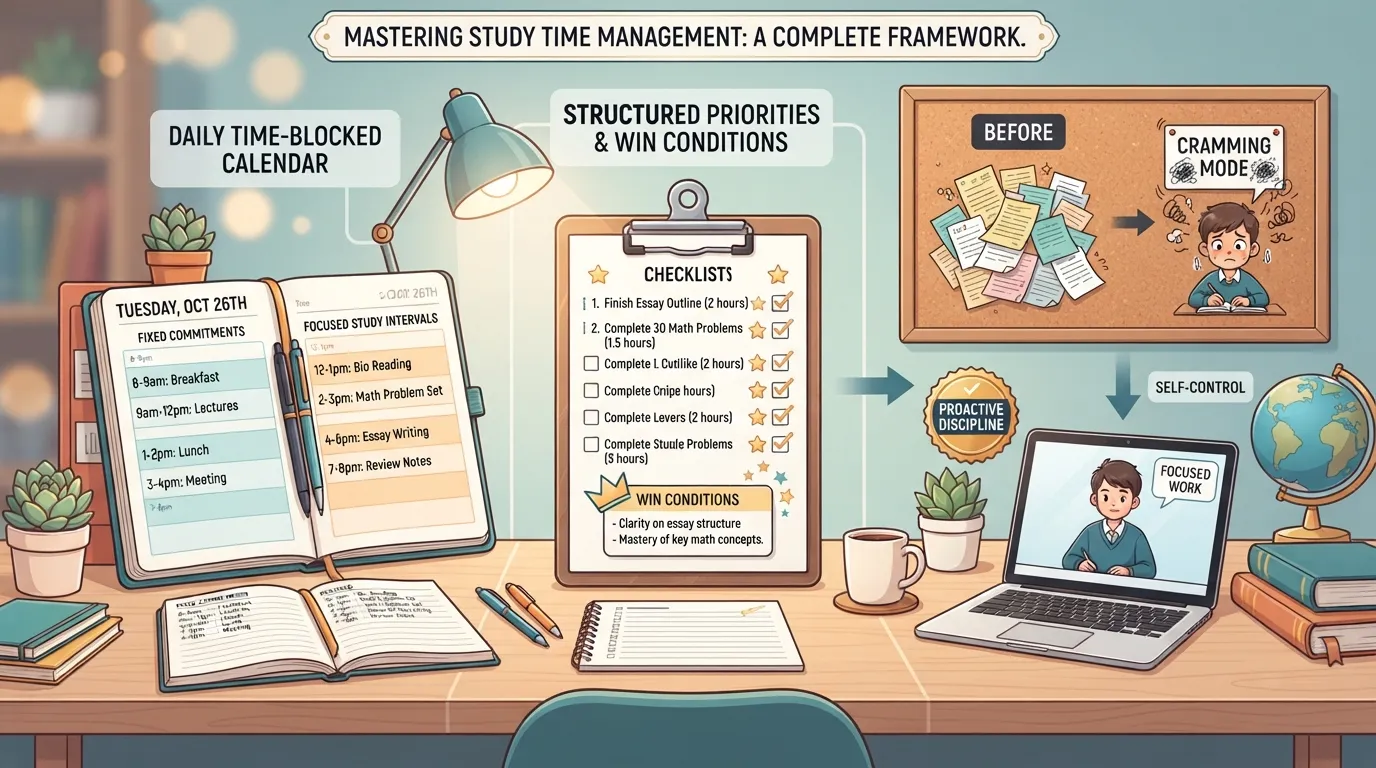
Study time management is the deliberate process of organizing, planning, and executing how you allocate your study hours across different subjects and tasks. It bridges the gap between raw potential and academic performance by ensuring every minute of effort contributes directly to learning goals.
Combines structured planning with intentional task prioritization to eliminate guesswork.
Maximizes cognitive output by aligning demanding subjects with your peak energy windows.
Shifts focus from simply studying harder to studying smarter and more strategically.
How Time Management Connects to Discipline
True discipline acts as the internal engine that powers effective time management, transforming good intentions into consistent daily action. While planning tells you what to do, discipline supplies the self-control required to override distractions and stick to your schedule when motivation fades.
Strengthens student engagement by holding you accountable to intentional focus periods rather than passive reading.
Replaces fleeting bursts of inspiration with reliable daily habits that compound over time.
Normalizes discomfort, making it easier to push past initial resistance and start difficult tasks.
The Real Cost of Poor Time Management
Ignoring time management triggers a compounding cycle of stress, inefficiency, and compromised academic results. Without a structured framework, students frequently fall into reactive traps that drain their energy and lower overall grades.
Chronic burnout: Constant all-nighters deplete mental stamina and trigger severe academic fatigue.
Diminished comprehension: Rushed cramming leads to surface-level memorization rather than deep, long-term retention.
Amplified anxiety: The looming pressure of unmanaged deadlines directly undermines confidence and exam performance.
Core Time Management Techniques Every Student Should Know
Mastering academic success requires moving past chaotic calendars and adopting proven, tactical frameworks. Implementing structured methodologies transforms vague study intentions into predictable, high-yield results.
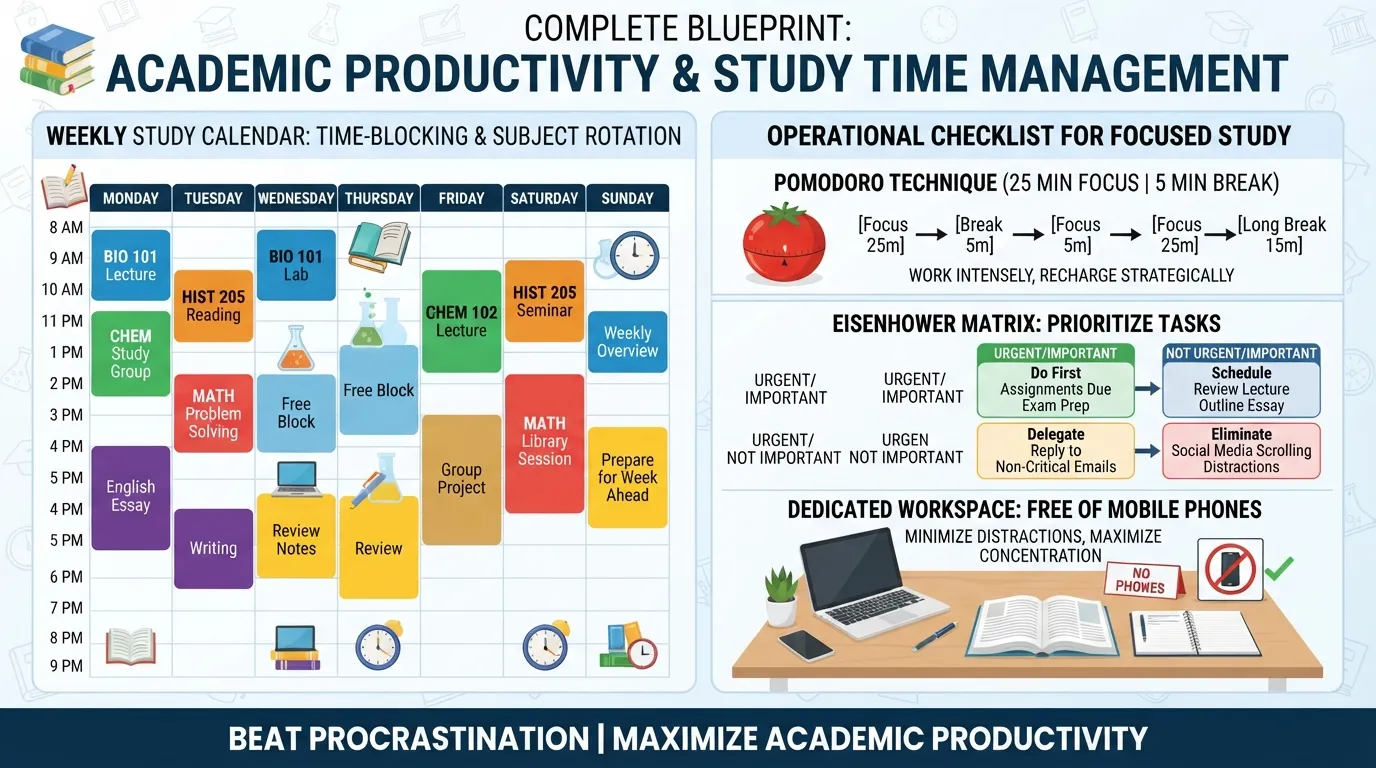
Time Blocking: Carve your day into rigid, dedicated chunks assigned to specific subjects to prevent operational drift.
The Pomodoro Technique: Alternate between hyper-focused intervals and short restorative breaks to protect your mental stamina.
The Eisenhower Matrix: Filter out administrative clutter by sorting academic demands through urgency and importance.
Time Blocking: Plan Your Day in Focused Chunks
Time blocking eliminates decision fatigue by mapping out your day before it starts. Instead of wondering what to study next, you dedicate fixed calendar slots to single, high-priority academic tasks.
Block off non-negotiable daily routines like classes, meals, and rest to expose your remaining open windows.
Assign distinct calendar blocks to specific subjects, treating each time slot like an unmissable appointment.
Transition seamlessly between tasks by establishing hard stops when your allotted block expires.
The Pomodoro Technique (25/5 Method) Explained
The Pomodoro technique harnesses short, structured focus intervals to keep cognitive burnout at bay. By working intensely for 25 minutes followed by a strict 5-minute break, you maintain high momentum without exhausting your brain.
Eliminates prolonged mental fatigue through scheduled, guilt-free micro-rest periods.
Lowers the psychological barrier to entry, making intimidating assignments feel approachable.
Keeps you anchored in the present moment by turning study time into a manageable sprint.
The Eisenhower Matrix: Sorting Urgent vs Important Tasks
The Eisenhower Matrix provides a strategic decision-making framework to evaluate your study backlog. It separates urgent tasks that demand immediate attention from truly important tasks that drive long-term mastery.
Urgent & Important: Crushing a deadline tomorrow or preparing for a surprise quiz.
Important, Not Urgent: Reviewing past lecture notes, outlining long-term essays, and building concept maps.
Urgent, Not Important: Responding to casual group chat messages about homework logistics.
Set “Win Conditions” for Every Study Session
Vague study plans trigger avoidance because your brain cannot process ambiguity. Establishing concrete win conditions defines an exact, measurable goal before you even open a textbook.
Replace vague goals like “study biology” with specific targets like “finish and mark 20 exam questions” [02:02].
Leverage Parkinson’s law by setting strict time limits, forcing your brain to work efficiently rather than dragging sessions out [06:39].
Stop working immediately once your target is met, training your brain to associate studying with satisfying completion [07:12].
Remove Distractions Before You Start
True productivity requires active distraction removal to safeguard your attention span from fragmentation [03:32]. Even having a smartphone visible on your desk drains cognitive energy through background resistance [04:05].
Move your phone entirely out of sight and reach to protect your working memory from micro-interruptions.
Silence non-essential notifications and close browser tabs unrelated to your current task block.
Prepare all necessary study materials beforehand to prevent mid-session wandering and loss of momentum.
Named Time Management Rules and Frameworks
Navigating complex academic schedules becomes significantly easier when you adopt proven conceptual frameworks. Utilizing established structural rules transforms abstract planning into foolproof daily habits that guarantee steady progress.
What Is the 7-8-9 Rule for Time Management?
The 7-8-9 rule is a daily pacing framework that divides a 24-hour day into three equal parts to balance responsibilities. It recommends dedicating 7 hours to sleep, 8 hours to focused work or school, and 9 hours to personal development, health, and relaxation.
Protects baseline cognitive performance by prioritizing adequate, non-negotiable nighttime rest.
Allocates a stable, dedicated block for high-intensity academic output without causing burnout.
Leaves ample white space for physical movement, social connection, and mental recovery.
What Is the 3-3-3 Rule for Time Management?
The 3-3-3 rule is a strategic task allocation method designed to conquer overwhelming to-do lists. It instructs you to spend 3 hours on your primary big project, accomplish 3 shorter secondary tasks, and knock out 3 maintenance chores daily.
Prevents decision fatigue by capping your daily high-effort commitments at a manageable limit.
Balances deep academic work with necessary administrative duties like organizing notes or emails.
Creates predictable momentum through a varied yet structured daily progression.
What Are the 5 P’s of Time Management?
The 5 P’s framework is a foundational mantra emphasizing that “Proper Planning Prevents Poor Performance.” It dictates that ultimate productivity relies entirely on anticipating obstacles, organizing resources, and preparing execution strategies well before action begins.
Eliminates mid-study friction by ensuring all tools and references are assembled beforehand.
Shifts your mindset from reactive scrambling to deliberate, calm execution.
Minimizes unexpected bottlenecks during high-stakes exam preparation phases.
What Are the Four Pillars of Time Management?
The four pillars of time management are awareness, goal setting, prioritization, and scheduling. Together, they create a comprehensive feedback loop that helps you audit how you spend hours and optimize future productivity.
Awareness: Tracking where your time actually goes to eliminate silent attention drains.
Goal Setting: Defining crystal-clear, measurable targets to give your brain direction.
Prioritization: Sorting tasks by true impact rather than superficial urgency.
Scheduling: Mapping out dedicated calendar blocks to protect your execution windows.
Elon Musk’s Time Management Method (Explained for Students)
Elon Musk’s method relies on “time blocking by exception” and “time boxing,” dividing the day into strict 5-minute or 10-minute micro-increments. Applied to students, it means accounting for every hour with zero dead space and fiercely defending those boundaries.
Treats time as a scarce physical currency that must be fully budgeted before the day begins.
Eliminates ambiguous transition periods where procrastination usually creeps in.
Encourages relentless efficiency by shrinking task windows to match exact output needs.
How to Manage Time When Studying Multiple Subjects
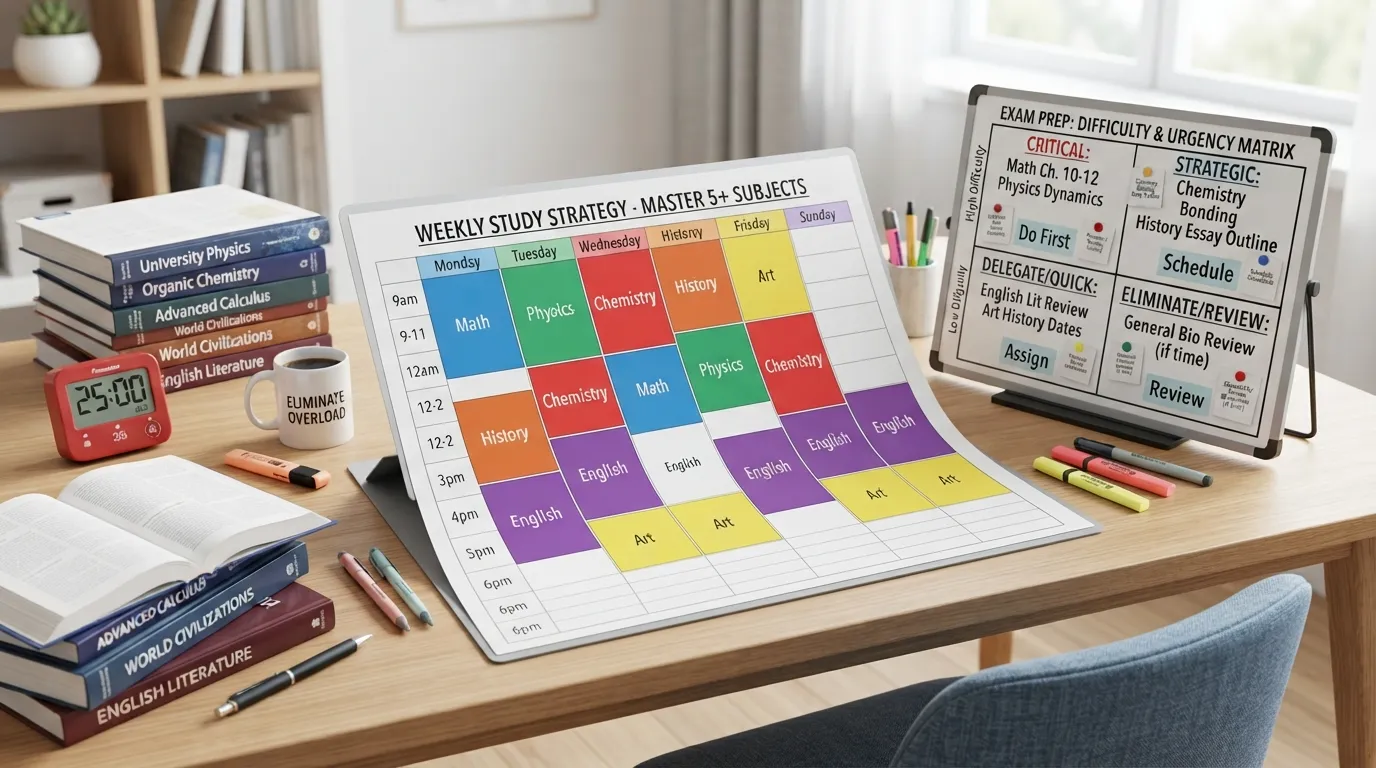
Juggling 5, 7, or even more subjects simultaneously creates immense cognitive overload, but you can conquer a massive syllabus load by abandoning daily cramming for structured rotational planning. Organizing your subjects into manageable groups prevents critical topics from slipping through the cracks during intense exam preparation.
Replaces frantic daily multitasking with predictable, focused subject rotation.
Lowers anxiety by breaking overwhelming course loads into manageable weekly quotas.
Ensures equal, balanced coverage across all your classes without burning out.
How to Divide Study Time Across Multiple Subjects
Dividing time across numerous subjects requires moving away from the mistake of trying to study every class every single day. Instead, group your courses into clusters and assign dedicated multiple subjects blocks on alternating days to protect your working memory.
Pair one heavy, analytical subject with one lighter, reading-intensive subject per study session to maintain high engagement.
Dedicate longer 60-to-90-minute windows to complex topics, and shorter 30-minute review blocks to lighter content.
Utilize weekends to catch up on overflow work or perform comprehensive cumulative reviews of the week’s material.
Prioritizing Subjects by Difficulty and Deadline
Strategic subject prioritization ensures your limited energy goes toward the topics yielding the highest academic impact. Evaluate your classes weekly based on upcoming test dates, grade weight, and personal comprehension struggles.
High Urgency & High Difficulty: Tackle these demanding subjects first during your peak morning or afternoon cognitive energy windows.
Low Urgency & High Difficulty: Introduce these foundational topics early in small, consistent daily increments to prevent last-minute panic.
Low Difficulty: Group these familiar subjects into shorter maintenance blocks later in the day when your focus naturally dips.
Sample Weekly Schedule for Students With 5+ Subjects
Building a realistic weekly study schedule anchors your intentions into a reliable routine that accommodates a heavy course load. A balanced weekly rotation ensures every class receives dedicated attention without overwhelming your calendar.
Monday & Thursday: Focus on your two hardest, most complex subjects using 90-minute deep work blocks and active recall techniques.
Tuesday & Friday: Rotate to your next two core subjects, pairing them with quick 30-minute vocabulary or flashcard review sessions.
Wednesday & Saturday: Dedicate these days to problem-solving practice, essay drafting, and reviewing weekly notes for remaining classes.
Sunday: Reserve this day for a light weekly review, organizing upcoming assignments, and complete cognitive rest.
Procrastination vs Distraction — Know the Difference
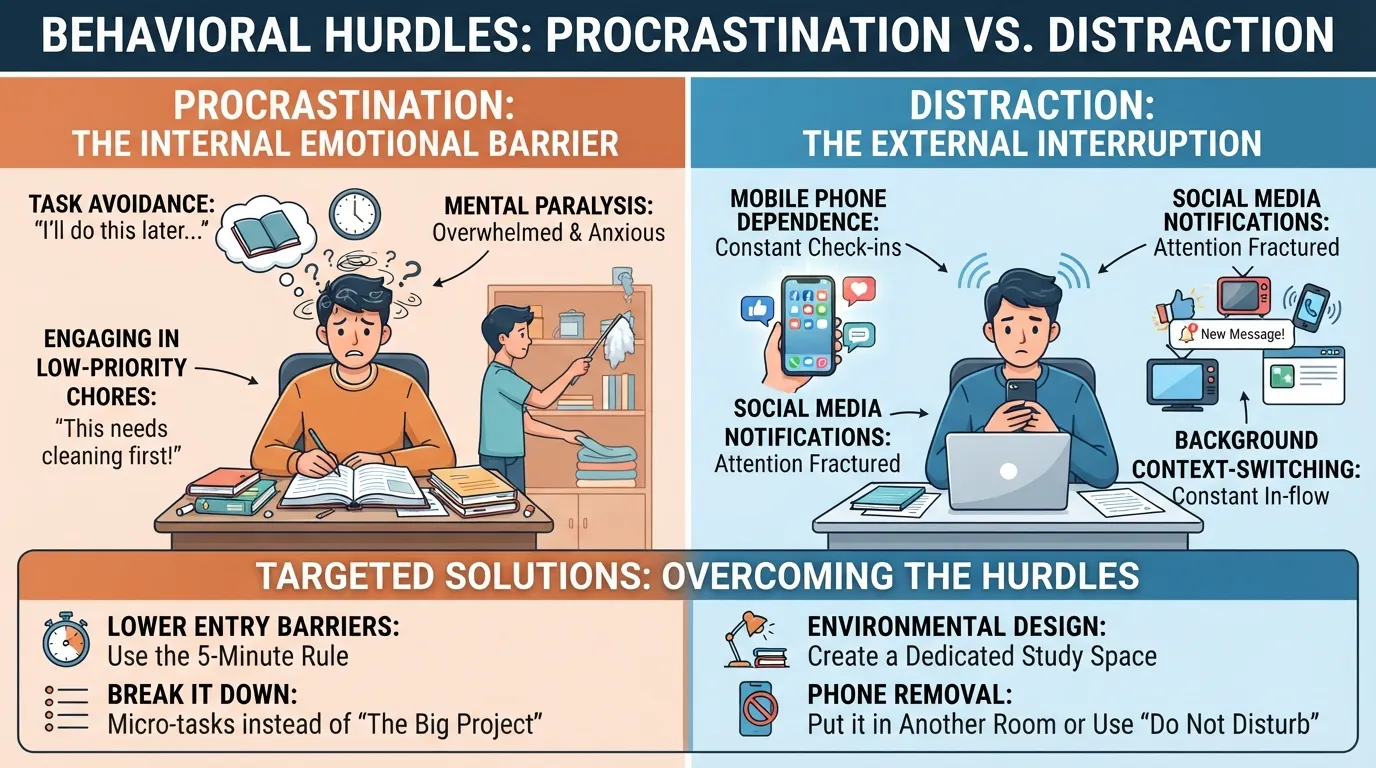
Procrastination and distraction are often lumped together, but they are fundamentally different psychological barriers that require entirely distinct solutions. Procrastination is an emotional avoidance of a task due to fear, overwhelm, or boredom, whereas distraction is an external interruption that hijacks your attention while you are already trying to study.
Treating procrastination like a simple distraction leads to failed time management strategies.
Recognizing the root cause allows you to apply the exact psychological tool needed to fix it.
Mastering both eliminates the hidden friction points that quietly sabotage your study sessions.
Signs You’re Struggling With Procrastination
Procrastination stems from internal resistance rather than a lack of time. If you find yourself endlessly cleaning your room, organizing digital folders, or staring blankly at a blank document instead of starting, you are fighting an emotional hurdle.
Task avoidance: Delaying the initiation of high-stakes assignments despite knowing the negative consequences.
Productive procrastination: Completing low-priority chores to trick yourself into feeling busy while avoiding the real work.
Mental paralysis: Experiencing heavy anxiety or self-doubt the moment you think about opening a specific textbook or essay prompt.
Signs You’re Struggling With Distractions
Distractions are external or internal noise points that pull you away from a task you have already started. This is frequently driven by mobile phone dependence, social media pings, or environmental interruptions that fracture your focus.
Frequent context switching: Jumping between your study material and social media feeds every few minutes.
Partial attention: Keeping tabs on group chats or notifications while attempting to read complex material.
Environmental triggers: Getting derailed by background noise, family members, or browser tabs left open from non-study activities.
Fixes for Each (Different Solutions for Different Problems)
Because procrastination and distraction attack different parts of your workflow, curing them requires tailored interventions that restore your self-control and protect your focus.
To fix procrastination: Lower the barrier to entry by committing to just 5 minutes of work, or break the project down into microscopic “win conditions” to eliminate overwhelm.
To fix distractions: Implement radical environmental design by placing your phone in another room, utilizing website blockers, and establishing a silent study zone.
To maintain momentum: Track whether your slip-ups stem from fear of failure (procrastination) or shiny object syndrome (distraction) to adjust your defense mechanism accordingly.
Personalized Study Routine — Build Your Own System
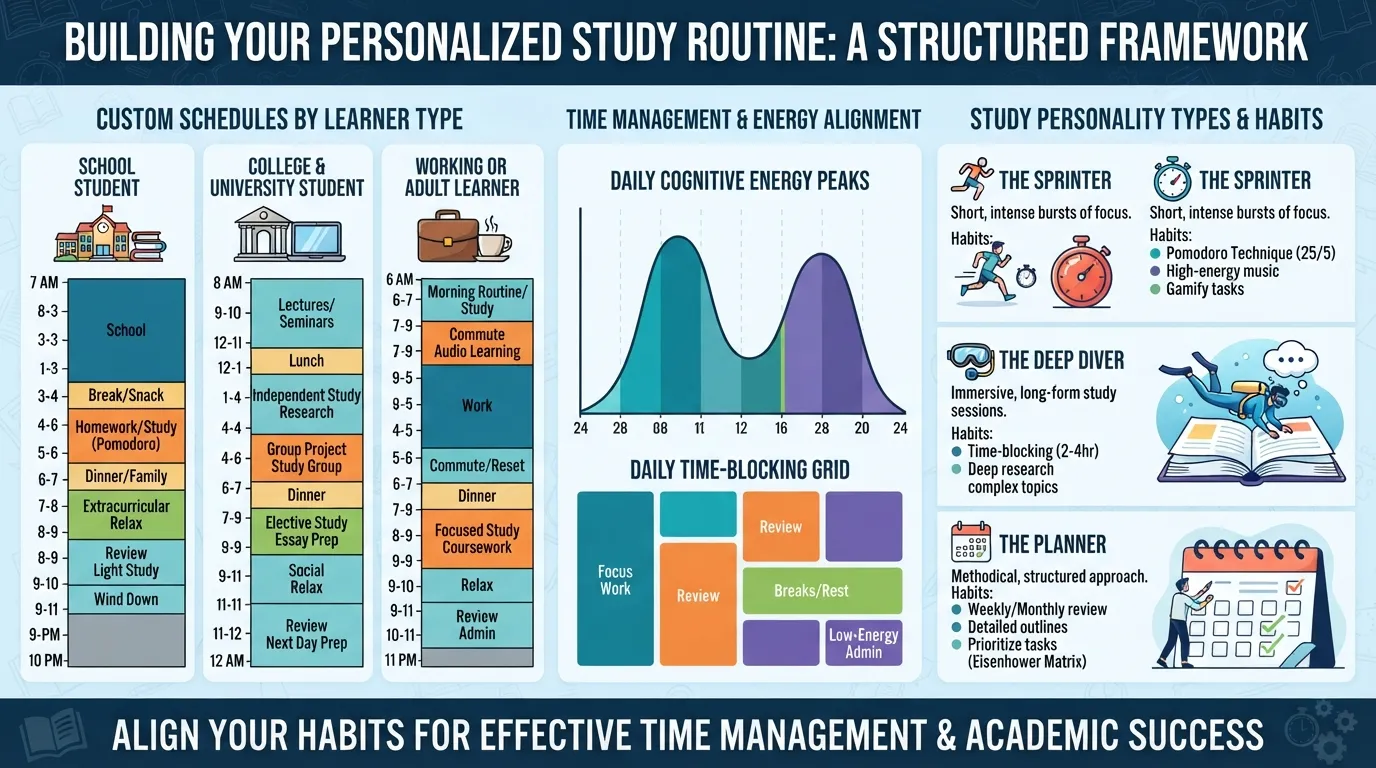
A truly effective personalized study schedule must account for your unique educational stage, daily bandwidth, and psychological triggers. Tailoring your approach ensures that your plan adapts to your life rather than forcing an unsustainable, generic template.
Aligns your daily commitments with your natural cognitive peaks to maximize energy efficiency.
Customizes interval structures to match the specific syllabus load of your current academic environment.
Backs up routine design with psychological frameworks proven to enhance student engagement and self-regulation.
For School Students
School students typically operate within a fixed daily timetable governed by secondary or high school attendance, leaving structured afternoon and evening blocks open for targeted review.
Build a 2-hour post-school decompression buffer before diving into homework to restore mental bandwidth.
Utilize 30-minute Pomodoro sprints for homework completion to prevent after-school fatigue from triggering procrastination.
Reserve weekends for consolidating weekly notes and previewing upcoming topics rather than full-day marathon cramming.
For College/University Students
Higher education features erratic class schedules, heavy independent reading loads, and extended blocks of unstructured time that require proactive management.
Convert open gaps between lectures into active study windows by camping in a library with pre-selected reading tasks.
Structure your week around deep work sessions rather than passive lecture transcription or endless highlighting.
Balance rigorous research projects with regular rest days to sustain long-term academic resilience.
For Working/Adult Learners
Balancing career duties, personal responsibilities, and continuing education demands an aggressive, highly efficient micro-scheduling framework.
Capitalize on early morning quiet hours or dedicated lunch breaks for high-focus micro-learning sessions.
Swap multi-hour evening study blocks for consistent 45-minute daily slots that compound knowledge steadily over time.
Treat professional and academic calendars as a unified ecosystem to avoid double-booking your cognitive energy.
Which Study Personality Are You?
Identifying your natural study personality helps you diagnose why standard routines fail and shows you how to adjust your habits for lasting success.
The Sprinter: Thrives on high-intensity, short-duration focus intervals (like 25/5 Pomodoros) but burns out quickly on long, open-ended tasks.
The Deep Diver: Prefers immersive 90-minute to 2-hour deep work blocks but struggles severely with task switching and unexpected interruptions.
The Overwhelmed Planner: Spends excessive time organizing aesthetic schedules and color-coding notes while avoiding the actual execution of hard material.
Tools and Templates to Make Time Management Easier
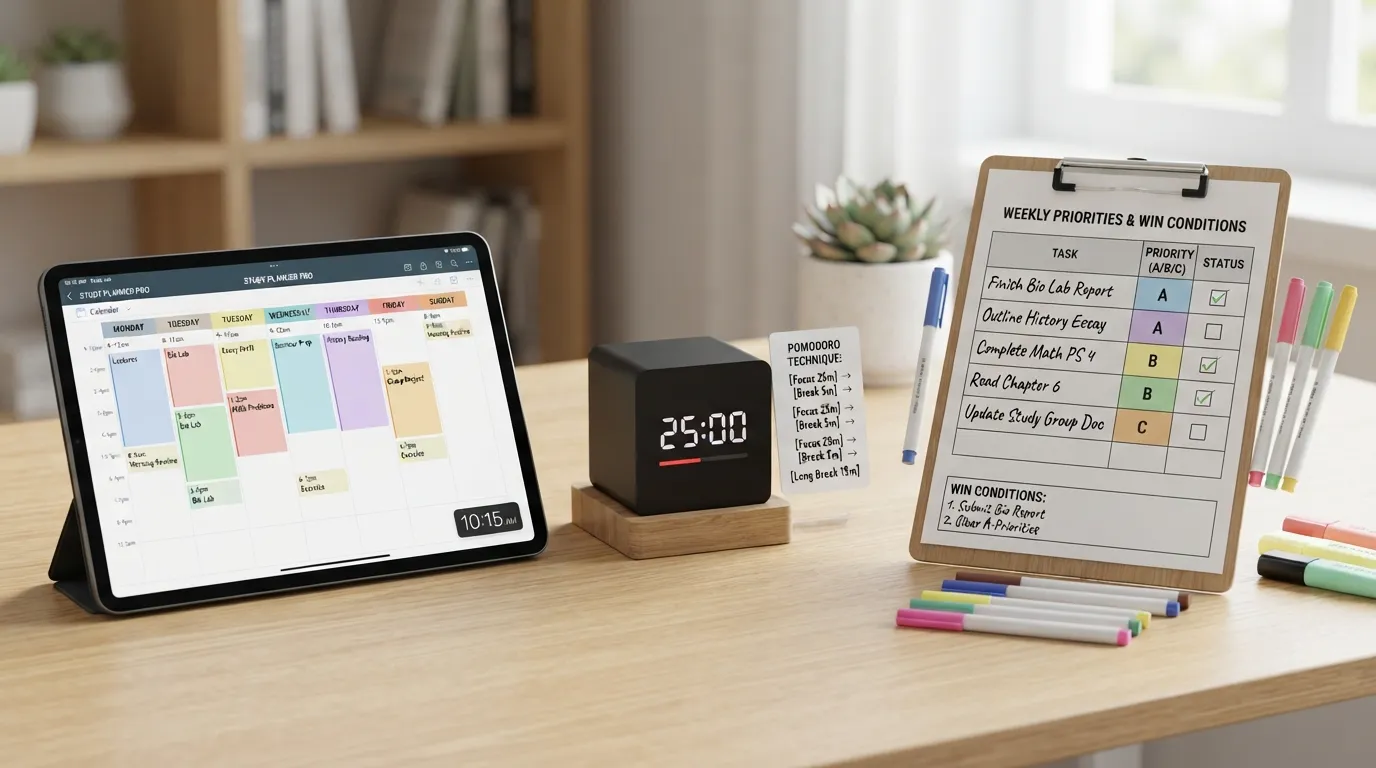
Leveraging the right time management tools eliminates the mental friction of manual scheduling and automates your academic tracking. Transitioning from abstract intentions to structured systems becomes seamless when you equip your workflow with reliable digital applications and printable frameworks.
Replaces chaotic mental notes with concrete, visual roadmaps for daily and weekly execution.
Streamlines your workflow by automating reminders, task prioritization, and break intervals.
Cuts down setup time so you can focus entirely on deep learning rather than administrative planning.
Simple Printable/Downloadable Study Schedule Idea
A physical layout or custom-drawn grid offers a tactile alternative to digital screens, helping you map your commitments without getting distracted by notifications. You can easily replicate this clean framework on a blank sheet of paper or in a spreadsheet.
The Weekly Matrix Grid: Draw a grid with columns for Monday through Sunday and rows divided into morning, afternoon, and evening blocks.
The Non-Negotiable Layer: Shade in your fixed commitments first—classes, meals, employment, and sleep—to expose your actual available study windows.
The Focus Allocation: Assign one core academic subject or project to each open block, pairing it with a specific, measurable win condition before the week begins.
Recommended Digital Tools
Modern software solutions can drastically reduce the administrative overhead of managing multiple classes, assignments, and exam calendars. Utilizing dedicated digital calendar platforms and focus aids keeps your entire academic life synchronized across devices.
Digital Calendar Apps: Centralize your lectures, study blocks, and personal deadlines into color-coded schedules with automated push notifications.
Dedicated Pomodoro Timer Apps: Utilize minimalist interval timers on your computer or phone to strictly enforce your 25-minute focus sprints and 5-minute breaks.
Task Managers and Digital Planners: Replace messy scratchpads with hierarchical to-do list applications that let you sort tasks using the Eisenhower Matrix or daily priority filters.
Common Mistakes Students Make With Time Management
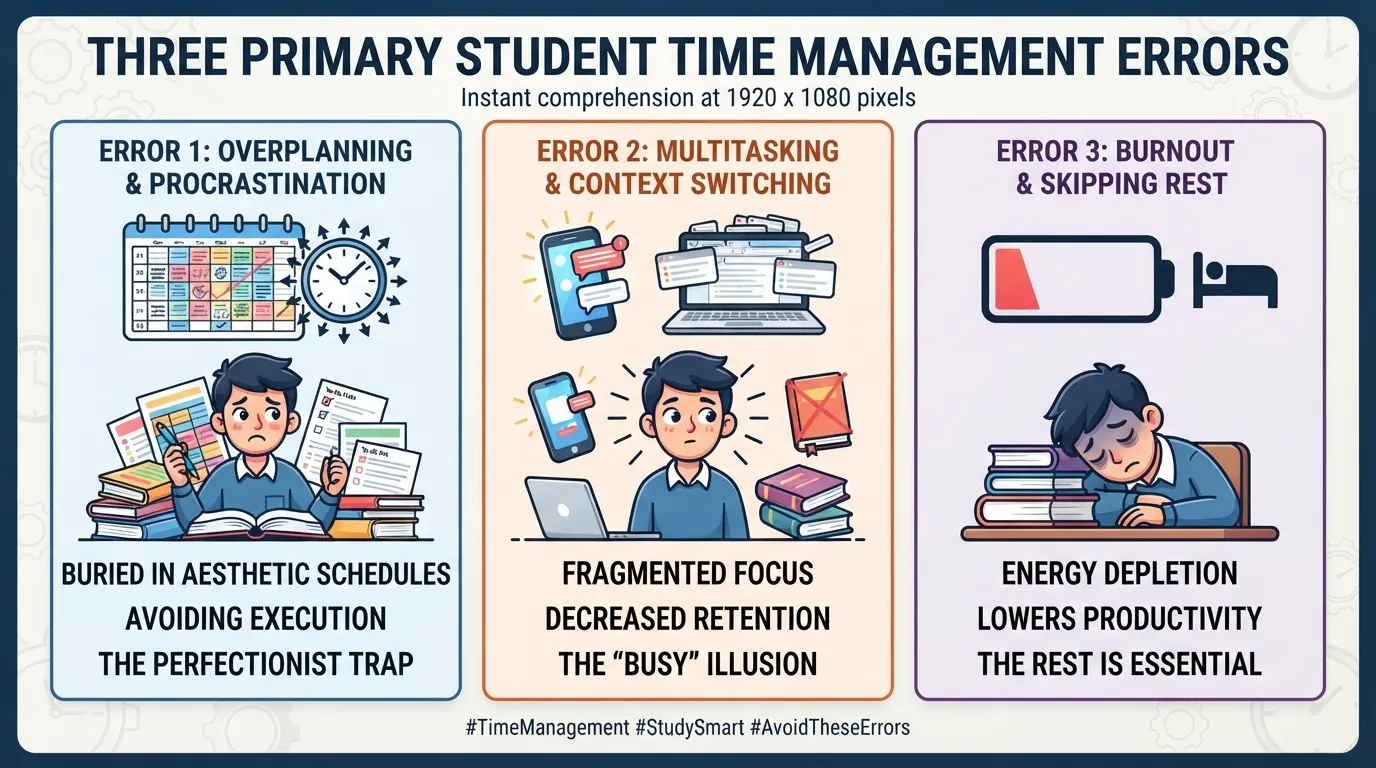
Even the most well-intentioned study plans can completely collapse if you fall into classic productivity traps. Avoiding these common pitfalls is essential for turning strict schedules into sustainable, high-performing academic habits.
Spotting these errors early prevents months of wasted effort and severe academic burnout.
Aligning your plans with actual execution ensures your discipline converts directly into better grades.
Streamlining your workflow removes hidden roadblocks that quietly drain your cognitive stamina.
Overplanning Without Execution
Many students spend hours creating aesthetic schedules, color-coding calendar apps, and organizing digital folders while completely avoiding actual studying. This “productive procrastination” creates a false sense of accomplishment without moving your academic progress forward.
Treats schedule design as a substitute for the hard work of deep learning and memory retention.
Leaves you overwhelmed when complex real-life variables disrupt an overly rigid timeline.
Drains mental energy on administrative setup instead of focusing on high-priority exam preparation.
Multitasking Instead of Focusing
Attempting to study while listening to lectures, checking group chats, and switching between multiple open tabs fragments your attention span. Human brains are biologically wired for single-tasking; switching tasks rapidly destroys comprehension and doubles completion time.
Drastically reduces your ability to encode information into long-term memory.
Extends study sessions by hours because your brain constantly resets after every interruption.
Triggers mental fatigue quickly, making simple reading assignments feel overwhelmingly difficult.
Ignoring Rest and Burnout Signs
Skipping rest breaks to cram for hours on end is a counterproductive strategy that backfires during high-stakes exams. Pushing through exhaustion degrades your cognitive processing speed and accelerates severe academic burnout.
Diminishes problem-solving capabilities and creative thinking when you need them most.
Normalizes chronic stress, which directly undermines confidence and long-term academic engagement.
Compromises your immune system and sleep quality, leading to unexpected sick days right before deadlines.
Frequently Asked Questions
How Do I Manage My Time for Study?
Mastering study time management requires replacing vague intentions with concrete daily priorities and structured blocks. Begin by setting a single, measurable win condition for each session, eliminating distractions like your phone, and using time-blocking techniques to protect your focus windows.
Set one explicit academic priority per day rather than an overwhelming to-do list.
Block out fixed commitments first to reveal your available study hours.
Stop working immediately once your specific session goal is met to prevent burnout.
What Are 10 Tips for Better Time Management?
Effective time management combines psychological discipline with tactical scheduling habits. Implementing these core strategies transforms chaotic cramming into a streamlined, high-performing study routine.
Set daily priorities: Focus on one major academic target every single day.
Use time blocking: Assign specific subjects to rigid calendar slots.
Leverage the Pomodoro technique: Work in intense 25-minute sprints followed by short breaks.
Eliminate phone distractions: Keep your device completely out of sight during focus blocks.
Define clear win conditions: Know exactly what “done” looks like before you open a book.
Apply the Eisenhower Matrix: Separate urgent tasks from truly important ones.
Embrace Parkinson’s law: Give tasks strict time limits so they don’t drag on.
Batch similar tasks: Group administrative or light review work together.
Protect your rest: Schedule non-negotiable downtime to maintain cognitive stamina.
Audit your schedule: Review what worked weekly and adjust your approach.
What Are the 7 Essential Time Management Skills?
Developing robust time management skills empowers you to control your calendar rather than letting deadlines dictate your life. These core competencies form the foundation of lifelong academic and professional success.
Prioritization: Discriminating between high-impact goals and low-value distractions.
Goal Setting: Translating massive semester requirements into achievable daily milestones.
Delegation/Reduction: Cutting out unnecessary commitments that drain your cognitive energy.
Organization: Maintaining structured workspaces and digital file systems.
Self-Control: Overriding emotional procrastination to start difficult tasks.
Focus Management: Defending your attention span against multitasking and interruptions.
Stress Regulation: Recognizing fatigue and implementing timely recovery breaks.
What Are the Best Time Management Tools?
The best tools are the ones that reduce administrative friction and keep your focus locked on learning. A balanced setup combines both digital applications and tactile frameworks.
Digital Calendar Apps: Google Calendar or Outlook for scheduling fixed blocks and reminders.
Interval Timers: Minimalist Pomodoro apps to strictly enforce focus sprints and rest periods.
Task Management Software: Todoist or Notion for organizing assignments by priority.
Physical Planners: Paper notebooks for handwritten weekly matrices and distraction-free planning.
What Are the Four Types of Time Management?
While individual styles vary, structural frameworks categorize time management into four primary behavioral approaches. Understanding your preference helps you choose the right planning system.
The Calendar-Driven Style: Relies heavily on rigid time blocking and strict daily schedules.
The List-Driven Style: Focuses on dynamic to-do lists, task checking, and priority ranking.
The Goal-Driven Style: Anchors every action to long-term milestones and specific outcomes.
The Flexible/Flow Style: Adapts fluidly to changing daily demands using short sprint blocks.
Building Discipline Through Time Management
Mastering study time management is ultimately about building sustainable discipline rather than rigidly color-coding calendars. When you replace chaotic cramming with deliberate, structured systems, you stop relying on fleeting bursts of motivation and start building reliable daily habits.
Consistency compounds over time. By defining clear win conditions, eliminating digital distractions, and respecting your rest periods, you transform academic pressure into predictable, long-term success.
Replaces overwhelming stress with calm, predictable daily execution.
Turns discipline from a difficult chore into an automatic, compounding routine.
Equips you with the cognitive stamina needed to conquer any academic challenge.
What is one time management technique from this guide you will implement in your study routine today?