Jump to:
ToggleTypes of Discipline: The Definitive Guide to Forms, Styles & Frameworks
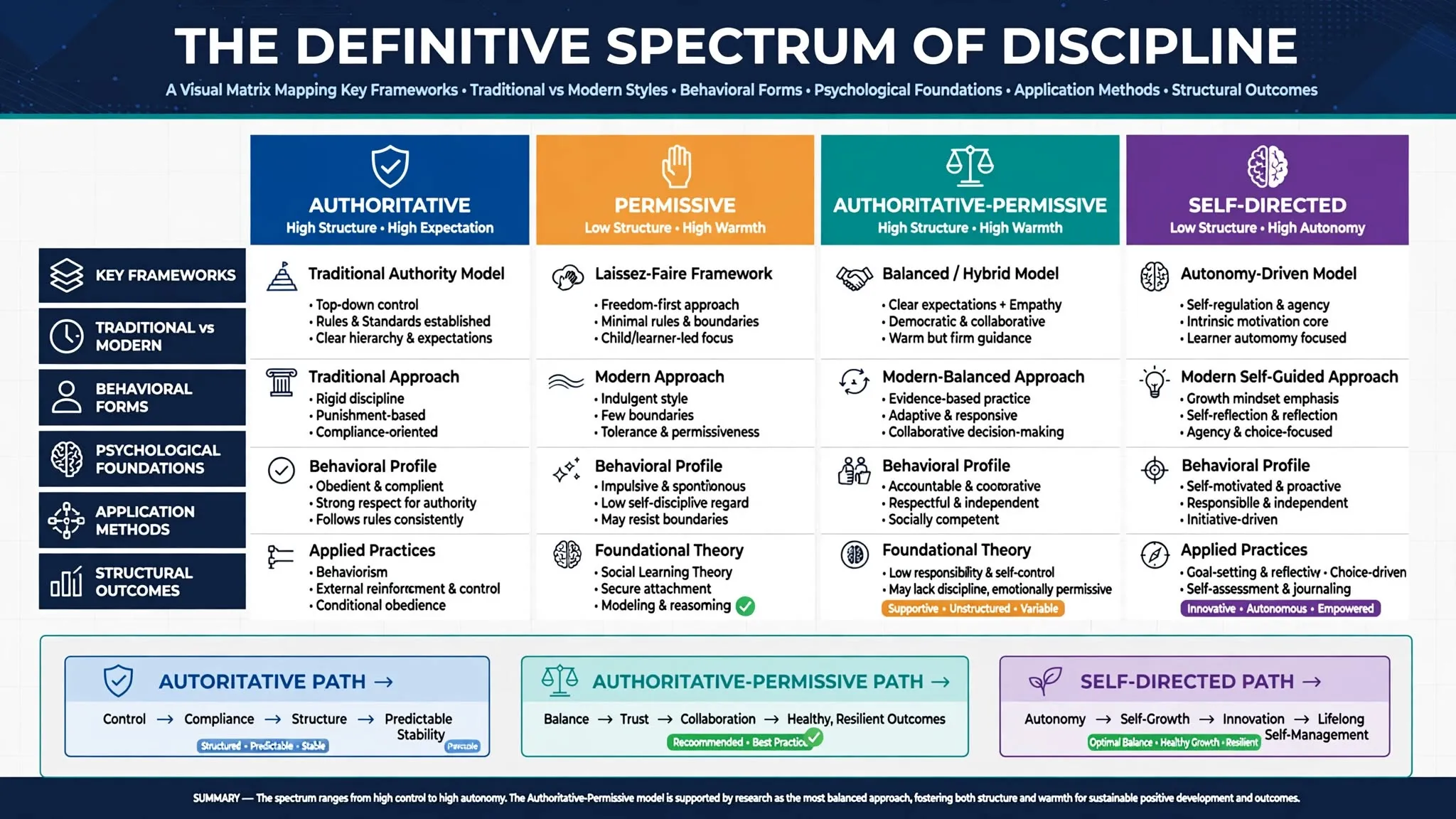
What Is Discipline & Why Types Matter
Discipline is the structural framework that governs human behavior, transforming abstract goals into consistent, daily execution. Without clear categorization, understanding how behavioral control operates becomes a guessing game of willpower.
What Does “Discipline” Actually Mean?
At its core, discipline definition revolves around controlled behavior, adherence to structured rules, and the capacity to delay immediate gratification for long-term rewards. It bridges the gap between intention and action, acting as the operational engine for habit formation and skill mastery.
Behavioral Regulation: The active management of impulses, time, and energy toward a designated standard.
Consistency Over Intensity: Prioritizing steady, repeatable routines rather than erratic bursts of high motivation.
Systemic Foundation: Establishing predictable patterns that eliminate decision fatigue in daily environments.
The Two Broad Categories: External Discipline vs. Self-Discipline
Human regulation fundamentally splits into two distinct operational buckets: structures imposed by outside forces versus those driven by internal volition. Recognizing this division clarifies whether behavior is sustained by rules/authority or internally motivated frameworks.
External Discipline: Governed by outside forces, including laws, organizational policies, parental guidance, and societal norms. It relies heavily on external rewards or consequences to enforce compliance and maintain order.
Self-Discipline (Self-Control): Rooted in internal autonomy, where an individual regulates their own actions without requiring oversight. It thrives on personal accountability, intrinsic values, and delayed gratification.
The Interplay: While external constraints build initial behavioral scaffolding, long-term mastery requires transitioning toward self-generated control to sustain growth independently.
Quick-Answer Table — Main Types of Discipline at a Glance
Navigating the various forms of discipline can be overwhelming due to overlapping terminology across psychology, education, and parenting. Organizing these frameworks into a single master index clarifies the exact application and intent behind each approach.
Table: Type | Category | Best Used For
| Type of Discipline | Category | Best Used For |
| Self-Discipline | Internal / Proactive | Personal goal attainment, long-term habit building, and intrinsic motivation. |
| External Discipline | External / Reactive | Establishing baseline safety, maintaining public order, and enforcing compliance. |
| Preventative Discipline | Proactive / Systems-Based | Designing environments and routines to minimize behavioral disruptions before they occur. |
| Supportive Discipline | Active / Guidance-Based | Providing gentle redirection, verbal cues, and continuous coaching during tasks. |
| Corrective Discipline | Reactive / Intervention-Based | Addressing policy violations or disruptive actions immediately after they happen. |
| Punitive Discipline | Reactive / Consequence-Driven | Imposing penalties or restrictions to deter severe or repeated infractions. |
| Natural Consequences | Experiential / Responsive | Allowing individuals to experience the direct, unmediated outcomes of their choices. |
| Logical Consequences | Structured / Responsive | Applying adult-designed outcomes that are directly relevant and proportional to a misbehavior. |
| Positive Time-Outs | Regulatory / Emotional | Providing a designated, calm space for emotional reset rather than social isolation. |
| Planned Ignoring | Passive / Behavioral | Withholding attention to extinguish minor attention-seeking or disruptive habits. |
What Are the Three Types of Discipline?
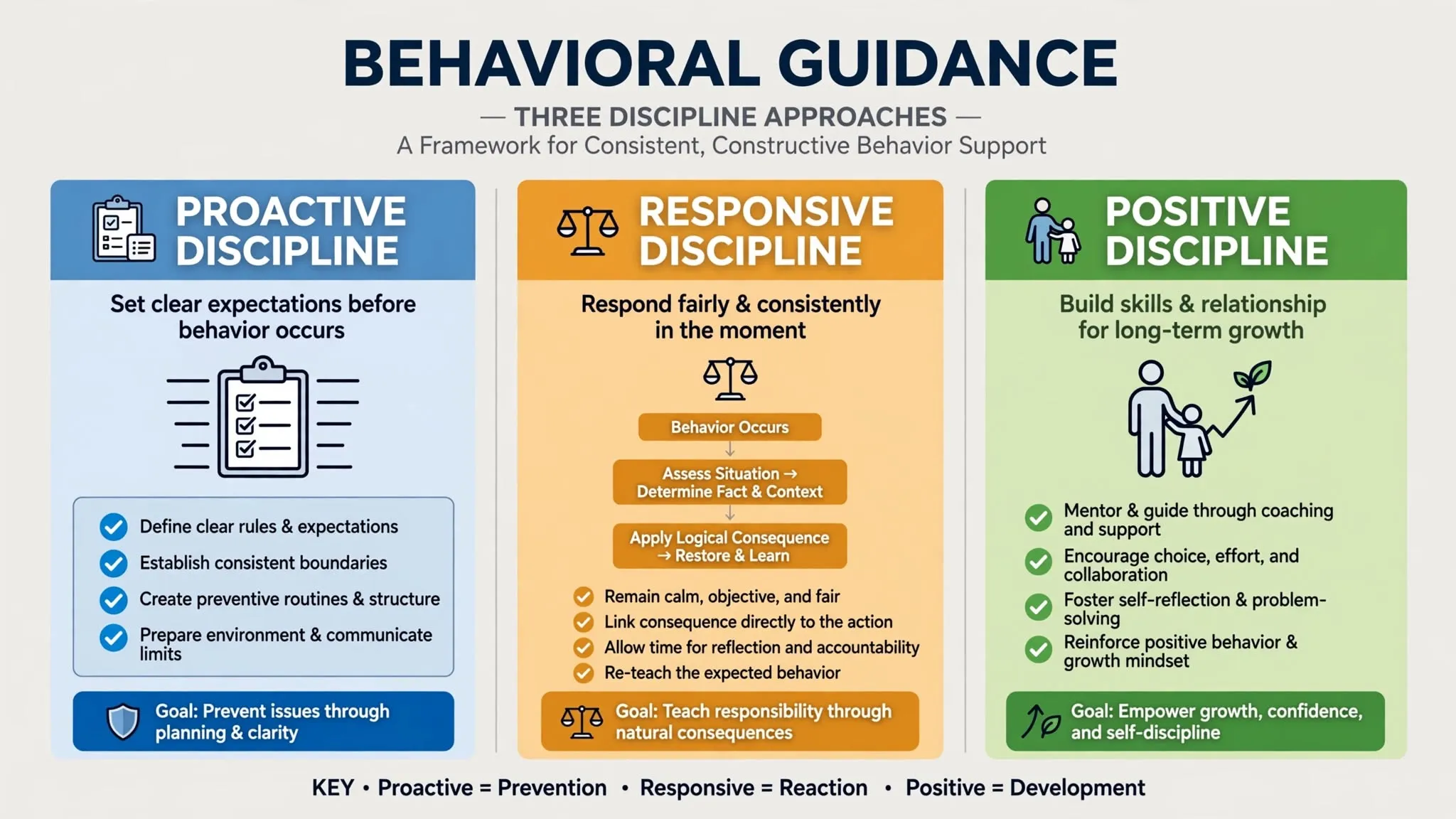
The three primary types of discipline most widely recognized in behavioral management and educational psychology are preventive, supportive, and corrective discipline. This triad forms a progressive continuum designed to stop issues before they start, guide individuals during tasks, and address disruptions effectively when they occur.
Preventive Discipline
Preventive discipline focuses on designing environments, establishing clear rules, and building predictable routines to stop behavioral issues before they start. By removing triggers and optimizing daily structures, this proactive approach minimizes the need for later intervention.
Clear Expectations: Establishing explicit, easy-to-understand rules and behavioral standards from day one.
Environmental Design: Arranging physical or digital spaces to reduce distractions and minimize friction.
Consistent Routines: Creating dependable schedules that provide psychological safety and predictability.
Supportive Discipline
Supportive discipline provides active guidance, non-verbal cues, and continuous coaching to help individuals stay on track when they begin to drift. It acts as an in-the-moment steering mechanism that redirects focus without imposing penalties or breaking rapport.
Non-Verbal Redirection: Using proximity, eye contact, or subtle hand gestures to signal a return to focus.
Verbal Prompting: Offering gentle reminders of expected standards while an activity is actively underway.
Scaffolding Independence: Assisting individuals just enough to let them course-correct under their own power.
Corrective Discipline
Corrective discipline intervenes immediately after a rule violation or disruption occurs, applying structured consequences to extinguish unwanted behavior. This reactive approach ensures accountability while teaching better decision-making alternatives for the future.
Immediate Accountability: Addressing infractions promptly so the link between action and consequence remains clear.
Proportional Penalties: Enforcing logical or pre-established consequences that match the severity of the disruption.
Restorative Follow-Up: Conducting a debrief or corrective conversation to ensure the individual understands why the behavior was unacceptable.
External & Parenting Discipline Types (Detailed Breakdown)
External and parenting discipline types shape how children and adults learn social boundaries, emotional regulation, and accountability. Navigating these strategies requires balancing immediate compliance with long-term behavioral development.
Corrective Discipline (Teaching, Not Punishing)
Corrective discipline focuses on teaching alternative behaviors rather than simply imposing penalties after a rule violation. By framing mistakes as learning opportunities, this approach builds internal problem-solving skills and reduces repeat infractions.
Skill-Building Focus: Identifying the missing skill or emotional trigger behind the misbehavior.
Active Guidance: Walking through alternative choices the individual can make in future scenarios.
Restorative Action: Encouraging the person to repair any harm caused by their actions.
Punitive Discipline (Risks & Why Experts Caution Against It)
Punitive discipline relies on harsh penalties, fear, and loss of privileges to force compliance and deter future misbehavior. While it may stop an unwanted action immediately, behavioral experts caution that it often damages trust and fails to teach lasting self-control.
Short-Term Compliance: Suppresses behavior out of fear rather than cultivating genuine understanding.
Escalation Cycle: Can trigger resentment, defiance, or secrecy rather than internal reflection.
Missed Teaching Moments: Fails to provide the individual with the tools needed to handle similar situations better next time.
Natural Consequences (Real-Life Experience)
Natural consequences allow individuals to experience the unmediated outcomes of their own choices without external interference. This experiential learning provides powerful, organic feedback from the environment itself.
Unfiltered Reality: The outcome happens naturally, such as feeling cold because a jacket was left behind.
Autonomous Learning: Encourages self-reliance by letting the environment teach the lesson.
Safety Boundaries: Only applicable when the natural outcome poses no risk of severe injury or danger.
Logical Consequences (Real-Life Example)
Logical consequences involve structured, adult-applied outcomes that are directly related, respectful, and proportional to the misbehavior. They connect the action to a meaningful remedy, such as cleaning up a mess made intentionally.
Direct Relevance: The consequence directly addresses the specific issue, like losing bike privileges for riding outside established boundaries.
Respectful Delivery: Administered calmly without shaming, yelling, or emotional outbursts.
Proportional Response: Kept reasonable to ensure focus remains on the lesson rather than the severity of the penalty.
Planned Ignoring (When & How It Works)
Planned ignoring is a behavioral strategy where attention is intentionally withheld to extinguish minor, attention-seeking habits. By refusing to reinforce disruptive actions, the behavior gradually decreases over time.
Targeted Application: Reserved strictly for minor nuisances like whining, interrupting, or attention-seeking posturing.
Consistent Execution: Requires complete withdrawal of eye contact, verbal response, and acknowledgment until the behavior stops.
Reinforcing Positive Alternates: Providing immediate praise and attention the moment the individual demonstrates calm, appropriate behavior.
Time-Outs (Age-Appropriate Use)
Time-outs provide a structured pause in a quiet, safe space designed to help an individual de-escalate emotional overload. When used as a regulatory reset rather than social isolation, they support emotional self-control.
Calming Environment: Utilizing a neutral, quiet spot focused on breathing and emotional reset rather than punishment.
Age-Appropriate Duration: Keeping intervals brief (typically one minute per year of age) to match developmental attention spans.
Post-Reset Connection: Following up with a brief discussion once the individual is fully calm to reinforce problem-solving.
Types of Self-Discipline (Active, Proactive, Reactive)
Self-discipline operates through distinct behavioral mechanisms that dictate how we manage effort, preparation, and unexpected stress. Understanding these specific modes of self-control allows you to deploy the right strategy depending on whether you are executing a task, building a long-term routine, or handling a crisis.
Active Discipline (In-the-Moment Action)
Active discipline is the conscious application of willpower to execute a task right now, especially when motivation is low. It requires overriding immediate impulses and forcing yourself to start or finish an obligation despite mental resistance.
Friction Elimination: Removing immediate distractions to make the desired action the easiest path forward.
The 5-Rule Execution: Committing to taking action immediately before your brain has time to talk you out of it.
Energy Management: Recognizing peak mental hours to tackle high-resistance tasks when cognitive reserves are highest.
Proactive Discipline (Planning Ahead)
Proactive discipline focuses on pre-deciding your actions and structuring your environment so you do not have to rely on raw willpower later. By anticipating future roadblocks, you design systems that make success automatic.
Pre-Planning and Scheduling: Blocking out dedicated calendar time for goals before competing demands arise.
Environment Design: Altering your physical and digital surroundings to prevent temptation before it appears.
If-Then Implementation Intentions: Creating conditional mental scripts that dictate your response to predictable obstacles.
Reactive Discipline (Staying Calm Under Pressure)
Reactive discipline is your psychological and emotional armor when unexpected chaos, stress, or setbacks hit. It governs your capacity to pause, regulate emotional turbulence, and respond with composure rather than impulsive reactivity.
The Pause Response: Inserting a deliberate delay between an external trigger and your internal reaction.
Stress Tolerance: Maintaining emotional equilibrium and focus when timelines collapse or plans fail.
Resilient Course-Correction: Assessing a mistake or setback objectively and pivoting without self-flagellation.
What Is Positive Discipline?
Positive discipline is a relationship-centered approach to behavioral guidance that prioritizes connection, mutual respect, and long-term skill-building over immediate control or fear. Rooted in frameworks popularized by educators like Jane Nelsen and modern child psychology, it views misbehavior not as willful defiance requiring punishment, but as an opportunity to teach emotional regulation, problem-solving, and accountability ([00:32]).
Core Principles of Positive Discipline
Positive discipline relies on establishing predictable environments while preserving emotional safety and dignity. It assumes that individuals behave well when they can, and lapses signal a missing skill rather than a character flaw.
Connection Before Correction: Building a secure relational bond first so the individual feels safe enough to accept guidance and reflect on their choices.
Firm and Kind Boundaries: Setting clear, unwavering limits delivered with warmth and respect, providing the psychological safety nets children and adults need to explore and grow ([04:16]).
Mutual Respect: Honoring the dignity of the individual by avoiding shaming, yelling, or authoritarian coercion during conflict.
Positive Discipline vs. Punishment
While traditional punishment focuses on stripping away privileges or inflicting pain to stop a behavior out of fear, positive discipline focuses on adding constructive learning experiences and proactive solutions ([00:52]).
Focus on Outcomes: Punishment asks, “How can I make them pay for this mistake?” whereas positive discipline asks, “What skill does this person need to handle this better next time?”
Relational Impact: Punishment often triggers resentment, secrecy, or defiance; positive discipline fosters trust, open communication, and internal accountability.
Long-Term Efficacy: Punitive measures only ensure short-term compliance under surveillance, while positive strategies cultivate sustainable internal self-control ([00:00]).
Practical Positive Discipline Techniques Parents Can Use Today
Applying positive discipline in daily life transforms routine power struggles into collaborative teaching moments. These actionable strategies help maintain household harmony without sacrificing accountability.
Offer Limited Choices: Provide two acceptable options to foster autonomy and cooperation, such as asking, “Do you want to brush your teeth before or after putting on your pajamas?”
Validate Feelings Before Setting Limits: Acknowledge emotional reality before enforcing a boundary, validating that it is okay to feel upset while holding the line on acceptable actions ([04:40]).
Focus on Progress Over Perfection: Celebrate small behavioral improvements and consistent effort rather than demanding flawless compliance, avoiding the frustration of impossible standards ([07:18]).
What Is Conscious Discipline? (Including in the Classroom)
Conscious Discipline is a comprehensive, brain-based social-emotional learning framework developed by Dr. Becky Bailey that integrates neuroscience, trauma-informed practices, and self-regulation into a unified system ([1.1.1, 1.1.2]). Grounded in an “adult-first” philosophy, it operates on the premise that before an adult or educator can teach a child how to manage emotions, they must first master their own internal state ([1.1.1, 1.1.2]).
The Core Idea Behind Conscious Discipline
The framework rests on the Brain State Model, which maps human behavior across three hierarchical neural states—the survival state, the emotional state, and the executive state ([1.1.1, 1.2.1]). Rather than treating misbehavior as willful defiance to be punished, Conscious Discipline reframes behavior as externalized communication of internal stress or missing developmental skills ([1.1.3, 1.1.4]).
Adult Self-Regulation First: Recognizes that children borrow our calm before they can generate their own, requiring educators and parents to self-regulate before intervening ([1.1.1, 1.1.2]).
The Hierarchy of Needs: Establishes that individuals must feel physically and psychologically safe before connection is possible, and connected before higher-order problem-solving can occur ([1.1.1, 1.2.1]).
Skill Over Compliance: Focuses on building internal emotional intelligence and conflict-resolution abilities instead of forcing temporary obedience through fear or rewards ([1.1.3, 1.1.4]).
How Conscious Discipline Works in the Classroom
In educational settings, Conscious Discipline transforms classroom management by replacing traditional punitive control systems with a unified, community-driven “School Family” model ([1.1.3, 1.1.4]). Teachers leverage daily routines, visual structures, and connection rituals to foster a cooperative climate where academic learning can thrive ([1.1.3, 1.2.1]).
Safe Place Setup: Designating a physical, calming area within the classroom equipped with deep-breathing tools and visual cues where students can independently reset when emotionally overwhelmed ([1.1.3]).
I Love You Rituals: Utilizing structured, playful, face-to-face bonding routines (such as rhythmic movement and eye contact) to build trust, reduce stress hormones, and anchor safety ([1.2.1]).
Active Co-Regulation: Responding to disruptions by stepping in as a calm anchor, using visual language and guided breathing to help students transition out of defensive survival states ([1.1.3, 1.2.1]).
Conscious Discipline vs. Traditional Discipline
Traditional discipline relies heavily on external management tools like rewards, demerits, time-outs, and punitive consequences to shape actions ([1.1.4]). Conscious Discipline shifts the paradigm entirely from external behavior control to internal self-mastery ([1.1.3, 1.1.4]).
The Core Mechanism: Traditional methods use fear, shame, or loss of privileges to force compliance; Conscious Discipline uses safety, connection, and coaching to teach new neural pathways ([1.1.1, 1.1.4]).
View of Conflict: Traditional models view rule violations as infractions requiring penalties; Conscious Discipline views them as teachable moments reflecting lagging social-emotional skills ([1.1.3, 1.1.4]).
Long-Term Impact: Punitive approaches cultivate short-term obedience under surveillance, whereas conscious frameworks build lifelong self-regulation, empathy, and resilience ([1.1.1, 1.1.3]).
For a deeper dive into the neurological foundations, research backing, and implementation guides, explore the official Conscious Discipline Methodology Hub ([1.1.1, 1.1.3]).
Discipline in the Military — Purpose & Meaning

Military discipline is an institutionalized framework of shared standards, immediate obedience, and organizational cohesion designed to maintain absolute operational readiness under extreme stress. Unlike personal or parenting frameworks focused on individual development, military discipline is engineered to ensure collective survival, synchronized execution, and absolute trust within a unit ([1.1.1, 1.1.2]).
Why Discipline Matters in the Military
The purpose of discipline in the military transcends mere rule-following; it is the fundamental mechanism that converts a group of individuals into a singular, highly reliable combat-effective force ([1.1.1, 1.1.3]). It ensures predictability and execution speed when chaos and friction threaten to disrupt operations.
Fostering Unshakable Trust: Building deep mutual reliance so service members trust their peers and leaders with their lives during high-risk missions ([1.1.2, 1.1.3]).
Habituating High Standards: Transforming complex tactical drills into second nature through rigorous repetition and standardization ([1.1.1, 1.1.3]).
Overcoming Self-Preservation: Equipping individuals to act decisively and execute orders despite fear, fatigue, or hostile environmental pressures ([1.1.1, 1.1.2]).
Order, Safety & Mission Readiness
Mission readiness relies on strict adherence to protocols, maintenance standards, and tactical procedures where a single oversight can compromise an entire operation ([1.1.3]). Institutional order serves as the structural bedrock for battlefield safety and tactical success ([1.1.1, 1.1.3]).
Chain of Command Integrity: Maintaining clear lines of authority to ensure orders flow without friction or hesitation across echelons ([1.1.2, 1.1.3]).
Preventative Maintenance: Enforcing rigorous upkeep of equipment and weapons systems to eliminate mechanical failure during critical deployments ([1.1.1, 1.1.3]).
Standardized Procedures: Utilizing uniform protocols so any unit member can seamlessly step into vital operational roles under fire ([1.1.1, 1.1.2]).
How Military Discipline Differs from Personal or Parenting Discipline
While self-discipline relies on intrinsic motivation and parenting focuses on nurturing emotional intelligence, military discipline is governed by institutional codes, external accountability, and collective necessity ([1.1.1, 1.1.2]).
Systemic Enforcement: Governed by explicit legal codes (such as the Uniform Code of Military Justice) where infractions carry formal, structured legal and career penalties ([1.1.2, 1.1.3]).
Collective Focus: Prioritizes the survival and mission success of the collective unit above individual comfort, preferences, or autonomy ([1.1.1, 1.1.3]).
External Instantiation: Built from the outside in through rigid boot camp conditioning, ritual, and standardization before transitioning into internal professional pride ([1.1.1, 1.1.2]).
Progressive Discipline in the Workplace
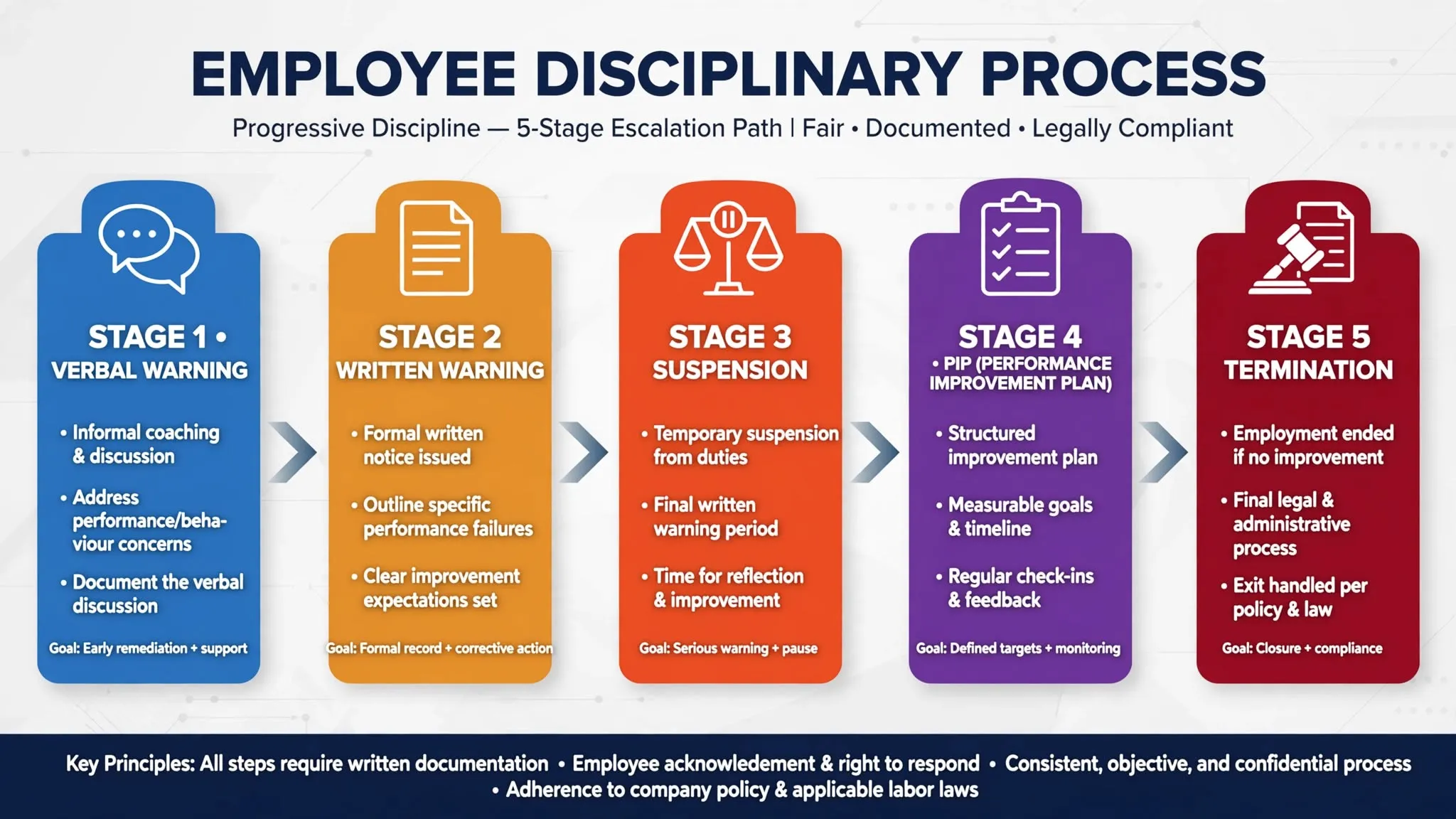
Progressive discipline is a systematic human resources framework designed to address employee performance or conduct issues through a graduated series of corrective actions. Rather than relying on immediate termination, this structured approach gives workers clear, documented opportunities to correct deficiencies while protecting organizations from legal and operational liability.
What Is Progressive Discipline?
Progressive discipline operates as an educational and corrective process that scales in severity depending on whether a workplace infraction is repeated or egregious. It replaces arbitrary managerial reactions with a predictable, transparent policy that prioritizes coaching and documented improvement.
Clear Expectations: Providing explicit written policies so employees understand performance standards from day one.
Documented Intervention: Creating an objective paper trail that records dates, specific infractions, and agreed-upon remediation steps.
Fair Opportunity: Giving workers a reasonable window to improve before escalating consequences.
Typical Steps: Verbal Warning → Written Warning → Suspension → Termination
A standard progressive discipline policy follows a sequential escalation path designed to signal increasing urgency while maintaining due process ([1.1.1, 1.1.2]). Each step serves as a formal checkpoint to ensure both parties understand the stakes ([1.1.1, 1.1.2]).
Verbal Warning: A documented informal conversation between the supervisor and employee addressing a minor infraction, outlining expected changes without formal penalty ([1.1.1]).
Written Warning: A formal document placed in the employee’s personnel file outlining the recurring issue, specific policy violations, and required corrective actions by a set deadline ([1.1.1, 1.1.2]).
Suspension: A temporary, often unpaid removal from work duties that signals severe non-compliance and serves as a final wake-up call ([1.1.1, 1.1.2]).
Termination: The final step, executed when all previous interventions fail to yield corrective improvement, ending the employment relationship ([1.1.1, 1.1.2]).
Why Employers Use a Progressive Approach
Organizations implement progressive discipline because it balances operational fairness with risk management, fostering a stable and legally defensible workplace culture ([1.1.1, 1.1.3]).
Legal and Compliance Protection: Demonstrates to labor boards and courts that employment decisions were fair, documented, and non-discriminatory ([1.1.1, 1.1.3]).
Retention and Retraining ROI: Salvages valuable talent by investing in coaching and remediation rather than prematurely firing trained staff ([1.1.1, 1.1.2]).
Consistent Accountability: Eliminates supervisor bias by enforcing standardized company-wide responses to behavioral or performance gaps ([1.1.1, 1.1.3]).
Why School Discipline Matters
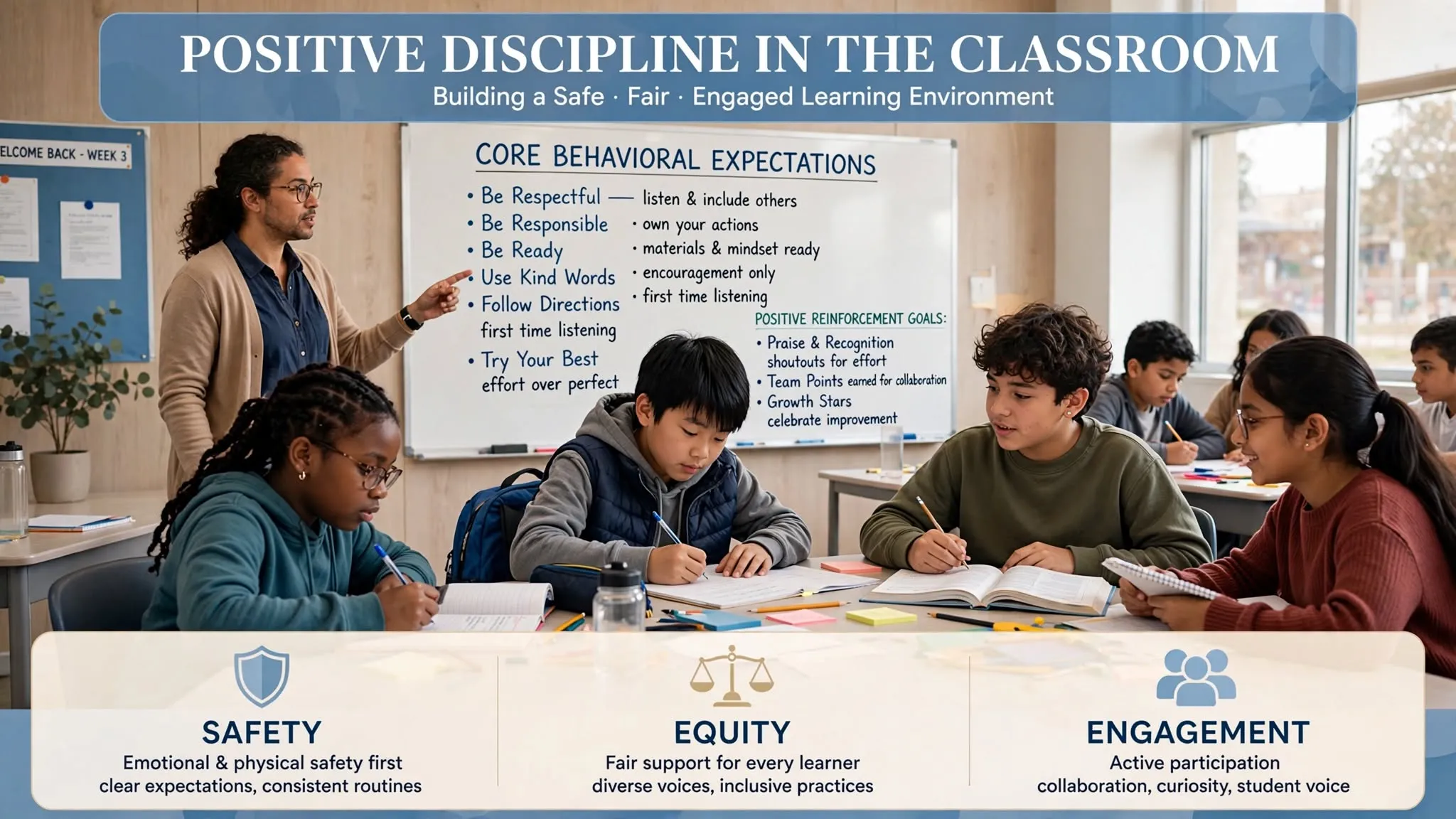
School discipline provides the foundational framework necessary for academic instruction, physical safety, and social-emotional development across educational institutions. Far beyond simple rule enforcement, a well-structured disciplinary approach creates a secure, predictable environment where students can focus on learning without disruption.
Academic & Behavioral Benefits of School Discipline
Consistent and fair discipline policies directly improve academic performance and student outcomes by establishing an orderly climate conducive to concentration. When expectations are clear, instructional time increases and classroom distractions plummet.
Optimized Learning Time: Minimizes instructional downtime caused by unresolved behavioral disruptions or chaotic transitions.
Psychological Safety: Fosters an inclusive, secure atmosphere where students from diverse backgrounds feel protected and respected.
Equitable Accountability: Ensures that behavioral standards are applied fairly across the student body, closing achievement and discipline gaps.
Building Long-Term Self-Regulation Skills
Effective modern school discipline shifts the focus from punishment to skill-building, teaching students how to manage their impulses and resolve conflicts peacefully. These foundational habits translate directly into lifelong emotional intelligence and civic responsibility.
Conflict Resolution: Equips students with restorative tools to address disagreements through communication rather than aggression.
Internal Accountability: Encourages learners to understand the impact of their choices rather than merely complying out of fear of detention.
Delayed Gratification: Strengthens patience and focus, helping students persevere through rigorous academic and personal challenges.
FAQs — Quick Answers to Common Discipline Questions
Navigating the nuances of behavioral management often raises specific questions regarding frameworks, frameworks, and terminology variants. These direct answers clarify common points of confusion across educational, psychological, and institutional contexts.
What Are the Four Types of Discipline?
The four primary types of discipline most frequently cited in developmental frameworks include preventive, supportive, corrective, and punitive discipline. Preventive and supportive approaches focus on proactive environment design and guidance, while corrective and punitive interventions address infractions after they occur.
Preventive: Establishing rules and routines before issues arise.
Supportive: Providing in-the-moment coaching and redirection.
Corrective: Enforcing logical consequences to teach alternative behaviors.
Punitive: Imposing penalties or restricting privileges to deter repeat actions.
What Are the Five Types of Discipline?
When expanding the classic behavioral model, child development and parenting experts often identify five distinct forms of discipline. This expanded set includes preventive, supportive, corrective, natural consequences, and logical consequences.
Preventive and Supportive: Proactive structures and continuous guidance.
Corrective: Direct intervention following a rule violation.
Natural and Logical: Experiential learning through organic outcomes or structured, adult-applied solutions.
What Are the 10 Types of Discipline (for Students)?
Classroom management models utilize a diverse mix of strategies to maintain an effective learning environment across varying student needs. The 10 recognized forms of student discipline span proactive systems and reactive interventions.
Preventive, Supportive, and Corrective Discipline as foundational classroom tiers.
Positive Discipline and Conscious Discipline for social-emotional growth.
Natural and Logical Consequences for experiential accountability.
Punitive Discipline for severe policy violations.
Planned Ignoring and Time-Outs for managing minor disruptions and emotional resets.
What Are the Seven Powers of Discipline?
Rooted in Dr. Becky Bailey’s Conscious Discipline framework, the seven powers of discipline are internal mental shifts that adults must master to effectively guide others. They transition the educator from a mindset of control to a mindset of connection.
Perception: Realizing that no one can make you angry without your consent.
Unity: Recognizing that we are all connected and sharing a safe space.
Attention: Directing focus to what you want to see happen.
Free Will: Understanding that the only person you can change is yourself.
Acceptance: Embracing the present moment exactly as it is.
Love: Offering unconditional regard to create a safe learning climate.
Intention: Choosing a response based on internal calm rather than emotional reaction.
What Is the Highest Form of Discipline?
Self-discipline is widely regarded as the highest form of discipline because it requires internal autonomy, emotional regulation, and intrinsic motivation rather than external coercion. Operating without the need for surveillance or fear of punishment, true self-control empowers individuals to align daily actions with long-term personal values.
Intrinsic Autonomy: Governed by internal standards rather than outside rules or authority.
Delaying Gratification: Consistently choosing long-term rewards over short-term impulses.
Unsupervised Integrity: Maintaining high standards and productivity even when no one is watching.
What Are the Three C’s of Discipline?
The three C’s of positive and effective discipline stand for Connection, Consistency, and Choice. These three pillars ensure that behavioral guidance remains respectful, predictable, and empowering.
Connection: Fostering a secure relationship so the individual feels valued and receptive to guidance.
Consistency: Maintaining steady, predictable boundaries and follow-through to build trust.
Choice: Providing controlled autonomy within limits to encourage internal decision-making.
What Is Domestic Discipline?
Domestic discipline refers to a structured, consensual agreement within a household where one partner assumes an authoritative role to manage rules, compliance, and household organization. Operating entirely on mutual consent and established boundaries, it focuses on domestic structure rather than professional or clinical management.
What Is Trigger Discipline?
Trigger discipline is a firearm safety practice where a shooter keeps their index finger straight and completely outside the trigger guard until they have made the conscious decision to fire. While sharing the word “discipline,” it is a tactical safety protocol entirely unrelated to behavioral psychology or self-control.
Conclusion — Choosing the Right Type of Discipline
Navigating the spectrum of behavioral management ultimately comes down to matching your strategy to the specific environment, objective, and developmental stage of the individual. Whether you are guiding a classroom, leading a professional team, or building personal habits, the right approach bridges the gap between immediate safety and long-term growth.
Key Takeaways by Context (Parent / Teacher / Manager / Self)
Selecting the most effective discipline style requires understanding the unique dynamics of your specific role. Each context demands a tailored blend of structure, empathy, and accountability.
For Parents: Prioritize positive and logical discipline techniques to build emotional safety, teaching kids why rules matter rather than relying purely on fear-based punishment.
For Teachers: Combine preventive routines with conscious discipline and supportive interventions to maintain an orderly, trauma-informed learning environment ([1.1.3]).
For Managers: Implement a transparent progressive discipline policy in the workplace to protect organizational standards while offering fair, documented paths for performance improvement.
For Personal Growth: Shift from reactive willpower to proactive discipline by designing your daily environment and pre-planning habits that make success automatic.
Kittisak Wattanakul
Kittisak Wattanakul is the Discipline Editor at Holistic Wellbeing Living. He writes about routines, focus, consistency, and practical follow-through. With nine years of experience creating personal-growth content, Kittisak helps readers build realistic systems for steady progress without extreme productivity pressure.