Jump to:
ToggleStrong Goal: How to Set and Achieve Goals That Actually Work
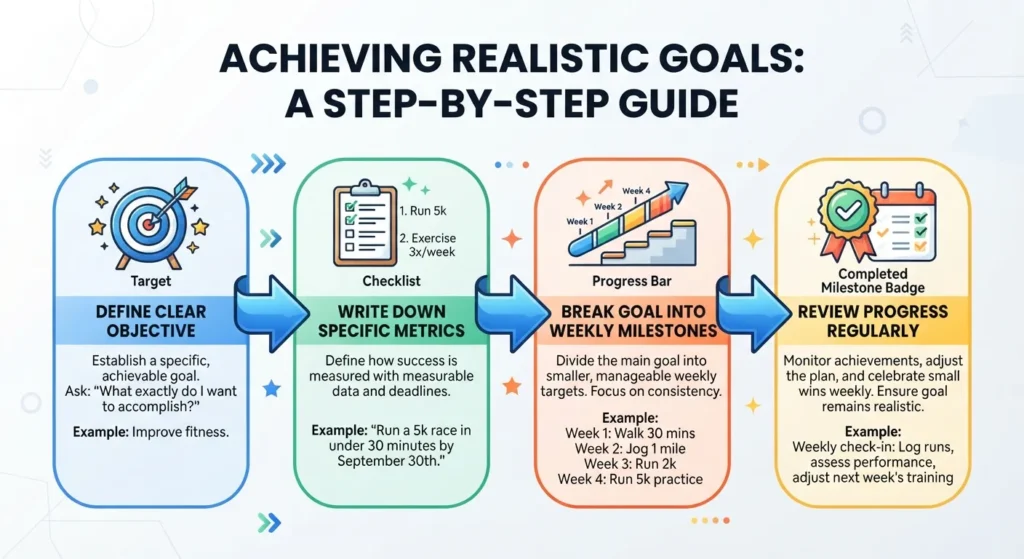
What Makes a Goal "Strong"
Most goals fail not from a lack of desire, but from a fatal structural flaw: they are vague aspirations rather than operational frameworks. A weak goal relies entirely on fleeting willpower and ambiguous intentions, while a strong goal functions as a precise navigational instrument that dictates daily behavior, measures tangible progress, and survives inevitable friction.
Understanding the mechanics of effective goal-setting requires looking closely at how cognitive architecture interacts with behavioral design. When you transition from a passive wish to a structured target, you trigger psychological commitment devices that drastically increase execution rates.
Behavioral Specificity: Strong goals eliminate ambiguity by defining the exact action, frequency, and context required for completion.
Measurable Feedback Loops: Effective targets include built-in metrics that provide instant visibility into whether you are winning or losing on a daily basis.
Intrinsic Alignment: Goals that survive long-term scrutiny connect directly to deeper personal values rather than superficial external pressures.
Resource Realism: A robust framework accounts for existing constraints, bandwidth limitations, and potential obstacles before execution begins.
The foundational shift from traditional frameworks like generic SMART goals to modern, high-performance execution involves building systemic guardrails. Instead of focusing solely on the final outcome, a strong goal transforms the end result into a byproduct of disciplined, repeatable daily systems.
Core Characteristics of a Strong Goal — The SMART Framework
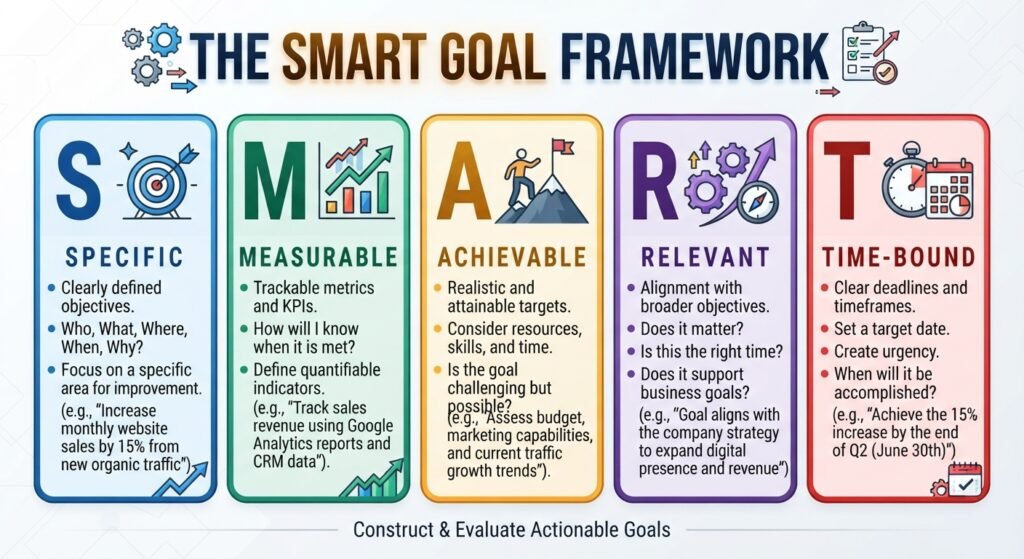
The SMART framework provides the bedrock structure for turning abstract ambitions into executable targets. Originally pioneered by George T. Doran, this methodology ensures that every goal possesses the structural integrity required to survive real-world friction and maintain momentum.
Specific: Define Exactly What You Want
A specific goal eliminates ambiguity by answering the fundamental questions of what you want to accomplish, why it matters, and who is involved. Vague targets like “get better at marketing” leave too much room for interpretation, whereas precise instructions trigger immediate cognitive alignment.
Use strong action verbs such as publish, launch, write, or reduce instead of passive verbs like try or improve.
Pinpoint the exact deliverable or outcome you expect to see upon completion.
Remove any overlapping interpretations so anyone reading the goal understands the exact objective.
Measurable: Track Progress With Real Numbers
Measurable goals include exact metrics that remove guesswork from your daily evaluation. Without quantifiable milestones, you cannot objectively determine whether you are winning or falling behind, making course-correction impossible.
Attach hard numbers, percentages, or financial sums to your objective (e.g., increase subscriber count by 15%).
Establish baseline metrics so you know your exact starting point before tracking movement.
Build in frequent check-ins to evaluate performance against your target numbers.
Achievable: Realistic Within Your Resources
An achievable goal balances ambition with operational reality to prevent burnout and premature abandonment. While targets should stretch your capabilities, they must remain grounded in your current access to time, capital, and skill sets.
Audit your current constraints, such as weekly hours available or budgetary limits, before committing.
Break massive long-term ambitions down into smaller, manageable increments.
Ensure you possess or can realistically acquire the necessary tools required to cross the finish line.
Relevant: Aligned With Your Bigger Vision
A relevant goal ensures that your daily energy serves a larger, meaningful purpose rather than distracting you with low-leverage tasks. Every target must matter to your overarching personal or professional trajectory to sustain long-term motivation.
Connect the immediate objective to your core values and long-term strategic plan.
Ask whether achieving this specific target moves the needle on your broader priorities.
Discard goals that feel impressive to others but fail to serve your genuine direction.
Time-Bound: Set a Clear Deadline
A time-bound goal anchors your target in reality by establishing a definitive deadline that creates healthy urgency. Deadlines prevent endless procrastination and force prioritization when competing demands threaten to derail your focus.
Set a hard calendar date for final completion rather than relying on open-ended timelines.
Establish interim milestone deadlines for multi-month or multi-year projects.
Build a daily or weekly schedule that reverse-engineers the timeline from your final deadline.
Beyond SMART — Additional Traits of High-Impact Goals
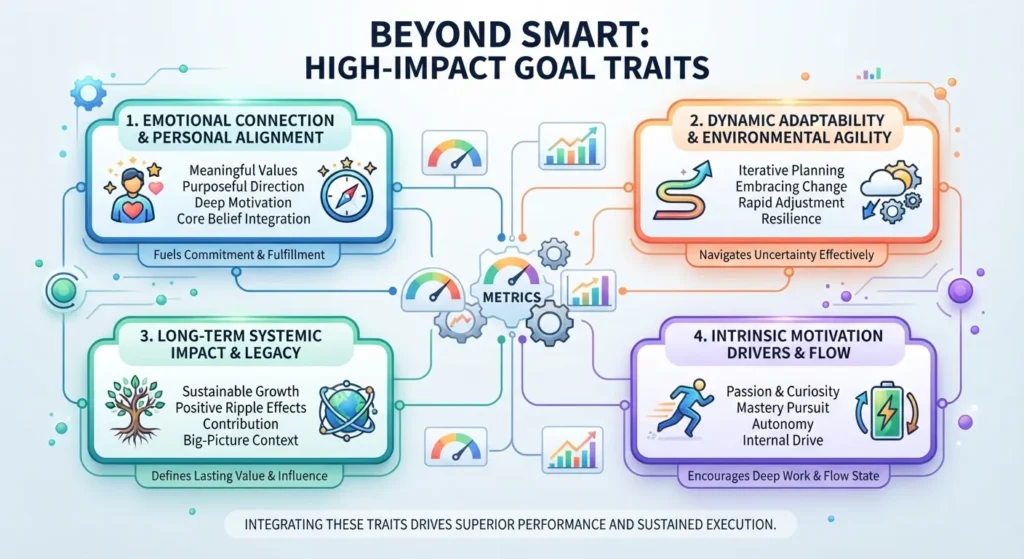
While the SMART framework provides a reliable structural baseline, elite performers incorporate three additional psychological and practical layers to maximize execution. Integrating these advanced traits bridges the gap between basic planning and elite-level achievement.
Written Down: Why Putting It on Paper Increases Accountability
Externalizing your targets by committing them to physical paper or digital documents transforms abstract thoughts into tangible contracts. The act of writing engages cognitive processing loops in the brain’s reticular activating system, which filters out distractions and prioritizes goal-relevant cues.
Externalized targets remove memory degradation, ensuring your core objectives remain identical over time.
Publicly or privately sharing written goals creates a psychological tracking mechanism that deters casual abandonment.
Physical documentation allows for regular auditing, annotation, and structural refinement as circumstances shift.
Challenging: The Locke and Latham Goal-Setting Theory Explained
According to Locke and Latham’s Goal-Setting Theory, performance linearizes upward in direct proportion to goal difficulty. Setting high, challenging targets unlocks greater cognitive focus, effort allocation, and persistence than easy or mediocre objectives.
Easy goals invite complacency and fail to stimulate the creative problem-solving required for breakthroughs.
Difficult targets mobilize hidden reserves of energy and force the development of novel operational strategies.
The challenge level must remain balanced against your capability threshold to avoid inducing total paralysis or burnout.
Flexible: Why Rigid Goals Break Under Pressure
High-impact goals incorporate systemic adaptability, ensuring that an unexpected obstacle does not destroy the entire execution pipeline. Rigidity fosters a brittle mindset where a single missed milestone triggers total project abandonment.
Build “if-then” contingency protocols into your planning to handle external disruptions seamlessly.
Separate the ultimate destination from the vehicle, allowing you to change tactics without altering the core target.
Regular reviews enable you to recalibrate milestones dynamically based on incoming performance feedback.
The 5 C's of Goal Setting — An Alternate Framework
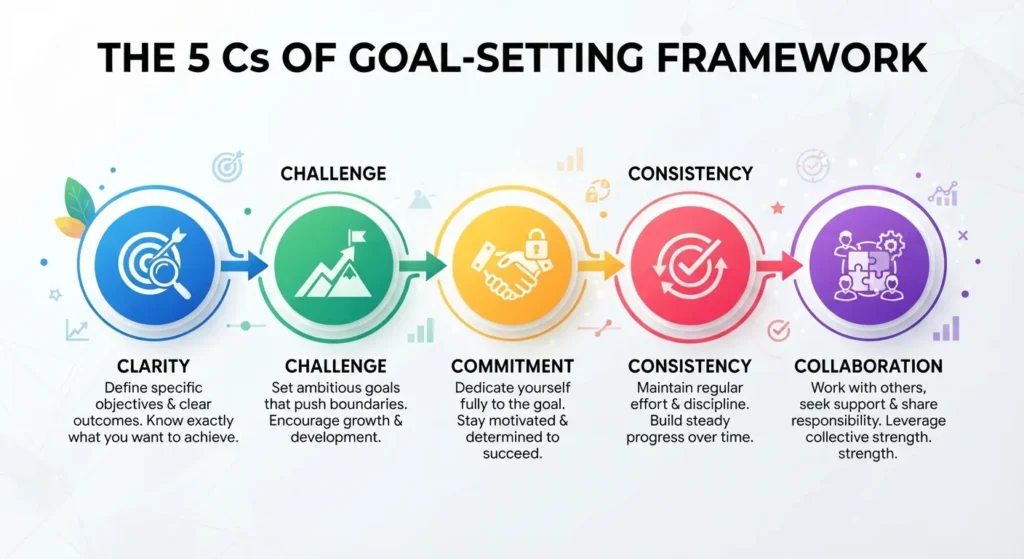
When standard methodologies feel too rigid, the 5 C’s of goal setting offer a streamlined, psychological blueprint for high performance. This alternative framework shifts focus toward behavioral readiness and systemic alignment, making it an ideal model for complex or fast-moving projects.
Clear
Clarity replaces vague aspirations with absolute transparency, ensuring zero confusion about the intended target. When a goal is clear, daily tasks directly serve the overarching objective without wasted cognitive bandwidth.
Strip away jargon and complex qualifiers to state the core intention in plain language.
Ensure the end deliverable can be visualized by anyone on your team or support network.
Challenging
Challenging targets push you past your comfort zone, triggering the psychological arousal needed to unlock peak performance. Easy objectives breed complacency, whereas stretch goals ignite creative problem-solving.
Raise the baseline expectations to test the limits of your current capabilities.
Balance the difficulty level to ensure growth without triggering total overwhelm.
Concrete
Concrete goals anchor abstract ambitions into physical reality by using exact metrics, tangible assets, and verifiable milestones. This prevents goals from remaining passive thoughts that get lost in daily friction.
Tie every objective to physical documentation, digital tracking boards, or hard numerical limits.
Define precise inputs and outputs rather than relying on subjective feelings of progress.
Committed
Commitment measures your internal buy-in and psychological contract with the target. Without deep dedication, even the most well-structured goal will dissolve the moment friction or setbacks occur.
Align the target directly with your core values and long-term professional identity.
Establish public or private accountability mechanisms to protect your consistency during low-motivation cycles.
Coachable
Coachability ensures you remain adaptable, open to performance feedback, and willing to adjust your tactics. High achievers treat goals as hypotheses that can be refined rather than unyielding laws.
Welcome constructive critique from mentors, peers, or objective performance data.
Build regular reflection checkpoints to pivot your approach when initial execution strategies underperform.
Weak Goal vs. Strong Goal — Real Examples
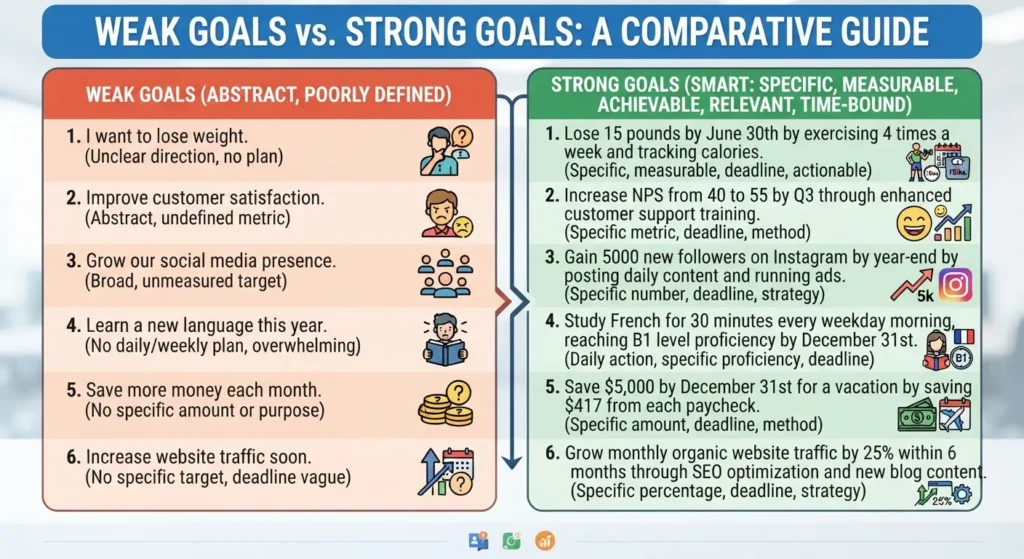
When I review goals with clients, this is the most common fix I make. Transforming a vague aspiration into an elite operational target requires stripping away passive intent and replacing it with precise, measurable mechanics. Reviewing these side-by-side comparisons demonstrates how structural upgrades instantly turn unworkable ideas into executable systems.
Example 1: Fitness Goal (Weak → Strong Rewrite)
Vague fitness intentions rely entirely on daily motivation, which inevitably fades when life gets busy. A strong fitness goal turns physical health into a predictable, non-negotiable schedule.
Weak Goal: I want to get in better shape and lose some weight this year.
Strong Goal: I will drop 10 pounds of body fat and reduce my resting heart rate by 5 beats per minute within the next 60 days by completing 4 strength-training sessions per week and walking 8,000 steps daily.
Why it works: The weak goal leaves “shape” and “some weight” up to interpretation. The strong goal establishes exact metrics, a strict deadline, and a repeatable weekly system.
Example 2: Career Goal (Weak → Strong Rewrite)
Professional growth stalls when ambitions are framed as broad wishes rather than skill-building deliverables. Strong career goals map out exact milestones that attract senior responsibilities.
Weak Goal: I want to get a promotion at work and become a better leader.
Strong Goal: I will secure a promotion to Senior Project Manager by Q4 by leading 2 cross-functional product launches, completing an advanced agile certification, and documenting our team workflow by August 15.
Why it works: The weak goal relies on management noticing your general effort. The strong goal reverse-engineers the promotion requirements into concrete tasks and calendar deadlines.
Example 3: Financial Goal (Weak → Strong Rewrite)
Financial security remains a pipe dream until savings targets are automated and bound to strict timelines. Strong financial goals eliminate spending ambiguity through rigid guardrails.
Weak Goal: I want to save more money and start investing for my future.
Strong Goal: I will build a $10,000 emergency fund and invest 15 percent of my monthly income into low-cost index funds by December 31 by setting up automatic transfers every payday.
Why it works: The weak goal lacks any sense of urgency or tracking. The strong goal defines the exact sum, percentage, and automated mechanism required to guarantee execution.
Common Mistakes That Weaken a Goal
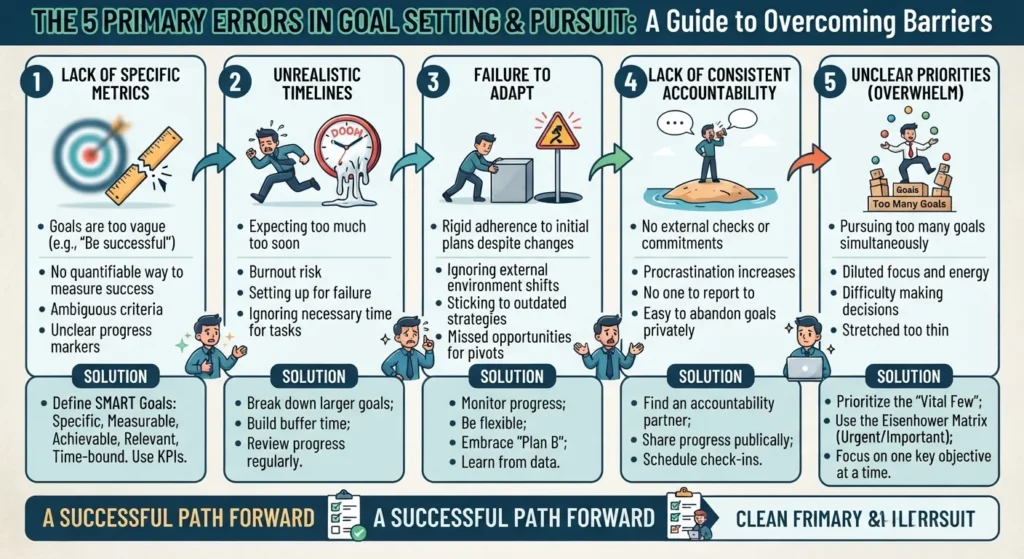
Understanding what destroys execution is just as important as knowing how to build a proper target. When reviewing stagnant projects or abandoned ambitions, the root cause usually traces back to predictable structural errors that sabotage motivation before real momentum can build.
Vague Language Instead of Specifics
Relying on generalized terms like “improve,” “better,” or “more” creates cognitive loopholes that invite procrastination. When your brain cannot visualize a concrete finish line, it defaults to low-leverage activities that feel productive without requiring hard work.
Replace open-ended vocabulary with precise action verbs and quantifiable deliverables.
Eliminate multiple interpretations so that success or failure is immediately obvious.
Avoid umbrella statements that group entirely different projects under a single, blurry heading.
No Deadline or Tracking System
Treating goals as open-ended wishes removes the urgency required to prioritize them over daily distractions. Without a visible deadline or a tracking mechanism, there is no psychological penalty for delaying action.
Establish hard calendar dates rather than relying on someday-statements.
Implement physical or digital tracking sheets where you can log daily or weekly progress.
Review your tracking metrics frequently to catch slipping momentum before it derails the entire initiative.
Setting Goals Too Easy or Too Hard
Poorly calibrated targets either foster complacency or trigger total burnout. Goals that require zero stretch fail to engage your problem-solving faculties, while impossible objectives cause psychological paralysis.
Ensure your targets demand real effort while remaining grounded in your actual resource bandwidth.
Break massive, overwhelming ambitions down into smaller, sequential steps.
Balance your current skill level against the difficulty of the task to maintain steady engagement.
Goals Disconnected From Personal Values
Adopting goals simply because they look impressive on paper or satisfy external expectations inevitably leads to quiet quitting on yourself. Sustainable effort requires an intrinsic connection to your genuine priorities and long-term vision.
Audit your targets to ensure they serve your personal trajectory rather than social validation.
Tie immediate daily tasks to a larger, meaningful outcome that you actually care about.
Discard objectives that conflict with your core values or drain your energy without a worthwhile return.
Self-Assessment — Test Your Goal's Strength

Before locking in your strategy, run your current objectives through a rigorous self-assessment. Testing your goals against a checklist reveals hidden structural flaws and ensures your targets possess the necessary strength to survive real-world execution.
Quick Checklist: Does Your Goal Pass the Test?
Evaluate your target against the following criteria to determine if it functions as a reliable navigational instrument or a fragile wish.
Is it written down? [01:34] If your goal only exists in your head, it lacks the physical accountability required to keep you on track [00:11].
Is it entirely personal? [01:52] Ensure the target belongs to your own authentic vision rather than trying to satisfy external pressures or expectations [01:52].
Is it hyper-specific? Strip away vague terminology and ensure anyone reading it understands the exact deliverable [01:59].
Is it realistically achievable? [02:09] Check that the goal stretches your capabilities without entering the realm of total impossibility [03:39].
Is it mathematically measurable? [02:18] Attach hard numbers or tracking metrics so you can objectively evaluate your daily progress [02:18].
Is it strictly time-sensitive? [02:27] Confirm that a hard calendar deadline exists to prevent your ambition from getting trapped in indefinite procrastination [02:27].
Frequently Asked Questions
What are the 5 characteristics of good goals?
Good goals follow the traditional SMART framework, ensuring every target is Specific, Measurable, Achievable, Relevant, and Time-bound. These five traits eliminate ambiguity, provide quantitative tracking, and create the necessary urgency for consistent execution.
Specific: Clearly defines what needs to be accomplished without leaving room for interpretation.
Measurable: Incorporates hard numbers or key performance indicators to track genuine progress.
Achievable: Balances ambition with realistic resource constraints to prevent early burnout.
Relevant: Connects directly to your broader vision, values, and long-term priorities.
Time-bound: Establishes a definitive deadline or recurring schedule to prevent procrastination.
What are the top 3 goals people set?
Most personal and professional development plans focus on three primary categories that universally impact long-term satisfaction and stability. Focusing heavily on these areas forms the bedrock of most annual resolution lists.
Health and Fitness: Improving physical well-being through weight loss, muscle gain, marathon training, or better nutrition habits.
Career and Professional Growth: Securing promotions, acquiring new high-income technical skills, or transitioning into a new industry.
Personal Finance: Building emergency savings, reducing debt obligations, or establishing automated long-term investment portfolios.
What are the qualities needed to set goals in life?
Setting effective life goals requires a blend of psychological discipline, self-awareness, and structural adaptability. Elite performers rely on specific intrinsic traits to ensure their targets survive inevitable setbacks.
Accountability: Committing targets to writing and utilizing public or private tracking systems.
Resilience: Building flexible contingency protocols to handle unexpected disruptions without abandoning the core objective.
Clarity: Maintaining absolute transparency about the underlying motivations driving each pursuit.
Coachability: Remaining open to performance feedback and willing to pivot tactics when initial execution stalls.
What are the 7 types of goals?
Comprehensive life planning usually categorizes ambitions into seven distinct pillars to ensure balanced personal and professional growth. Spreading focus across these areas prevents hyper-fixating on one domain while neglecting others.
Career Goals: Targets related to professional output, leadership status, and business ventures.
Financial Goals: Objectives focused on net worth, savings milestones, and asset accumulation.
Health Goals: Metrics governing physical stamina, nutrition, and mental wellness.
Intellectual Goals: Plans for acquiring new languages, certifications, or deep-skilling.
Personal Growth Goals: Milestones centered on emotional maturity, habit formation, and mindset shifts.
Social and Relationship Goals: Commitments to strengthening bonds with family, friends, and community networks.
Experiential Goals: Bucket-list achievements focused on travel, adventures, and unique life experiences.
Conclusion — Turning a Strong Goal Into Action
A strong goal remains nothing more than a well-worded wish until backed by unyielding daily discipline and systematic execution. Transitioning from abstract planning to concrete results requires treating your targets not as distant dreams, but as non-negotiable operational standards that dictate your daily behavior.
By anchoring your ambitions in specific metrics, embracing healthy challenges, and maintaining the structural flexibility to adapt when friction arises, you eliminate the guesswork that causes most initiatives to stall. True goal achievement is never about waiting for motivation to strike; it is about building reliable execution loops that carry you forward even when inspiration fades.
Take your newly refined targets, write them down where you can see them every single day, and let your disciplined systems turn those objectives into your new reality.
Kittisak Wattanakul
Kittisak Wattanakul is the Discipline Editor at Holistic Wellbeing Living. He writes about routines, focus, consistency, and practical follow-through. With nine years of experience creating personal-growth content, Kittisak helps readers build realistic systems for steady progress without extreme productivity pressure.