study skills: The Ultimate Guide to Effective Learning Strategies
What Is a Study Skill?
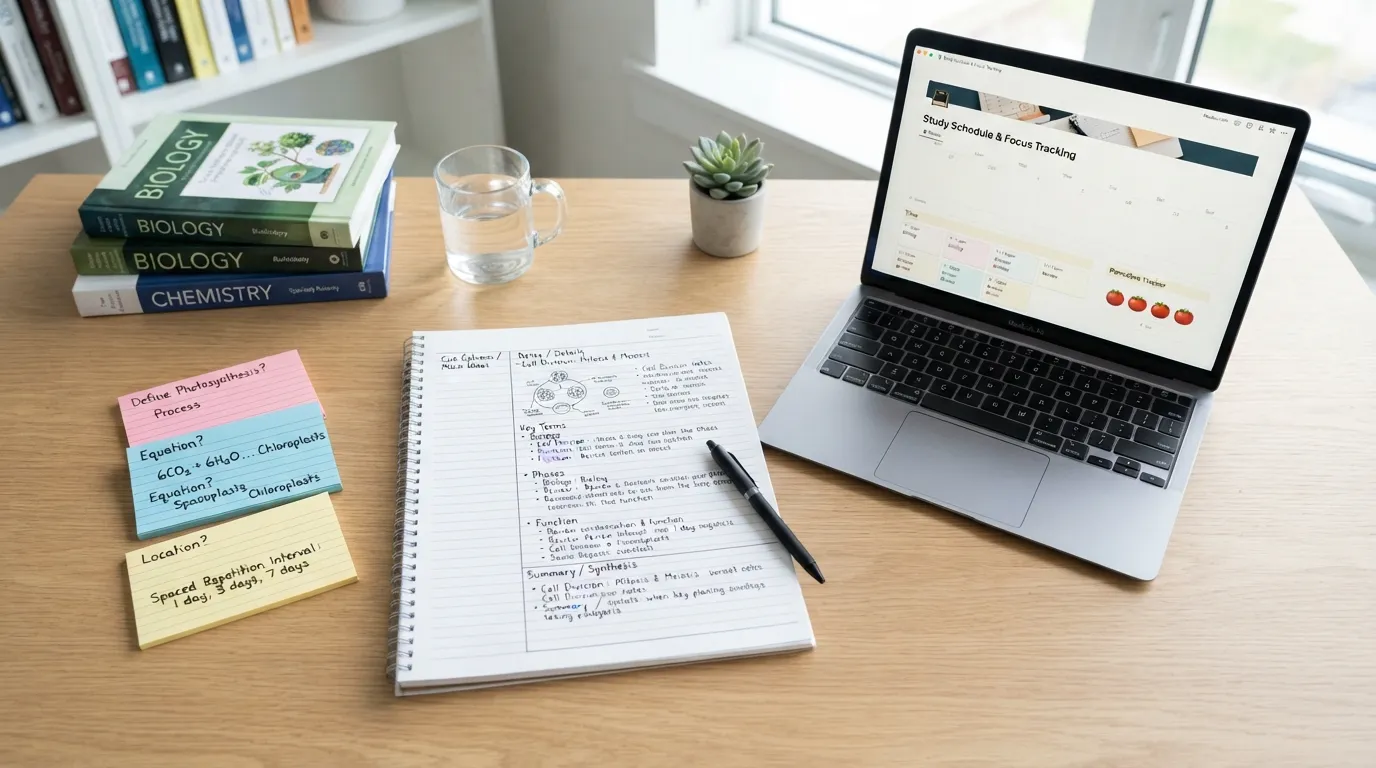
Study skills are systematic, cognitive strategies applied to the process of learning, enabling students to organize, process, and retain information efficiently. Mastering these competencies transforms passive reading into targeted cognitive engagement, ensuring long-term academic retention and performance.
Cognitive Optimization: Streamlines how the brain encodes new data into long-term memory.
Time Efficiency: Reduces hours spent re-reading materials without genuine comprehension.
Core Competencies: Encompasses note-taking, time management, information synthesis, and memory retrieval.
What Is a Study Skill? (Simple Definition)
At its core, a study skill is a structured learning strategy designed to improve how you absorb, organize, and recall information. Unlike raw intelligence, these are learned behaviors that directly bridge the gap between exposure to material and true comprehension.
Strategic Framework: Provides a repeatable blueprint for tackling complex subjects.
Adaptable Techniques: Applies across diverse academic disciplines, from STEM fields to the humanities.
Skill-Based Growth: Develops through consistent practice rather than innate talent.
Example: Active Recall as an Effective Study Skill
Active recall stands out as a premier example of an effective study skill because it forces the brain to retrieve information from memory rather than simply recognizing it on a page. This deliberate act of retrieval strengthens neural pathways and dramatically boosts your ability to retain information during high-stakes exams.
The Flashcard Method: Posing a question on one side of a card and forcing your brain to answer it before checking the back.
The Feynman Technique: Teaching a concept aloud in your own words immediately after reading it to expose knowledge gaps.
Practice Testing: Completing unassisted quizzes to stimulate active retrieval patterns over passive re-reading.
Effective vs. Ineffective Study Skills — Know the Difference
Differentiating between true learning strategies and comforting habits is critical for academic success. While ineffective study habits create an illusion of competence, proven techniques stimulate deep cognitive processing for long-term retention.
The Illusion of Competence: Mistaking the familiarity of highlighted text for actual mastery of the subject matter.
Cognitive Load Management: Moving away from rote memorization toward methods that force structural understanding.
Strategic Selection: Prioritizing evidence-based techniques over comfortable, passive routines.
Comparison Table: Effective vs. Ineffective Study Habits
Evaluating study methods side by side reveals why certain practices yield high exam scores while others result in forgotten material. This breakdown exposes the structural differences between low-yield and high-yield learning strategies.
| Feature / Metric | Ineffective Study Habits (e.g., Highlighting) | Effective Study Skill Example (e.g., Active Recall) |
|---|---|---|
| Cognitive Effort | Low; primarily passive recognition of words on a page. | High; forces the brain to construct and retrieve answers. |
| Memory Retention | Short-term; fades rapidly within 24 to 48 hours. | Long-term; strengthens neural pathways for lasting memory. |
| Exam Performance | Often fails under pressure due to the illusion of competence. | Highly reliable for complex problem-solving and critical thinking. |
| Time Efficiency | Poor; requires hours of re-reading with minimal comprehension. | High; maximizes knowledge acquisition in shorter, focused bursts. |
Why Rereading and Highlighting Feel Productive But Aren’t
Passive rereading and excessive highlighting trick your brain into feeling productive through mere exposure. Because the text looks familiar the second time around, students confuse visual recognition with genuine mastery.
Fluency Illusion: Mistaking smooth reading tracking for actual encoding into long-term memory.
Low Mental Demand: Requires minimal cognitive processing compared to summarizing or questioning the material.
False Confidence: Leads to sudden surprises on exam day when faced with application-based questions.
Common Mistakes Students Think Are “Study Skills”
Many students rely on deeply ingrained routines that masquerade as effective study strategies. Recognizing these common pitfalls helps you eliminate wasted effort and pivot toward evidence-based methods.
Last-Minute Cramming: Stramming hours of information into the night before an exam causes rapid cognitive overload and quick forgetting.
Passive Listening: Re-watching recorded lectures or reading chapters without pausing to test comprehension.
Multitasking While Studying: Trying to review notes while checking phones, which fragments attention and shatters focus.
Core Memory-Based Study Skills (With Real Examples)
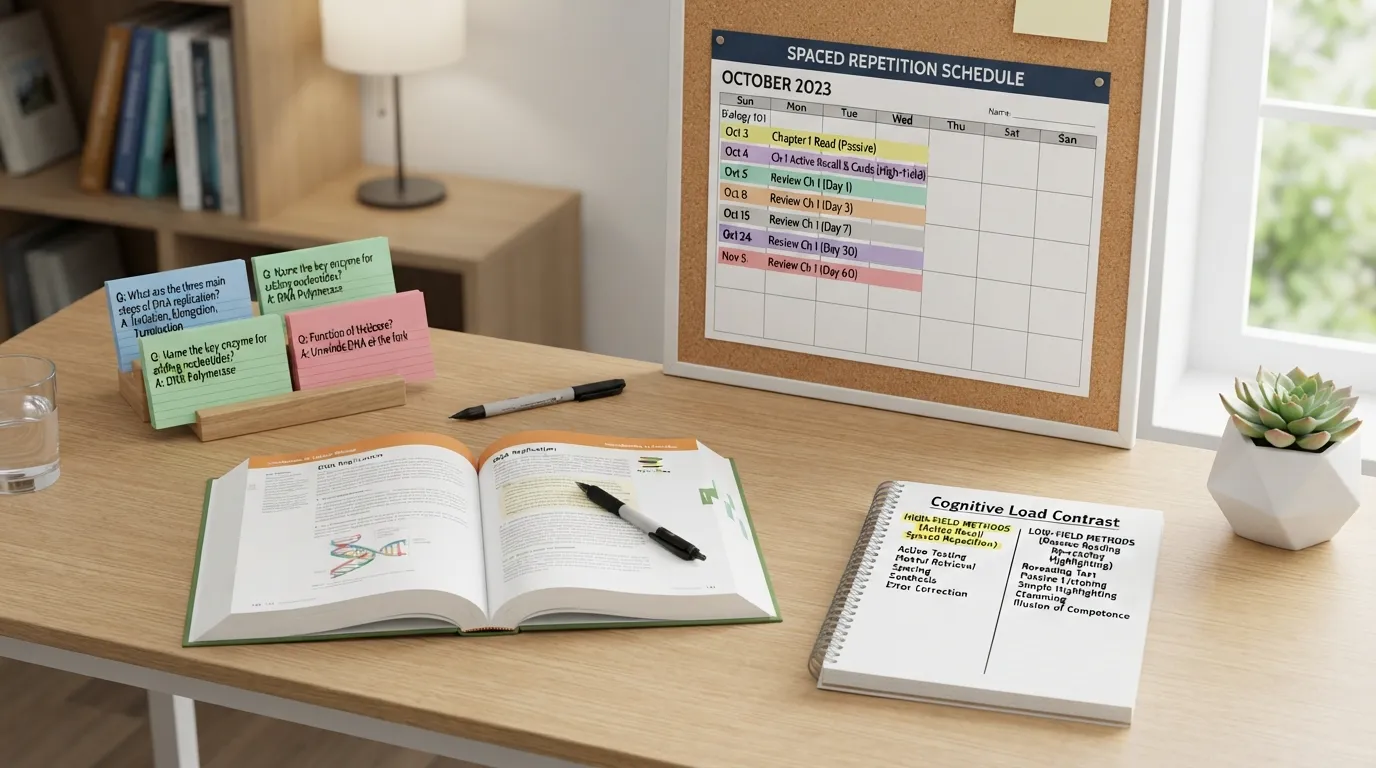
Mastering cognitive-science-backed learning strategies permanently shifts academic performance by aligning study routines with how the human brain naturally processes and encodes information. Implementing these evidence-based techniques prevents the rapid decay of knowledge and secures long-term retention.
Cognitive Alignment: Capitalizes on natural neurological pathways to encode data efficiently.
Resilient Storage: Protects acquired knowledge against the natural forgetting curve.
Practical Application: Transforms theoretical memory concepts into repeatable daily study habits.
Active Recall / Self-Testing (Example + Why It Works)
Active recall forces your brain to retrieve information from scratch rather than passively reviewing a textbook. According to findings highlighted by educational researchers at Retrieval Practice Org [rel=”nofollow”], this deliberate mental struggle signals to your brain that the retrieved data is critical for long-term survival, strengthening neural pathways and boosting long-term memory.
The Flashcard Approach: Writing a question on one side of a card and forcing your mind to generate the answer before looking.
The Blank Sheet Method: Closing your book after a reading session and writing down everything you can remember on a blank page.
Neural Pathway Reinforcement: Each act of difficult retrieval deepens the synaptic connection, making future recall significantly faster.
Spaced Practice / Spaced Repetition (Example + Why It Works)
Spaced practice involves distributing your study sessions across multiple days or weeks rather than packing them into a single marathon session. This technique combats the psychological forgetting curve by forcing your brain to rebuild fading memories right before they disappear entirely.
Incremental Intervals: Reviewing material after 1 day, 3 days, 7 days, and 16 days to cement memory tracks.
Desirable Difficulty: Relearning fading details requires active brainpower, which converts short-term input into durable storage.
Cumulative Retention: Prevents the cognitive crash associated with night-before cramming sessions.
Interleaving — Mixing Subjects for Better Retention
Interleaving is the practice of switching between different topics or problem types within a single study session rather than focusing on one blocked topic. This method trains your brain to identify underlying patterns and select the correct strategy rather than blindly repeating a single formula.
Topic Rotation: Alternating between historical eras, math problem types, or vocabulary lists in one sitting.
Discriminative Learning: Teaches the brain to distinguish between similar concepts instead of blurring them together.
Enhanced Adaptability: Prepares students for unpredictable exam questions that require fluid thinking.
Retrieval Practice in Real Study Scenarios
Integrating retrieval practice into your daily workflow requires intentional friction and self-testing habits. Shifting away from passive re-reading ensures that your study hours translate directly into high performance.
Practice Exams: Taking unassisted mock tests under timed conditions to simulate actual exam stress.
Concept Mapping from Memory: Drawing complex diagrams or flowcharts entirely from memory before checking references.
Peer Teaching Sessions: Explaining complex topics to a classmate without notes to instantly expose weak spots.
Note-Taking & Comprehension Study Skills
Transforming raw lecture data and dense textbooks into organized mental frameworks requires deliberate note-taking and comprehension strategies. Applying these structured methodologies moves students beyond rote dictation, turning passive text into accessible cognitive maps.
Structured Capture: Organizes unstructured lectures into logical hierarchies for efficient review.
Comprehension Filtering: Forces the brain to translate raw concepts into personalized summaries.
Visual Synthesis: Connects disparate ideas through diagrams, tables, and concept maps.
The Cornell Note-Taking System (Step-by-Step Example)
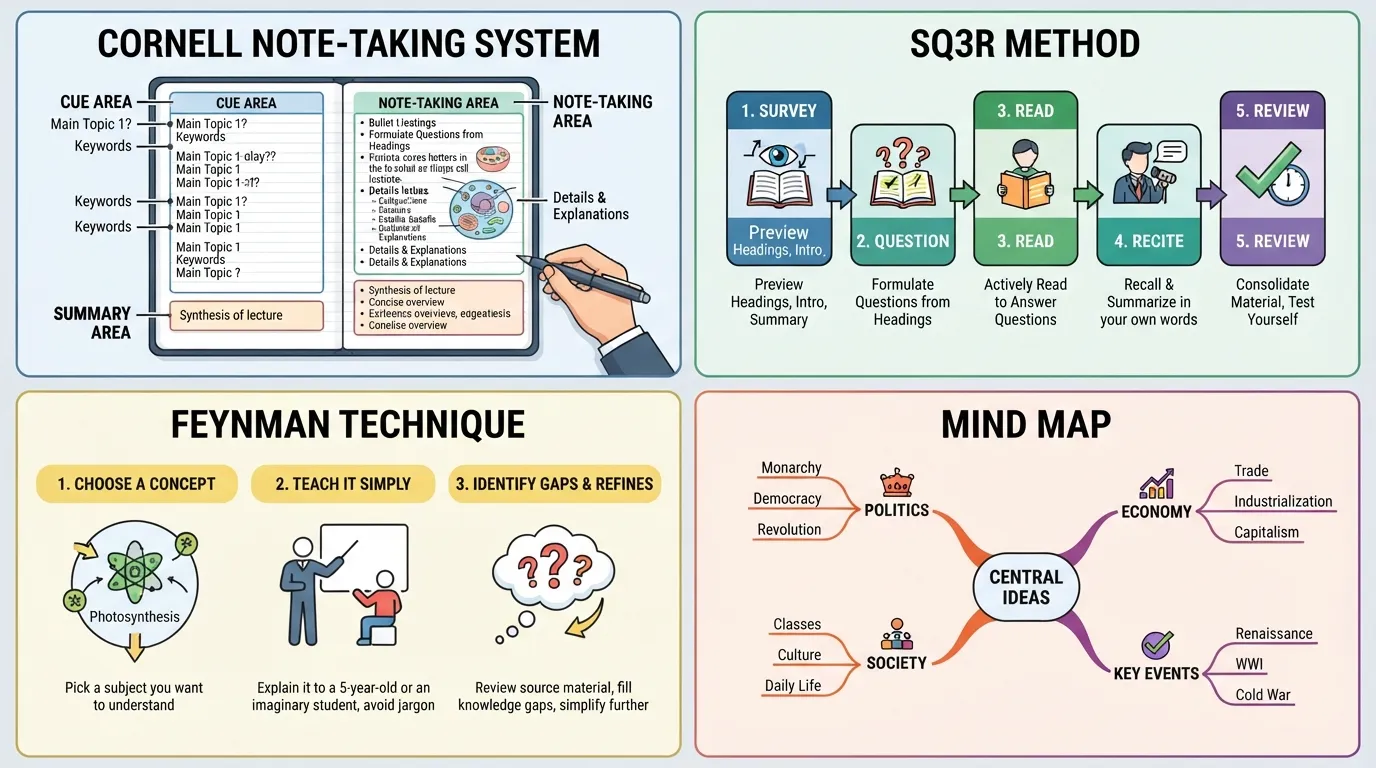
The Cornell note-taking system divides your page into specific functional zones, separating raw lecture input from high-level synthesis and quick-reference cues. This layout encourages immediate post-lecture review and built-in self-testing.
Cue Column: A narrow left-hand margin used for writing keyword prompts, potential test questions, and core themes.
Note-Taking Area: The large right-hand section dedicated to capturing main ideas, diagrams, and explanations during class.
Summary Section: A bottom block reserved for a concise 2-3 sentence summary written immediately after the session ends.
SQ3R Method (Survey, Question, Read, Recite, Review)
The SQ3R method is a structured reading strategy that transforms passive textbook chapters into active investigations. By front-loading curiosity before reading a single paragraph, you prime your brain for high-level comprehension.
Survey & Question: Scan headings, charts, and chapter summaries, turning headings into direct questions before reading.
Read & Recite: Read specific subsections to answer your formulated questions, then immediately recite the core concepts aloud in your own words.
Review: Go over your notes and recited summaries at regular intervals to anchor the information permanently.
The Feynman Technique — Learning by Teaching
The Feynman Technique bypasses complicated jargon by forcing you to explain a complex topic in plain, accessible language. If you stumble or rely on technical buzzwords, you have immediately exposed a gap in your real understanding.
Plain Language Breakdown: Write down a concept as if you were teaching it to a complete beginner or a young child.
Gap Identification: Note the exact moments where you struggle to find simple words or clear analogies.
Source Refinement: Return to your core study materials to patch those specific knowledge holes before testing yourself again.
Mind Mapping for Visual Learners
Mind mapping uses non-linear visual hierarchies to connect central themes with supporting sub-topics, mirroring how the human brain naturally associates ideas. This graphical layout enhances creative problem-solving and speeds up review sessions.
Central Anchor Node: Place the core study topic or chapter title directly in the center of a blank page.
Radiating Branches: Draw branching lines outward for major sub-themes, using distinct colors for different categories.
Keyword Economy: Limit branch labels to single keywords or short phrases rather than dense paragraphs.
Time Management & Focus-Based Study Skills
Mastering your schedule and protecting your attention are essential prerequisites for deep work and high-level academic performance. Organizing your study hours with strict frameworks eliminates decision fatigue and ensures steady, sustainable progress.
Cognitive Endurance: Prevents mental burnout by pairing intense focus with structured recovery windows.
Environmental Control: Eliminates external triggers that fragment concentration and derail productivity.
Strategic Routines: Replaces erratic studying with predictable blocks of high-yield output.
Time Blocking — Planning Your Study Schedule
Time blocking requires dividing your day into distinct, non-negotiable calendar slots dedicated to specific academic subjects or tasks. Treating these blocks like formal appointments prevents procrastination and ensures every topic receives adequate coverage.
Dedicated Calendaring: Assign precise time windows for each subject rather than relying on an open-ended to-do list.
Proactive Scheduling: Build your study schedule around peak cognitive hours when your energy and alertness are highest.
Boundary Enforcement: Treat study blocks with the same urgency and commitment as attending a live lecture.
The Pomodoro Technique (25/5 Example Breakdown)
The Pomodoro Technique breaks long study sessions into short, intense bursts of labor followed by brief rest intervals to maintain high attention spans. This rhythm sustains mental stamina and wards off cognitive fatigue.
25-Minute Work Sprint: Focus entirely on a single task without checking notifications or switching tabs.
5-Minute Recovery Break: Step away from your desk, stretch, or rest your eyes to clear your working memory.
Longer Reset Cycles: Take a 15 to 30-minute break after completing four consecutive cycles to fully recharge.
Distraction Control — Building a Focused Study Environment
Distraction control involves actively engineering both your physical workspace and digital devices to eliminate interruptions before they happen. Minimizing friction makes deep concentration your default state.
Digital Isolation: Put your phone on silent mode, turn off non-essential notifications, and close distracting browser tabs.
Workspace Optimization: Keep only the necessary materials for your current task on your desk to reduce visual clutter.
Environmental Consistency: Establish a dedicated study spot that conditions your nervous system for immediate focus the moment you sit down.
Metacognition — The Advanced Study Skill Most Students Skip
Metacognition involves thinking about your own thinking, allowing you to monitor and adjust your learning strategies in real time. This advanced cognitive skill separates top-performing students from the rest by helping them recognize when a study method is failing and pivot immediately.
Cognitive Awareness: Monitors your level of comprehension while you actively engage with new material.
Strategy Adjustment: Empowers you to switch tactics when a particular learning approach stops working.
Self-Regulated Learning: Eliminates blind studying by anchoring every session in deliberate performance evaluation.
What Is Metacognition in Studying?
Metacognition in studying is the internal compass that tells you whether you actually understand a concept or merely recognize the words on the page. Developing this self-awareness transforms you from a passive recipient of information into an active manager of your own education.
Monitoring Comprehension: Continuously asking yourself if you could explain the current concept to a peer without notes.
Diagnostic Reflection: Evaluating why you missed a practice question rather than just marking the answer incorrect.
Cognitive Control: Selecting specific strategies tailored to the difficulty of the material at hand.
Self-Monitoring Example: Tracking What You Don’t Know
Self-monitoring requires keeping a running inventory of your knowledge gaps so you can target your review sessions effectively. Instead of rereading entire chapters, you isolate confusing formulas or difficult theories for deliberate practice.
The Muddy Point Log: Jotting down specific confusing concepts immediately after a lecture or reading session.
Targeted Remediation: Dedicating subsequent study blocks exclusively to clearing out logged knowledge gaps.
Confidence Scoring: Rating your certainty level next to practice questions to catch false feelings of mastery early.
Setting SMART Study Goals
SMART study goals replace vague intentions with precise, measurable targets that give every learning session a clear direction. Defining exact outcomes prevents wandering attention and provides an immediate sense of accomplishment.
Specific & Measurable: Setting goals like “complete 15 practice physics problems” instead of a vague “study physics.”
Achievable & Relevant: Aligning daily milestones with broader exam preparation schedules to avoid unrealistic workloads.
Time-Bound: Assigning hard deadlines to individual learning tasks to maintain momentum and combat procrastination.
Real-Life Example Scenarios — Effective vs. Ineffective Study in Action
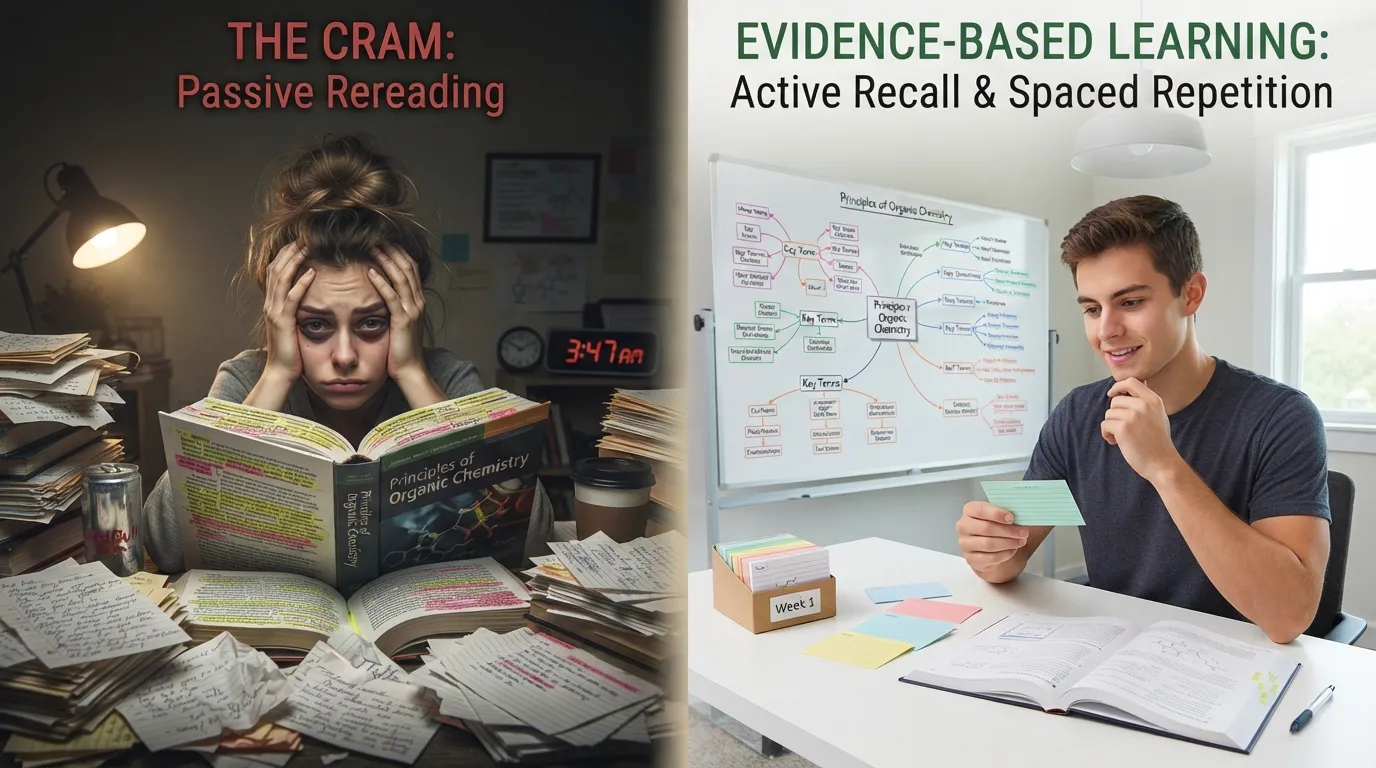
Examining how different study methods play out in real-world academic settings reveals why the number of hours spent at a desk does not dictate final grades. Comparing these contrasting approaches highlights how strategic, evidence-based habits consistently outperform brute-force studying.
Performance Discrepancies: Explains why two students with identical study schedules achieve drastically different outcomes.
Contextual Application: Demonstrates how abstract cognitive theories translate into daily student routines.
Strategic Pivots: Illustrates the moment a learner abandons low-yield habits in favor of high-yield techniques.
Scenario 1: Two Students, Same Study Time, Different Results
Consider two university biology students, Alex and Jordan, who both dedicate three hours to preparing for an upcoming midterm exam.
Alex’s Approach: Spends all three hours passively rereading textbook chapters, highlighting key sentences, and listening to recorded lectures.
Jordan’s Approach: Spends 30 minutes reading the core material, then dedicates the remaining two and a half hours to active recall flashcards and practice testing.
The Result: Alex walks into the exam feeling confident due to the fluency illusion but struggles with application questions, while Jordan successfully retrieves complex physiological pathways and scores an A.
Scenario 2: A Nursing Student’s Real Study Challenge (Beyond Flashcards)
Sarah, a nursing student facing a massive pharmacology exam, initially relies on standard digital flashcards but finds herself mixing up drug classifications under pressure.
The Challenge: Rote flashcard memorization fails because exam questions require clinical decision-making rather than simple definitions.
The Strategic Shift: Sarah incorporates the Feynman Technique and interleaving, teaching drug mechanisms aloud to a study partner and mixing drug categories in practice quizzes.
The Result: By shifting from isolated memorization to applied conceptual synthesis, Sarah easily distinguishes between similar medications during high-stress clinical evaluations.
Scenario 3: A High School Student Prioritizing the Right Skills
Marcus, a high school junior struggling with AP Chemistry, shifts his study habits from late-night cramming to structured daily routines.
The Challenge: Marathon weekend study sessions result in severe mental fatigue and rapid forgetting of chemical equations.
The Strategic Shift: Marcus implements time blocking, scheduling two focused 45-minute blocks each weekday utilizing Cornell note-taking and spaced practice intervals.
The Result: His daily cognitive load decreases significantly, while his long-term retention rates soar, transforming his chemistry performance without increasing total study hours.
Frequently Asked Questions
Addressing common student inquiries with direct, authoritative answers captures high-intent People Also Ask (PAA) boxes and voice search queries. Providing concise definitions right at the start of each subsection ensures maximum visibility in Google’s featured snippet positions.
Targeted Clarity: Delivers exact-match answers for high-volume academic search queries.
Comprehensive Coverage: Resolves foundational questions regarding study habits, categories, and self-improvement.
Actionable Insight: Translates complex learning theories into clear, accessible guidance for students.
What Are 5 Study Skills?
Five essential study skills include active recall, spaced repetition, the Cornell note-taking system, time blocking, and the Feynman Technique. Mastering these five techniques covers information encoding, storage, organization, time management, and conceptual synthesis.
Active Recall: Forcing memory retrieval through flashcards or self-testing instead of passive reading.
Spaced Repetition: Distributing review sessions over increasing intervals to beat the forgetting curve.
Cornell Note-Taking: Structuring notes into cues, details, and summaries for rapid review.
Time Blocking: Allocating dedicated calendar windows to specific subjects to eliminate procrastination.
Feynman Technique: Explaining concepts in simple language to expose and fix knowledge gaps.
What Are Examples of Study Skills?
Examples of study skills span cognitive memory methods, organizational frameworks, and comprehension strategies. Applying these specific techniques transforms unstructured reading into measurable learning outcomes.
Practice Testing: Answering unassisted mock exam questions under timed conditions.
Interleaving: Mixing different subjects or problem types during a single study session.
SQ3R Method: Surveying, questioning, reading, reciting, and reviewing textbook chapters.
Mind Mapping: Diagramming central themes and radiating sub-topics visually.
What Skills Are Needed to Study?
Studying effectively requires a blend of cognitive, organizational, and metacognitive competencies that allow you to process and retain information. These core skills turn raw effort into sustainable academic performance.
Focus & Attention Control: The ability to eliminate digital and physical distractions during deep work sessions.
Information Synthesis: Translating dense, complex lectures into clear, personalized notes.
Self-Monitoring: Evaluating your own comprehension accurately rather than relying on the illusion of competence.
How Do I Improve My Study Skills?
Improving your study skills requires auditing your current habits, eliminating passive techniques like highlighting, and adopting evidence-based cognitive strategies. Consistency and reflection drive long-term improvement.
Audit Your Routine: Identify and replace low-yield habits like cramming and rereading with active recall and spaced practice.
Schedule Focused Blocks: Use the Pomodoro Technique or time blocking to manage your energy and prevent burnout.
Track Your Gaps: Keep a log of missed concepts during practice tests and review them systematically.
What Are the Three Main Types of Study Skills?
The three main types of study skills are cognitive-memory strategies, organizational note-taking systems, and time-management practices. Categorizing study methods ensures a balanced approach to academic preparation.
Cognitive-Memory Strategies: Techniques like active recall and spaced repetition that secure long-term retention.
Organizational Note-Taking Systems: Frameworks like Cornell notes and mind mapping that structure raw information.
Time-Management Practices: Methods like time blocking and Pomodoro sprints that protect focus and regulate schedules.
Conclusion — Choosing the Right Study Skill for You
Mastering effective study skills is not about putting in endless hours of exhausting brute-force work; it is about aligning your daily habits with proven cognitive science. Transitioning from passive reading and last-minute cramming to targeted, high-yield strategies transforms your academic trajectory.
Strategic Alignment: Replaces low-yield routines like highlighting and rereading with evidence-based cognitive frameworks.
Sustainable Execution: Combines memory retrieval, structured note-taking, and rigorous time management for balanced growth.
Long-Term Mastery: Secures permanent knowledge retention while protecting your mental stamina and focus.
Most Effective Study Skills at a Glance
Reviewing the core competencies covered throughout this guide reinforces how each method targets a specific dimension of learning. Selecting the right combination ensures comprehensive academic preparation.
Memory & Retention: Active recall and spaced repetition permanently encode information into long-term storage.
Comprehension & Organization: The Cornell note-taking system, SQ3R, and the Feynman Technique break down complex data into manageable insights.
Focus & Time Management: Time blocking and the Pomodoro Technique protect your attention and structure your daily schedule.
Which One Should You Start With?
Trying to implement every strategy at once can lead to immediate overwhelm and burnout. Instead, pick a single evidence-based technique to test during your very next study session.
The Single-Shift Approach: Start by swapping out passive highlighting for active recall flashcards or the blank sheet method.
The Pomodoro Baseline: Introduce 25-minute focus sprints if you struggle with procrastination or digital distractions.
Continuous Refinement: Track your results, evaluate your progress honestly through metacognition, and layer in additional strategies over time.