Bad Habits in Children: Causes, Types & How to Break Them
What Counts as a "Bad Habit" in Kids?
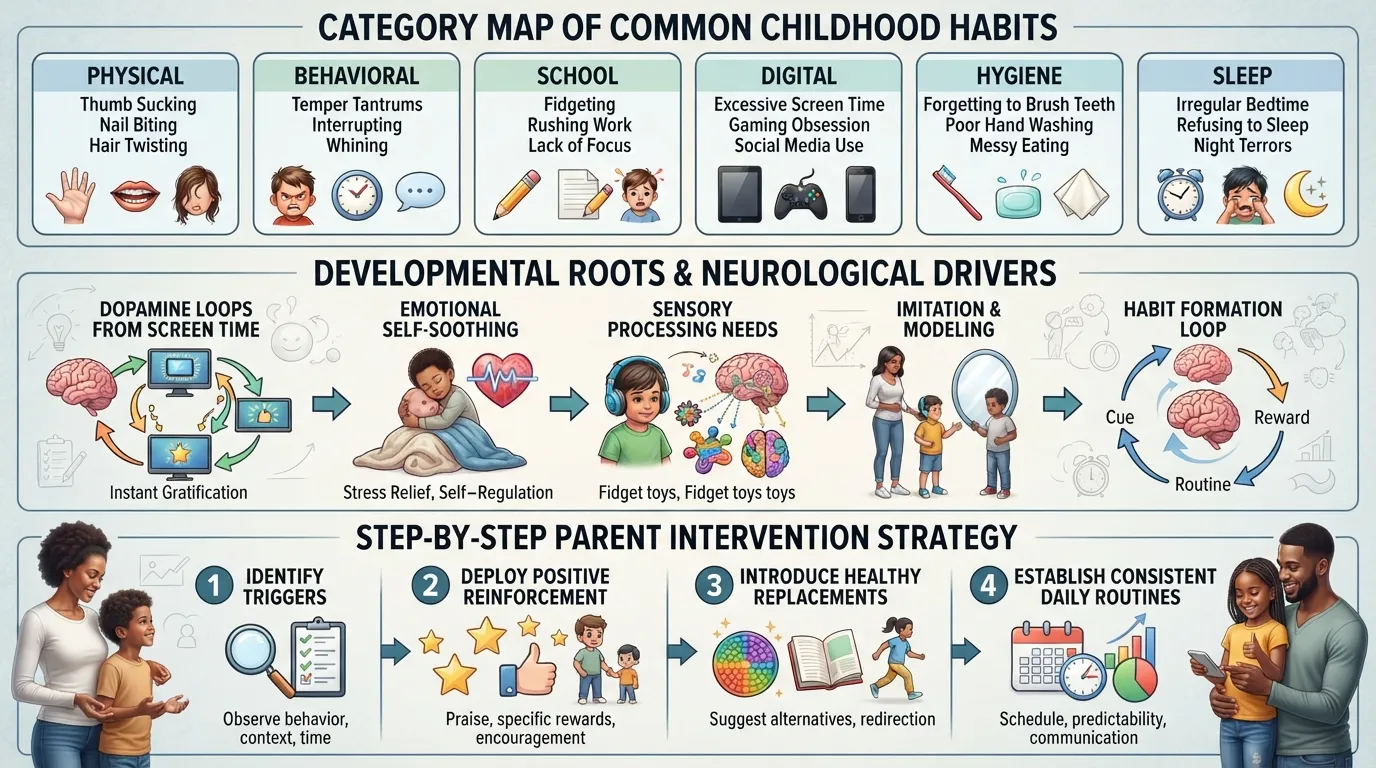
Every parent has experienced that moment of quiet panic watching their child bite their nails, pick at a scab, or blurt out every passing thought. When you are deep in the trenches, it is easy to label any repetitive, frustrating, or socially awkward behavior as a “bad habit.” But before you try to fix or eliminate a behavior, you have to look closer at what is actually driving it.
Definition + Normal Developmental Phase vs. Actual Concern
In the context of childhood, a true bad habit is a deeply ingrained, repetitive behavior that interferes with a child’s daily functioning, social interactions, or physical health, and persists long past when it should have naturally faded. However, the vast majority of behaviors parents worry about are simply normal developmental phases in disguise.
Young children use their bodies and actions to self-soothe, process big emotions, or simply figure out how the world works.
Normal developmental phases are temporary, driven by growth milestones or stress, and eventually self-correct as the child matures or their emotional vocabulary expands.
Actual concerns involve behaviors that cause physical harm (like tissue damage from chronic skin-picking), severe social isolation, or anxiety that intensifies rather than lessens over time.
The main differentiator is intent and impact. If a toddler sucks their thumb because their nervous system is overwhelmed and they need comfort after a long day, it is a coping mechanism, not a malicious vice. If that same thumb-sucking continues into late elementary school and begins altering the shape of their jaw, it crosses the line from a self-soothing phase into a habit that requires intentional intervention.
Toddler vs. School-Age Quick Distinction Note
Context and age change everything when defining a habit. What is entirely age-appropriate at age two can be a red flag at age eight.
Toddlers (Ages 1 to 3): Habits at this stage are almost entirely sensory or self-regulatory. Repetitive behaviors like hair-twirling, head-banging during meltdowns, or whining are standard ways little ones cope with a world they cannot yet control with words. They lack impulse control by biological design, meaning most toddler “habits” require patience and environmental changes rather than strict behavior modification.
School-Age Children (Ages 6 to 12): By this stage, children have significantly greater cognitive maturity and emotional awareness. Habits here are more likely to be subconscious stress-responses (like nail-biting before a math test) or ingrained behavioral loops. If a school-age child is regularly engaging in repetitive behaviors that disrupt classroom learning, cause peer rejection, or persist despite gentle reminders, it moves past typical growing pains and becomes a pattern worth actively addressing.
Common Bad Habits in Children Full List
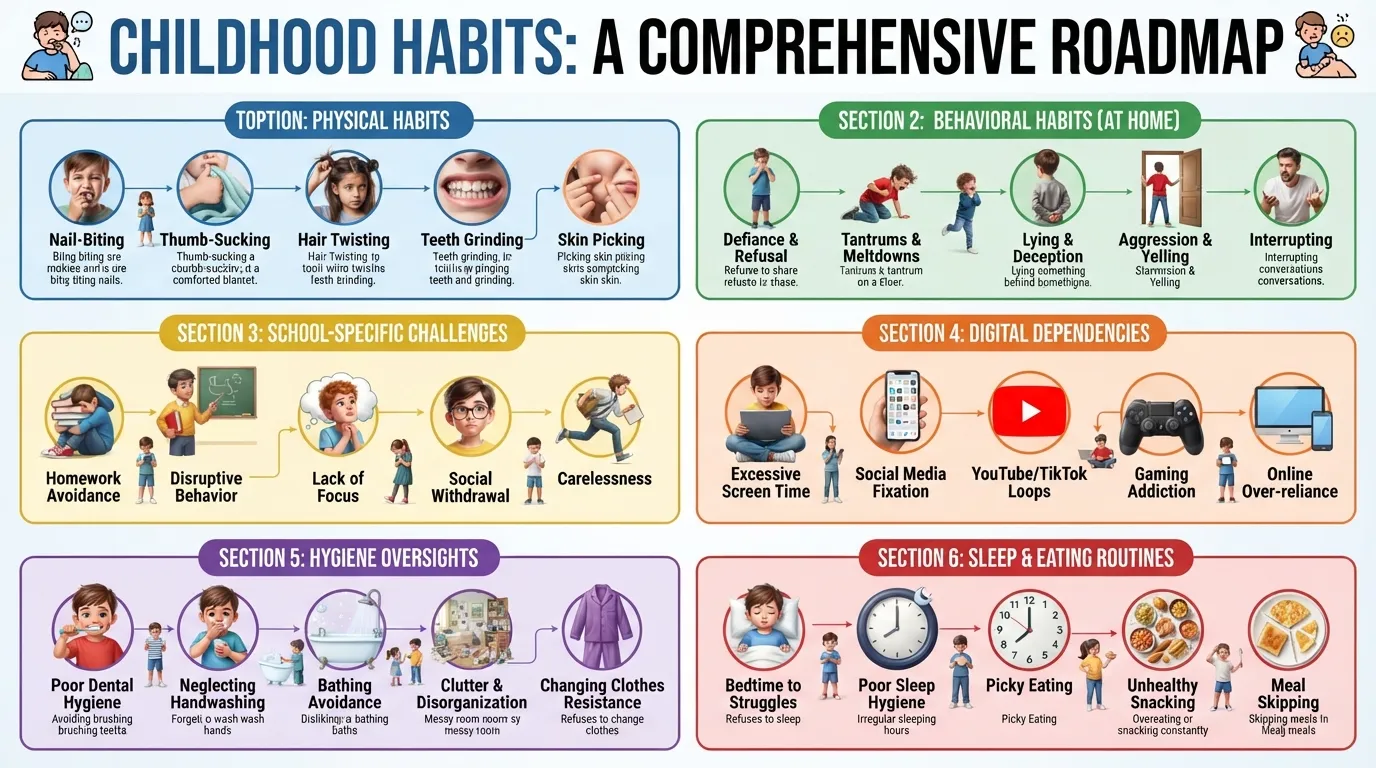
Physical habits (nail biting, thumb sucking, hair pulling, nose picking)
Physical habits are often the most visible and frustrating behaviors parents notice, usually peaking during times of transition or anxiety.
Nail Biting and Hair Pulling (Trichotillomania): These are classic tactile self-soothing mechanisms. When a child feels bored, anxious, or hyper-focused, their hands seek out repetitive motions to regulate their nervous system.
Thumb Sucking: While biologically normal for infants and toddlers to soothe themselves to sleep, it becomes a concern when it persists past age five, as it can push permanent teeth out of alignment and alter the roof of the mouth.
Nose Picking: Often driven by physical irritation or dry air, it quickly hardens into an unconscious habit when children tune out during homework or screen time.
Behavioral habits — home (lying, tantrums, talking back, interrupting)
Home-based behavioral friction usually flares up when a child’s communication skills or impulse control fall short of parental expectations.
Lying: In younger children, lying stems from magical thinking or a protective impulse to avoid punishment rather than malice. In older kids, it is often a shortcut to bypass disappointment.
Tantrums and Talking Back: These signal a breakdown in emotional regulation. When children lack the mature cognitive tools to express frustration or feel a loss of control, they resort to verbal pushback or explosive meltdowns to test boundaries.
Interrupting: Driven by poor impulse control and an underdeveloped sense of conversational turn-taking, kids blurt out thoughts immediately because they fear forgetting them.
School-specific habits (classroom disruption, homework avoidance, peer conflict, cheating)
School environments place heavy demands on a child’s executive functioning, attention span, and social agility.
Classroom Disruption: Often masks academic boredom, unmet sensory needs, or a desperate bid for peer attention when a child feels inadequate with the material.
Homework Avoidance: This is rarely simple laziness; it typically points to transition fatigue at the end of a long school day, executive dysfunction, or a specific learning gap that makes the work overwhelming.
Peer Conflict and Cheating: Peer clashes often arise from poor emotional literacy during group play, while cheating usually surfaces under intense performance anxiety or pressure to meet unrealistic grading standards.
Digital/screen habits (excessive screen time, gaming, YouTube addiction)
Digital habits are uniquely challenging because modern apps and games are literally engineered to hijack the brain’s dopamine pathways.
Excessive Screen Time and Gaming: Quick-hit digital rewards create a state of hyper-focus that makes transitioning back to the real world exceptionally jarring.
YouTube and Short-Form Video Addiction: Endless scroll loops destroy attention spans, making it difficult for children to tolerate the “boring” pace of real-life tasks like reading or free play. This often triggers severe behavioral resistance when devices are turned off.
Hygiene habits (skipping brushing/handwashing)
Hygiene routines require daily executive function, self-monitoring, and delayed gratification—all of which are still developing in children.
Skipping Brushing: Kids view brushing teeth as a tedious chore interrupting their play rather than a health necessity, leading to rushed, ineffective brushing or outright skipping.
Forgetting Handwashing: Because germs are invisible, children struggle to grasp the consequence of skipping handwashing after the bathroom or before meals, treating it as an arbitrary parental annoyance.
Sleep & eating habits (late bedtime, junk food dependency)
Foundational biological routines dictate a child’s mood, immune system, and cognitive capacity, making disruptions here deeply cyclical.
Late Bedtime and Resistance: Overtired children paradoxically get a second wind of adrenaline, making them wired and harder to put down, which wrecks morning wake-ups.
Junk Food Dependency: Heavily processed foods high in sugar and fat hijack palate preferences and create blood sugar spikes and crashes, fueling a cycle of emotional reactivity, fatigue, and intense cravings for more processed foods.
Habits That Seem Bad But Are Actually Normal
When you are deep in the parenting trenches, it is easy to view every defiant streak or repetitive motion as a flaw that needs immediate correction. However, child development is rarely a straight line. Many behaviors that drive parents crazy are actually vital milestones in disguise—signs that your child’s brain and nervous system are growing the exact way they are supposed to.
Thumb Sucking and Pacifiers in Toddlers: While veteran parents and pediatric dentists eye long-term thumb sucking with caution, in a toddler, it is a masterclass in independent self-regulation. Long before children learn to articulate anxiety or sensory overload, their nervous systems use the rhythmic motion of sucking to lower cortisol and soothe themselves to sleep.
Stubbornness and “No” as a Default Setting: That intense resistance to every little request is often mislabeled as defiance, but it is actually the birth of healthy autonomy. A child cannot build a strong sense of self without testing where their boundaries end and yours begin; stubbornness is the raw, unrefined engine of independent decision-making.
Picky Eating and Food Jags: Rejecting entire food groups or demanding the exact same meal three days in a row feels maddeningly stubborn. Biologically, however, it is an evolutionary survival mechanism leftover from ancestral times when toddlers began walking and exploring, keeping them from ingesting unfamiliar toxic plants.
Fidgeting and Constant Movement: Kids who wiggle, rock, or pace while listening or working are often written off as having poor focus. In reality, vestibular and proprioceptive movement acts as vital neurological “white noise” that actually helps their developing brains stay alert and process incoming information.
Inventive Lying (Magical Thinking): When a five-year-old insists a stuffed animal ate the last cookie, it looks like blatant dishonesty. But at this age, the boundary between fantasy and reality is delightfully blurred, and “lying” is often just an exercise in creative storytelling or wishful thinking rather than deceit.
Effects of Bad Habits on Child's Brain & Development
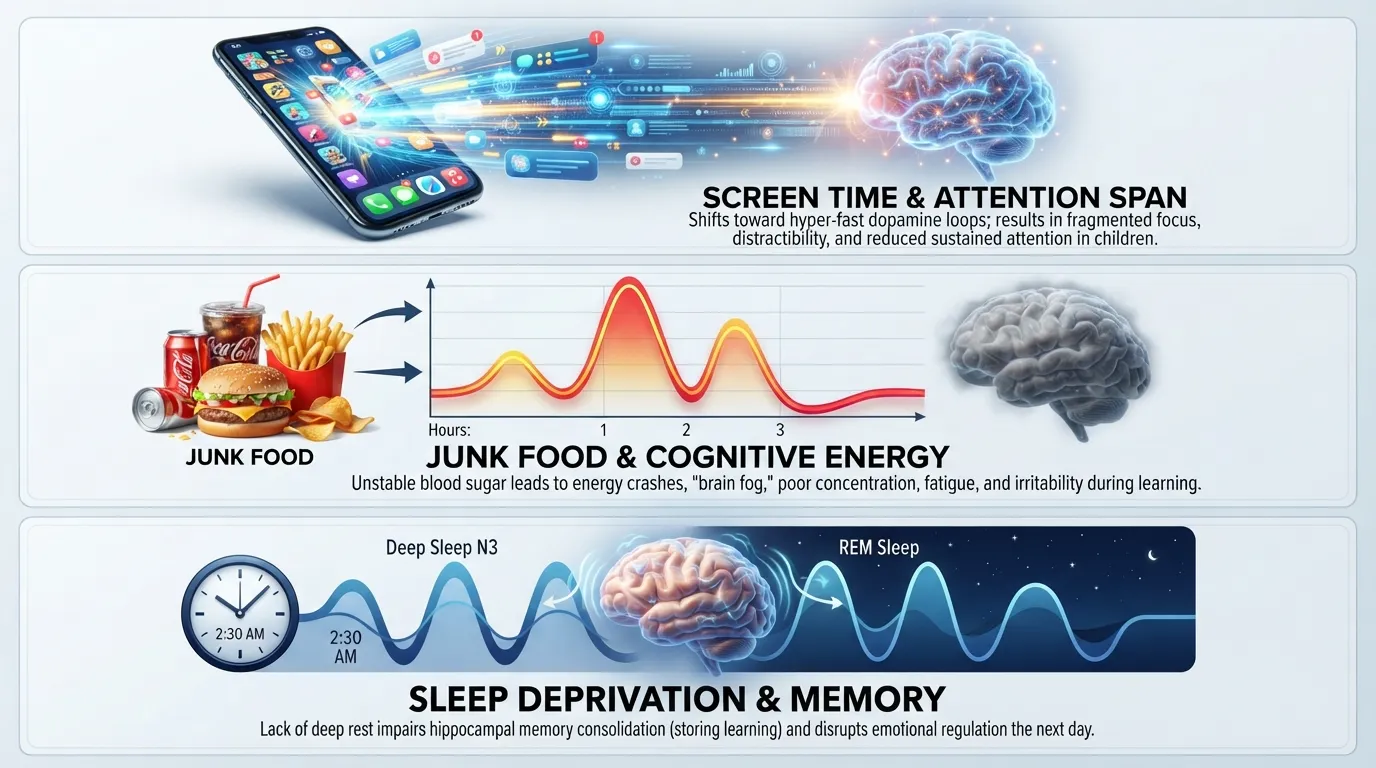
A child’s brain is a remarkably plastic, high-speed construction zone, forming millions of neural connections every second. While occasional slip-ups are a normal part of growing up, chronic “bad habits” do more than just test a parent’s patience—they actively shape the neural architecture of a developing mind. When repetitive behaviors wire themselves into daily routines, they begin to alter cognitive growth, emotional regulation, and physical health.
Screen Time and the Fragile Attention Span: Excessive exposure to fast-paced digital media and short-form video loops floods the brain with rapid bursts of dopamine. Because modern interfaces are engineered to constantly stimulate instant gratification, a child’s developing prefrontal cortex adapts to this high-speed environment, making it agonizingly difficult to sustain focus on slower, linear tasks like reading a book or listening in class.
Junk Food and Cognitive Energy: A steady diet of processed sugars and nutrient-poor foods creates volatile blood sugar rollercoasters. The brain demands a massive, steady share of the body’s energy to fuel learning and impulse control; when fueled by junk food, children experience sharp glucose spikes followed by severe crashes that manifest as brain fog, irritability, and a diminished capacity for problem-solving.
Sleep Deprivation and Memory Consolidation: Chronic late bedtimes directly sabotage the brain’s overnight housekeeping cycle. During deep sleep, the hippocampus actively transfers short-term daily experiences into long-term memory storage while clearing out metabolic waste; cutting this process short impairs working memory, emotional resilience, and executive functioning the following day.
How to Break Bad Habits in Children Step-by-Step
Breaking an ingrained habit is tough for adults, so it is no surprise that children need structural support and patience to rewire their routines. Yelling, shaming, or handing out harsh punishments rarely works because it fails to address the underlying neurological loop driving the behavior. Instead, shifting a child’s habits requires a systematic, compassionate approach that targets the root cause and builds healthier pathways.
Identify the Trigger and Root Cause: Every habit follows a predictable loop of cue, routine, and reward. Before trying to stop a behavior like nail-biting or evening meltdowns, observe what happens right before it occurs. Are they anxious, bored, overstimulated, or seeking connection? Once you pinpoint the underlying emotional or physical trigger, you can address the need at its source rather than just policing the symptom.
Deploy Positive Reinforcement Instead of Punishment: Punishing a child for an unconscious habit usually increases their stress, which only drives them right back into the behavior. Instead, catch them succeeding and lean heavily into positive reinforcement. Praise small wins, use low-pressure reward charts for consistency, and celebrate progress to release natural dopamine tied to positive choices.
Replace the Habit with a Healthy Alternative: You cannot easily extinguish a habit by telling a child to stop cold turkey; the brain still needs a way to fulfill that underlying need. If a child chews their collar when stressed, provide a wearable chewelry item or a smooth worry stone. If they grab a phone out of boredom, have a pre-selected physical alternative ready, like building blocks or a quick game of catch.
Focus on Consistency and Routine Building: Habits live in automatic brain loops, which means predictability is your best ally. Anchor new, positive responses to established daily routines—like brushing teeth or sitting down for homework. Keep cues clear, environments organized, and responses uniform across all caregivers so the brain can easily map the new neural pathway.
Know When to Consult a Pediatrician or Child Psychologist: Most childhood habits fade with gentle redirection and maturity, but some require professional backup. Consult a specialist if a habit causes physical tissue damage (like severe hair pulling or skin picking), is accompanied by debilitating anxiety, or persists past early childhood despite consistent, calm parental intervention.
Real Parent Experiences Community Insights
Scrolling through parenting forums or listening to parents swap stories at the park reveals a comforting universal truth: almost every frustrating habit you are dealing with right now has been weathered by someone else. When you read through community threads on parenting spaces, the collective wisdom rarely points to a magical, overnight fix. Instead, real parents consistently emphasize that shifting a child’s behavior requires letting go of perfection and looking beneath the surface of the frustration.
Many parents share how tackling physical habits like nail-biting or hair-twirling only worked once they stopped calling attention to it. Shaming or constantly swatting hands away usually backfires, driving the behavior underground or intensifying it out of anxiety. Instead, experienced parents find success by quietly introducing a tactile substitute—like keeping a smooth worry stone in a pocket or switching to a fidget toy during homework time—so the child’s hands stay busy without drawing parental lectures.
Other community discussions frequently highlight the sheer exhaustion of screen-time meltdowns and digital dependency. Parents often admit that implementing cold-turkey device bans leads to explosive house-wide standoffs. A more sustainable strategy shared across online forums is the “bridge” technique: giving a clear, predictable 10-minute warning paired with a fun, physical activity ready to launch immediately when the screen goes off. By smoothing the jarring transition from a high-dopamine digital world back to reality, parents find they can sidestep the worst of the emotional friction.
Ultimately, real-world parenting insights point back to empathy. Behind almost every stubborn habit, defiance loop, or bedtime battle is a child who is simply overwhelmed, overtired, or undertrained in emotional regulation. Meeting those moments with calm consistency rather than a reaction changes the dynamic from a power struggle into a team effort.
10 Good Habits vs. 10 Bad Habits in Children
Understanding the push-and-pull between daily routines helps clarify why certain behaviors stick while others cause friction. Children thrive on predictability, and the habits they practice every day directly shape their emotional resilience, physical health, and long-term learning capacity.
Reviewing how positive routines stack up against common pitfalls reveals how small daily adjustments can shift a child’s trajectory:
| Good Habit | Corresponding Bad Habit | Why It Matters |
| 1. Daily Reading & Learning | 1. Excessive Screen/YouTube Addiction | Cultivates sustained attention spans and deep comprehension rather than hyper-fast dopamine loops. |
| 2. Consistent Sleep Hygiene | 2. Chronic Late Bedtimes | Allows the hippocampus to consolidate memory and clear metabolic waste, ensuring balanced emotional regulation the next day. |
| 3. Open Emotional Expression | 3. Tantrums & Talking Back | Teaches kids to label feelings with words rather than relying on explosive behavioral meltdowns. |
| 4. Balanced Nutrient Intake | 4. Junk Food Dependency | Stabilizes blood sugar levels to prevent energy crashes, brain fog, and intense mood volatility. |
| 5. Gentle Self-Soothing | 5. Thumb Sucking / Nail Biting | Provides healthy tactile regulation when anxious without causing dental misalignment or tissue damage. |
| 6. Active Outdoor Play | 6. Sedentary Gaming Loops | Supports gross motor development, spatial awareness, and natural physical fatigue for better rest. |
| 7. Independent Problem-Solving | 7. Homework Avoidance | Builds executive functioning skills and teaches children how to push through frustration instead of quitting. |
| 8. Respectful Conversational Turn-Taking | 8. Constant Interrupting | Fosters patience and impulse control during social interactions. |
| 9. Consistent Hygiene Routines | 9. Skipping Brushing & Handwashing | Protects long-term physical health through basic disease prevention and self-care responsibility. |
| 10. Honest Communication | 10. Habitual Lying | Strengthens family trust and removes the fear-based impulse to hide mistakes. |
FAQs
Bad habits: Chronic lateness, excessive screen scrolling, skipping meals, negative self-talk, poor posture, multitasking continuously, hitting snooze, impulsive purchasing, neglecting breaks, and avoiding difficult conversations.
Thanawat Rattanakul
Thanawat Rattanakul is the Habits Editor at Holistic Wellbeing Living. He writes about daily routines, habit systems, small behavior changes, and sustainable progress. With eight years of experience creating personal-growth content, Thanawat helps readers build practical routines that fit real life.