Deep Habits: Should You Track Hours or Milestones?
If you have ever stared at a completed timesheet or a checked-off task list and felt a hollow sense of emptiness—wondering if you actually moved the needle—you have hit the wall of the productivity tracking trap.
When building deep habits for complex, high-focus work, the right choice depends on your objective: track hours when your primary challenge is showing up and overcoming resistance, but track milestones when your work requires a tangible, finished output to create momentum.
What Does It Mean to Track Hours vs Milestones?
Tracking hours — definition
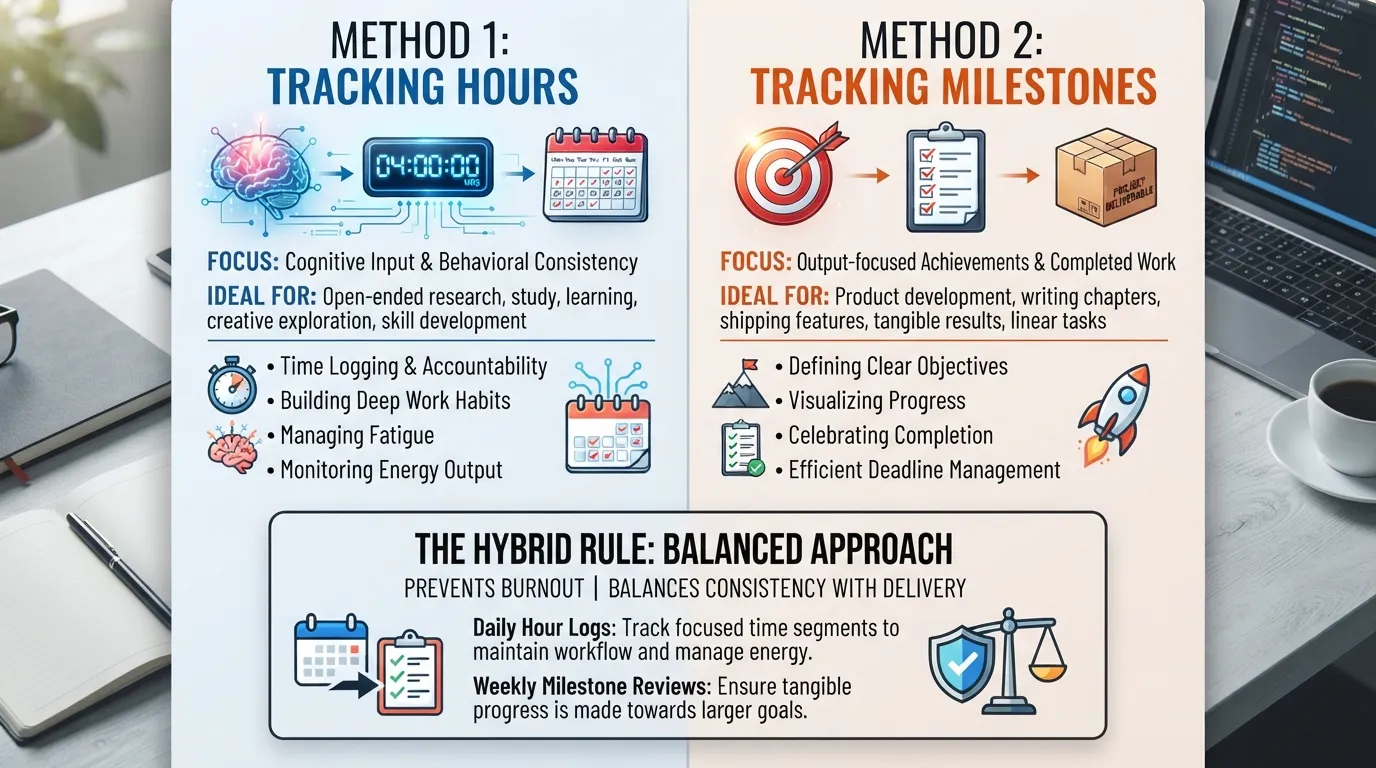
Tracking hours means treating deep work as an input-driven discipline where the primary metric of success is time spent in uninterrupted concentration. Instead of measuring what you produce during a session, you measure your adherence to a scheduled block of focus—using a timer, a spreadsheet tally, or a dedicated productivity log. This approach removes the anxiety of immediate results and focuses entirely on behavioral consistency, ensuring you put in the raw repetitions required to build long-term cognitive endurance.
Tracking milestones — definition
Tracking milestones means focusing exclusively on output-driven completions, where success is defined by a tangible, finished unit of value. Rather than logging how long you sat at a desk, you record completed deliverables—such as finishing a specific chapter outline, shipping a software patch, or solving a designated problem set. This method taps into our psychological need for completion, providing clear, objective markers of progress that prevent endless tinkering and force projects across the finish line.
Tracking Hours — Pros and Cons
Tracking your deep work by the clock is one of the most reliable ways to forge unbreakable daily discipline, but it comes with a hidden psychological tax.
Builds consistency and trains focus
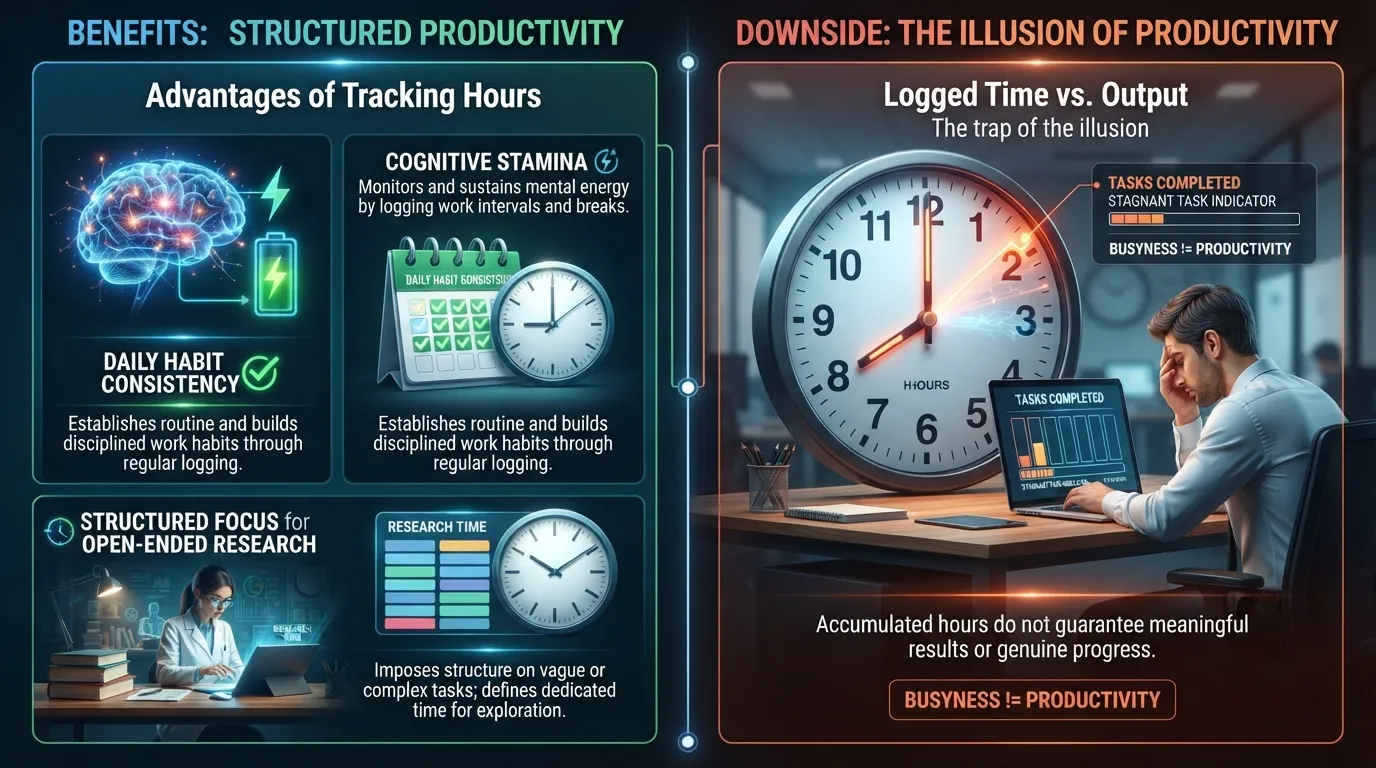
The greatest advantage of logging hours is that it lowers the barrier to entry. When your only daily objective is to sit down and protect a 90-minute block of undistracted attention, you strip away the paralyzing pressure of having to produce a masterpiece right away. This input-focused approach acts like physical training: you are simply putting in the reps to build your cognitive stamina. Over time, these repeated sessions rewire your brain to settle into deep focus faster and resist distractions more naturally.
Best for open-ended and unpredictable work
Some tasks defy neat, linear measurement. If you are exploring a complex research topic, learning a dense new subject, or brainstorming exploratory concepts, you cannot reliably predict what a successful hour looks like. Tracking hours shines in these scenarios because it protects your time without penalizing you for the messy, non-linear nature of complex learning. It gives you permission to explore, fail, and iterate without the panic of a blank output tracker.
Downside: hours do not equal guaranteed output
The trap of tracking hours is the illusion of productivity. It is entirely possible to log three hours of “deep work” while subtly spinning your wheels, editing the same paragraph five times, or giving in to half-focused multitasking. Because the metric rewards sheer presence rather than tangible results, you can walk away feeling accomplished just because a timer ran out—even if you barely moved the needle. When used carelessly, it encourages a clock-punching mentality where time spent substitutes for actual progress.
Tracking Milestones — Pros and Cons
Measuring your progress by finished deliverables completely flips the script from input to output, offering a powerful engine for momentum alongside a few hidden dangers.
Drives hustle and prevents procrastination
Tracking milestones acts as an immediate antidote to endless over-thinking. When your daily objective is explicitly tied to a finished outcome—such as hitting a specific word count, closing three client tickets, or finishing a precise code module—vague efforts transform into urgent, actionable targets. This output-focused clarity removes the comfort of hiding behind busywork, forcing you to confront the task head-on and cross the finish line.
Best for well-defined, linear tasks
Milestones thrive where the path from start to finish is clear and predictable. If you are editing a manuscript, building a standardized landing page, or executing a structured checklist, you know exactly what success looks like before you begin. This method provides clean, satisfying feedback loops that keep motivation high because every completed piece represents a permanent, undeniable step forward.
Downside: burnout risk and unpredictable friction
The dark side of milestones is the psychological weight of a stalled project. When a task hits unexpected roadblocks—like a stubborn coding bug or a creative block—your milestone tracker stays frozen day after day. Chasing these unyielding targets can easily breed anxiety, forcing you to rush, cut corners, or work exhaustive hours just to check a box. When applied to messy, exploratory work, rigid milestones turn into a recipe for fast burnout.
The Psychology Behind Hours vs Milestones
To understand why tracking hours and tracking milestones affect your motivation so differently, we have to look beneath the surface at how our brains process reward and routine. These two metrics trigger entirely different psychological circuits.
Hours equal behavioral consistency and habit formation
When you focus on tracking hours, you are playing the long game of neuroplasticity. This input-focused approach removes the cognitive friction of having to “create something good” every single day, lowering the barrier to entry so you can simply show up.
Psychologically, logging hours reinforces the identity of someone who does the work regardless of inspiration. It trains your brain to associate the physical environment or a specific time of day with deep concentration, automating the habit loop. You are rewarded by the consistency of the routine itself, which builds deep-rooted psychological resilience against resistance and procrastination.
Milestones equal achievement and motivation-driven output
Tracking milestones, on the other hand, hooks directly into our brain’s dopamine reward pathways via concrete progress. This output-focused method feeds our intrinsic desire for completion, mastery, and visible momentum.
When you check off a well-defined milestone, you get an immediate surge of satisfaction that validates your effort and proves the work mattered. It provides an energetic jolt of motivation, signaling to your brain that real-world value has been created. However, because it relies heavily on external proof of success, it can easily backfire when progress stalls, leaving you vulnerable to frustration if the output does not match the time invested.
How to Decide Which One Fits Your Project
Choosing between hours and milestones does not have to be a guessing game. By evaluating the predictability of your work and your primary psychological bottleneck, you can select the exact tracking metric that keeps you moving forward without unnecessary friction.
Decision framework and checklist
Run your current project or daily routine through this quick evaluation checklist to determine your ideal tracking method:
Is the path to completion clear and predictable? If yes, lean toward milestones. If the work is exploratory, research-heavy, or experimental, lean toward hours.
Is your biggest enemy procrastination or perfectionism? If you struggle to simply open your laptop and start, use hours to lower the barrier. If you easily spend hours tinkering without finishing anything concrete, use milestones to force a hard stop.
Does poor output reflect low effort or high complexity? If complex problems require deep cognitive soaking time that cannot be rushed into daily chunks, protect your hours.
Scenario examples across industries
Writing: If you are drafting a first-rate content outline or doing exploratory research, track hours to give yourself permission to think. Once you shift to drafting, switch to daily milestones (such as a 1,000-word daily target) to maintain momentum.
Studying: When tackling dense professional certifications or complex academic subjects, track hours. Comprehension cannot be squeezed into arbitrary daily output targets without sacrificing depth.
Fitness: Use a hybrid approach. Track hours or weekly frequency for endurance routines where showing up is the main battle, but track milestones (weight lifted or reps completed) for strength progression.
Business Operations: For client acquisition, outbound outreach, or setting up new digital systems, use milestones (e.g., sending five custom proposals or publishing a landing page) to prevent administrative busywork from masquerading as productivity.
Creative Design: When wireframing a new website layout or brainstorming visual assets, track hours to allow room for creative iteration, then pivot to milestones once you move into execution and asset export.
Compact decision summary
| Target Audience & Work Type | Recommended Method | Why It Works Best |
|---|---|---|
| Exploratory & Complex Work (Research, studying, brainstorming) |
Hours | Protects cognitive input and prevents frustration when output is non-linear. |
| Linear & Deliverable-Driven Work (Writing, coding, publishing) |
Milestones | Forces hard completions and prevents endless, unproductive editing loops. |
| Habit Formation & Skill Building (Fitness, new routines) |
Hybrid (Hours to start, Milestones to scale) |
Builds baseline consistency first, then transitions into performance tracking. |
The Hybrid Approach: Tracking Both Together
Relying exclusively on a single tracking metric often creates blind spots. When you lean too hard into hours, you risk becoming a professional clock-watcher; when you fixate entirely on milestones, you invite burnout when complex work hits a wall.
The most effective way to resolve this dilemma is a hybrid system that marries both approaches into a unified workflow.
Milestones provide the “why” while hours provide the “how”
To make a hybrid framework work, you have to separate your vision from your execution.
Milestones represent your “why.” They define your destination—such as shipping a fully optimized website section, publishing a comprehensive pillar article, or completing a specific software build. They give your labor purpose and ensure your effort is tied to real-world value.
Hours represent your “how.” They form the engine of your daily execution. On days when a milestone feels insurability distant or a creative block sets in, your fallback is simply logging your deep work hours.
By separating the vision from the daily input, you remove the paralyzing pressure of needing every single session to result in a finished masterpiece.
A simple system: daily hours log and weekly milestone review
You do not need an elaborate, over-engineered tracking app to implement this. A lightweight notebook or a simple spreadsheet is enough to run a sustainable weekly rhythm:
Daily Input Tracking: Each day, log only your uninterrupted hours or blocks of deep concentration. Do not stress about the final output of that specific hour; your sole victory is protecting the time and showing up.
Weekly Output Review: Once a week, step back from the daily clock and evaluate your progress against your broader milestones. Ask yourself: Did my cumulative hours actually move the needle on my primary deliverables?
This cadence ensures you maintain behavioral consistency through daily hour tracking while keeping your overarching projects anchored to tangible, results-driven milestones.
How to Start Tracking Today
Jumping straight into an elaborate tracking system often leads to early burnout. To build sustainable deep habits, you need a frictionless, step-by-step entry point combined with a tracking format that matches your personal workflow.
A 3-step first-week action plan
Define your core focus for the week: Pick one primary project or skill that genuinely moves the needle. Do not try to track every minor task in your life; concentrate exclusively on your most high-leverage objective.
Commit to a two-week baseline trial: Give your chosen tracking method a strict minimum of two weeks before evaluating its effectiveness. Switching methods too early prevents you from building real cognitive momentum.
Log your sessions immediately: Whether you choose hours or milestones, record your progress right after your session ends while the context is fresh. Keep the data entry process under thirty seconds so it never feels like administrative drag.
Tracking formats and tools
Spreadsheet tally: Ideal for data-driven professionals who want to track weekly hour totals alongside completed project milestones in a single, customizable view.
Notebook log: A physical, analog approach that works wonders for clearing mental clutter and building a tactile ritual around your daily deep work sessions.
Kanban board: Perfect for milestone-heavy workflows (such as content production or software development), letting you visually drag tasks from “In Progress” to “Done.”
App-based timer: Best for those who need automated hour-logging, ambient focus sounds, and clean digital analytics without manual data entry.
Common Mistakes People Make
Even with the best framework in place, it is easy to accidentally sabotage your own progress. Avoiding these three common pitfalls will keep your tracking system working for you rather than against you.
Quitting a method too early
The single most common mistake is abandoning a tracking method after just two or three days because it feels awkward or uncomfortable. Building deep habits requires a transition period where your brain adapts to the new structure. If you switch between hours and milestones every time you hit a slight roadblock, you never give either method a fair trial. Stick with your chosen approach for at least two full weeks before deciding whether it needs an adjustment.
Logging data but never reviewing it
Tracking your hours or milestones without a review rhythm turns your log into a digital graveyard of vanity metrics. Collecting data for the sake of checking a box provides zero benefit if you never look back to analyze your patterns. Set aside a brief window at the end of every week to examine your logs: Where did your time actually go? Are your hours converting into meaningful milestones, or are you just spinning your wheels?
Forcing tracking on genuine flow states
When you find yourself deep in a rare, effortless creative flow state, trying to stop and log an hour or check off a micro-milestone can shatter your concentration. Rigorous tracking is meant to support and structure your focus, not micromanage every minute of inspiration. If you are in the middle of breakthrough creative work, put the timer away, let go of the tracker, and simply ride the wave.
Signs You Should Switch Your Tracking Method
Even the best productivity systems lose their edge over time. Recognizing when your current metric has stopped serving you is essential for avoiding prolonged frustration.
The two-week minimum trial rule before judging
Before you panic and overhaul your entire workflow, remember the two-week rule. It takes at least fourteen days for your brain to adjust to a new tracking cadence and work past the initial discomfort. Do not abandon an hours-based or milestone-based approach just because you had a couple of unproductive days. Give the system a fair, uninterrupted trial before deciding it is broken.
Real friction points and warning signs
If you have given your method a fair two-week run and notice these red flags, it is time to pivot:
Logging hours while making zero progress: If your timesheet looks pristine but your projects remain completely stagnant, your hours have turned into “empty work.” Switch to milestones to force tangible outputs.
Chasing milestones leads to rushed, sloppy work: If hitting your daily milestone forces you to cut corners, sacrifice quality, or feel chronic anxiety, the target is too rigid. Pivot to tracking hours to protect your cognitive depth.
Persistent creative dread: If opening your tracker fills you with resistance rather than focus, the current metric is creating friction instead of momentum. Swap methods to realign with your work’s natural rhythm.
Thanawat Rattanakul
Thanawat Rattanakul is the Habits Editor at Holistic Wellbeing Living. He writes about daily routines, habit systems, small behavior changes, and sustainable progress. With eight years of experience creating personal-growth content, Thanawat helps readers build practical routines that fit real life.