Habit Formation and Behavior Change: The Complete Science-Backed Guide
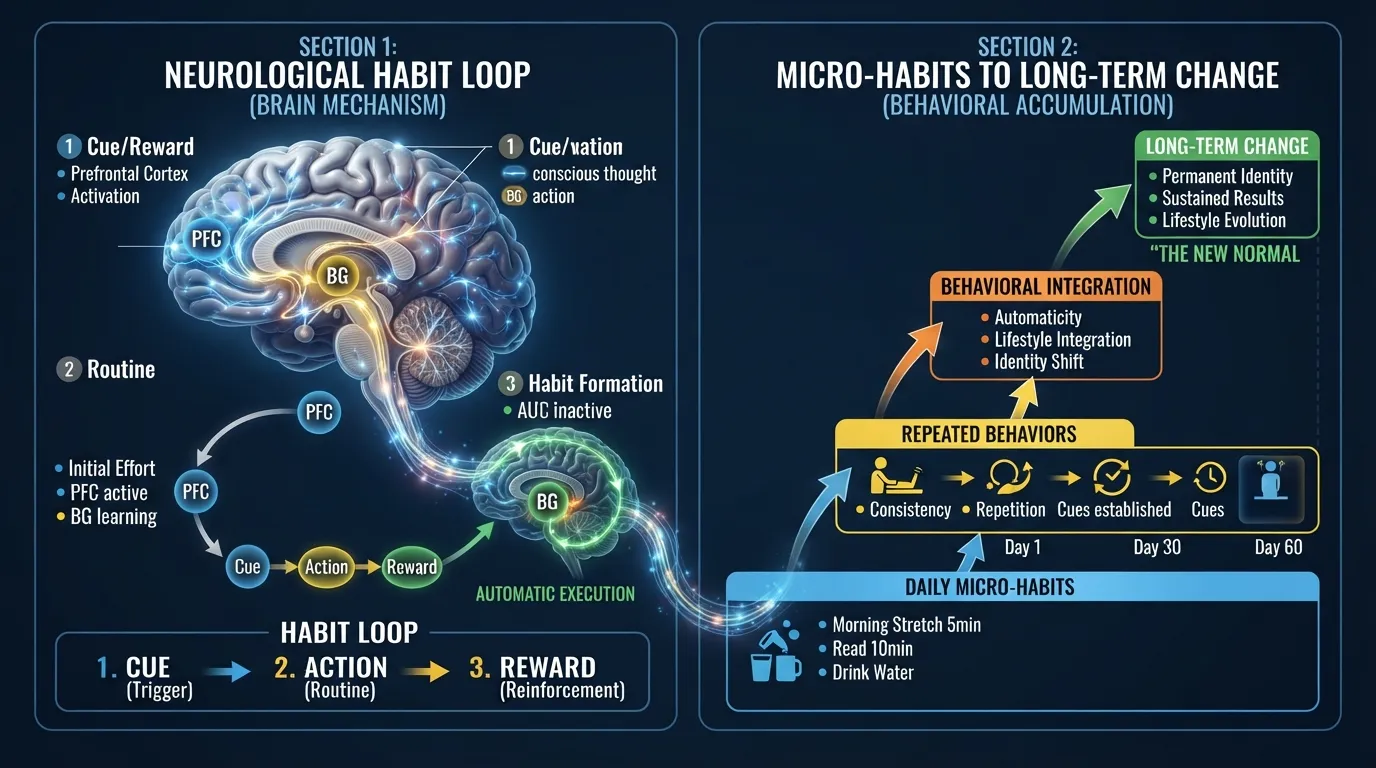
Most people fail to transform their daily routines because they confuse the engine with the destination. Habit formation is simply the mechanical process your brain uses to automate a repeated action, while behavior change is the broader, intentional outcome of shifting how you live.
When you rely solely on willpower to alter your lifestyle, you are forcing your prefrontal cortex to micromanage tasks that your basal ganglia should be handling on autopilot. Lasting transformation does not happen by fighting your impulses; it happens by understanding how neurological loops build automated behaviors. Once you learn how to bridge the gap between mechanical habit formation and conscious behavior change, consistency stops feeling like an exhausting daily battle.
What Is Habit Formation and Behavior Change?
Habit formation is the neurological process by which a frequently repeated action gradually becomes automatic, shifting cognitive processing from the brain’s decision-making centers to the basal ganglia. Conversely, behavior change is the broader, intentional process of altering lifestyle patterns, choices, and long-term actions to align with personal goals.
While they are often used interchangeably, they represent two distinct phases of personal transformation. Small habits act as the foundational building blocks; when individual routines are repeated consistently over time, they accumulate and solidify into sustainable behavior change. You cannot achieve lasting modification in your daily life without first mastering the underlying mechanics of how automatic habits are built.
How Habits Form in the Brain
When you repeat a specific action within the same context, your brain undergoes a process called chunking, hardwiring new neural pathways that reduce cognitive load. Initially, every small step requires intense focus from the prefrontal cortex, consuming significant mental energy. As repetition continues, the brain shifts control of that sequence to the basal ganglia, turning a conscious choice into an efficient, automated program. This shift to automaticity is why driving a familiar route or typing a password eventually requires almost zero active thought.
Yet, this exact neural efficiency explains why destructive patterns are so remarkably sticky. Bad habits persist because they are reinforced by powerful emotional triggers and an established dopamine reward history that bypasses rational analysis. When stress or anxiety acts as a cue, the brain immediately seeks the familiar comfort of a ingrained routine, reinforcing a neural shortcut that is far easier to run than to rewrite.
The Habit Loop: Cue, Routine, Reward
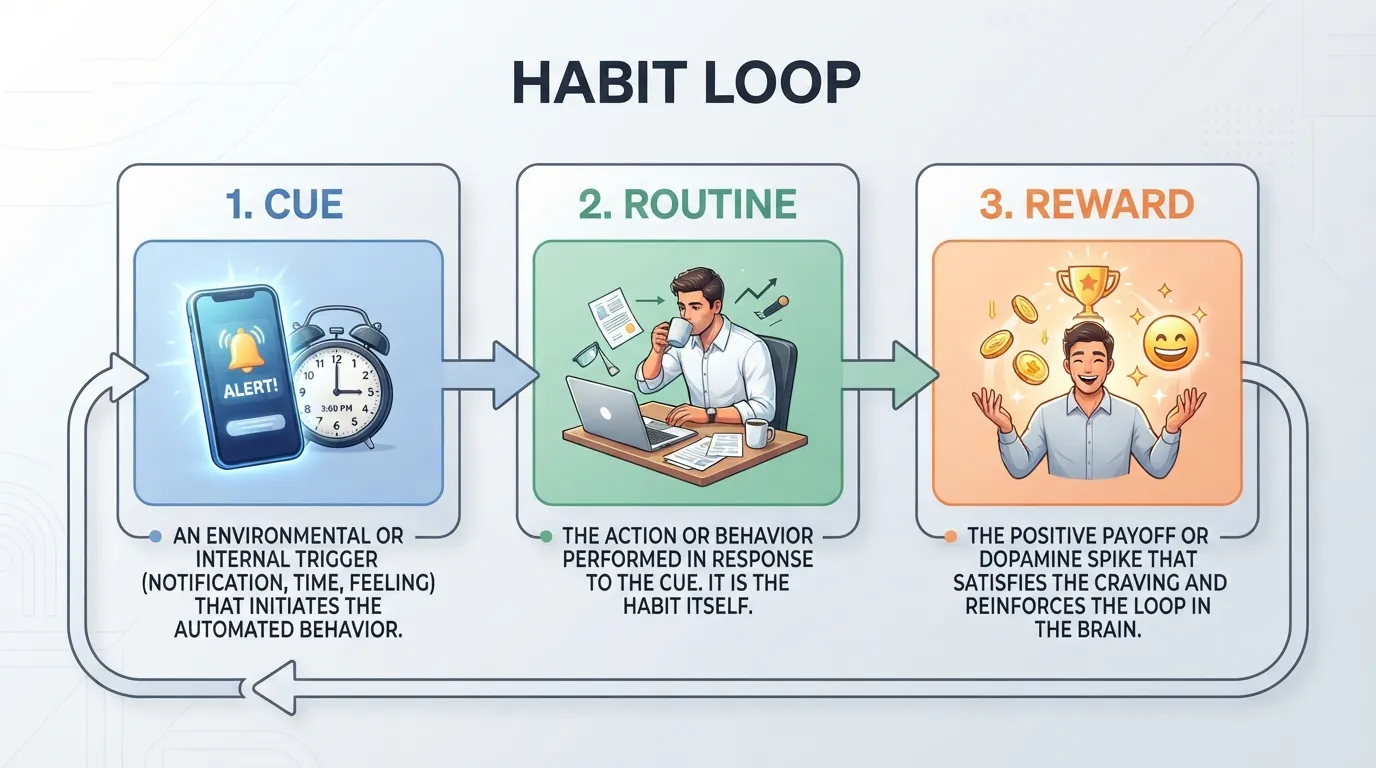
At the core of neurological automation lies a continuous three-part feedback loop that dictates nearly all routine actions. Recognizing how these distinct phases interact is essential for anyone attempting intentional behavior modification.
Cue
The cue is the initial trigger that initiates the brain’s automated sequence, acting as an environmental or internal signal to run a specific program. This can range from a specific time of day or a location to an emotional state like stress or boredom. Identifying your unique cues is the vital first step in effective behavior change.
Routine
The routine represents the actual behavior or response executed in reaction to the trigger, which can manifest as a physical action, a mental habit, or an emotional reaction. Because the brain prefers efficiency, this sequence runs effortlessly once triggered, bypassing active decision-making entirely.
Reward
The reward is the ultimate payoff that reinforces the entire sequence, satisfying a craving and teaching the brain that this specific loop is worth remembering for the future. When you experience a spike of dopamine upon receiving that reward, your neural circuitry encodes the connection, making you significantly more likely to repeat the exact same response the next time the cue appears.
For instance, when a heavy workload triggers sudden work anxiety (cue), you might instinctively open a tab to scroll through social media (routine) to numb the discomfort and get a quick dopamine lift (reward). Breaking or altering this pattern requires swapping out the routine while keeping the cue and the desired underlying reward intact.
The 3 Phases of Habit Formation Initiation, Learning, Stability

Transitioning a conscious choice into an ingrained, automatic action does not happen overnight. The brain progresses through distinct developmental stages before a new pattern becomes second nature.
Initiation Phase
The initiation phase marks the beginning of habit formation, where you intentionally choose a specific new behavior and set up the environmental triggers to support it. This stage demands the highest amount of conscious effort and mental energy because the neural pathways for the new action have not yet been established.
Learning Phase
As you repeat the action day after day, you enter the learning phase, where the behavior becomes progressively more fluent and automatic. During this middle stage, the brain begins chunking the sequence, meaning the mental friction decreases as the action relies less on active decision-making and more on contextual cues.
Stability Phase
In the final stability phase, the habit reaches peak automation and is integrated seamlessly into your daily routine with minimal cognitive load. The behavior now runs smoothly in the background, requiring little to no deliberate willpower to execute when the familiar cue appears.
How Long Does It Really Take to Form a Habit?
Popular culture has long claimed that breaking or building a habit takes precisely 21 days, a persistent myth born from a misinterpretation of plastic surgery patient recovery timelines in the 1960s. Rigorous psychological research paints a very different picture. Groundbreaking studies led by health psychology researcher Dr. Phillippa Lally at University College London found that actual habit formation takes anywhere from 18 to 254 days, with the average clocking in at 66 days depending on the complexity of the behavior, the individual, and environmental consistency. Missing a single day occasionally does not derail the process, but patience and sustained repetition are non-negotiable for true neural rewiring.
What Are the 4 Stages of Habit Formation?
When researching habit formation, you will often encounter a completely different four-stage framework that causes widespread confusion among readers. While the earlier three-phase model describes the neurological journey from a conscious choice to automaticity (initiation, learning, and stability), the four-stage framework—popularized by James Clear in Atomic Habits and rooted in behavioral psychology—focuses entirely on the mechanics of the habit loop: Cue, Craving, Response, and Reward.
To clear up this common search confusion, the four-stage model breaks down the internal psychological drivers of behavior modification rather than tracking the timeline of neural automation:
Cue: The environmental spark or trigger that notices a reward and signals the brain to initiate action.
Craving: The motivational force and internal desire behind every habit, driven by the anticipation of the reward rather than the action itself.
Response: The actual thought, habit, or behavior you perform to satisfy the craving.
Reward: The ultimate benefit or emotional payoff that satisfies the craving and teaches the brain which sequence is worth remembering.
Understanding these four psychological stages helps you diagnose where a broken routine fails. If you lack consistency, the issue usually stems from a weak cue or an uncompelling reward, rather than a lack of personal discipline.
The 5 Stages of Behavior Change Transtheoretical Model
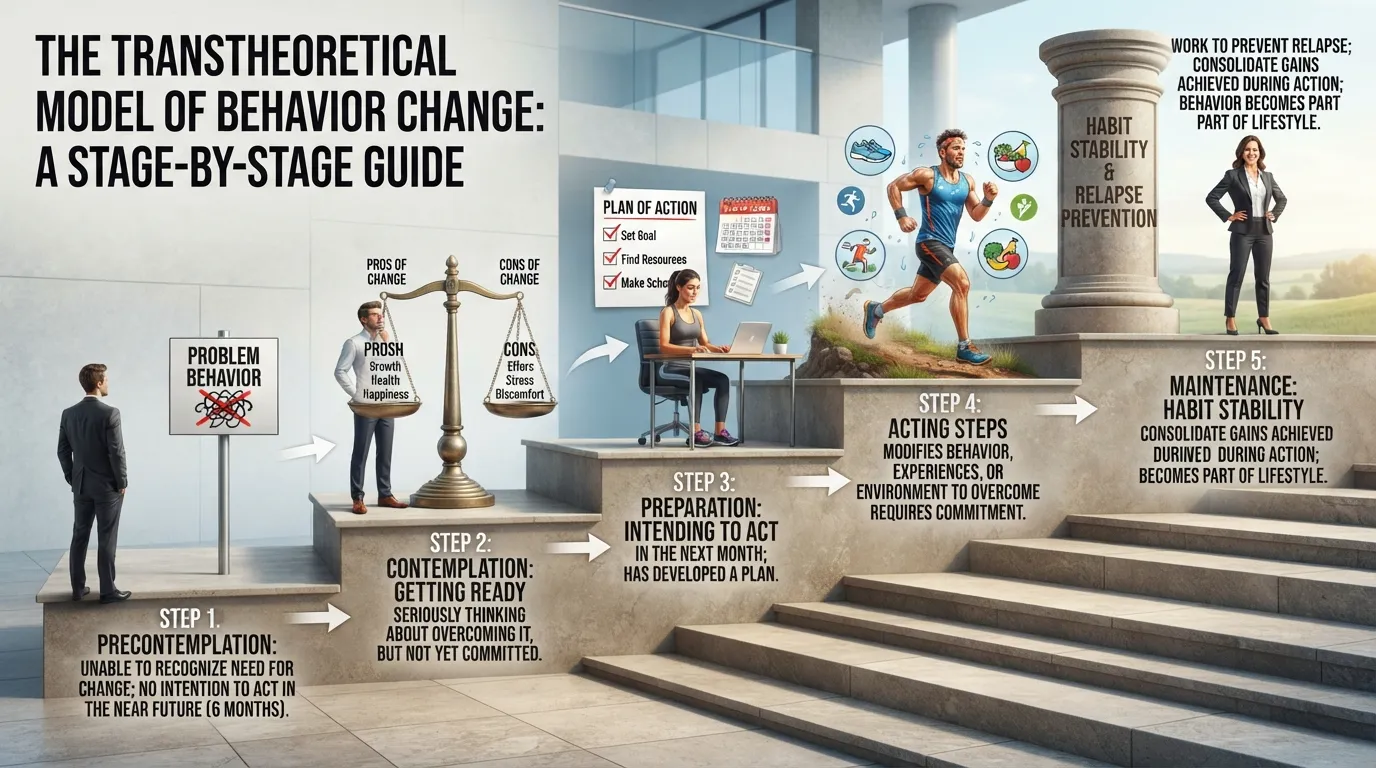
Moving beyond daily routines requires understanding that behavior change is a dynamic progression rather than a single, instantaneous event. Developed by researchers James Prochaska and Carlo DiClemente, the Transtheoretical Model explains that individuals move through distinct psychological milestones when modifying their actions. Recognizing which stage you currently occupy prevents burnout and dictates the right strategies for sustainable behavior modification.
Precontemplation
In the precontemplation stage, individuals are unaware or unconcerned that a problem exists, often viewing their habits as harmless or unchangeable. People here rarely seek out self-improvement resources, as external pressure from others usually drives any acknowledgment of a potential issue.
Contemplation
During contemplation, you recognize that a problem exists and seriously begin weighing the pros and cons of changing your behavior. While you acknowledge the need for alteration, you remain ambivalent, often caught in chronic hesitation about the effort required to shift your lifestyle.
Preparation
Preparation arrives when intention meets planning, and you actively commit to making a change in the immediate future. In this phase, people research actionable steps, set up environmental supports, and assemble the tools required to execute their new routine successfully.
Action
The action stage is where visible modification occurs, requiring the highest concentration of conscious effort, energy, and immediate focus. Individuals actively alter their behavior, routines, or environment while fighting off old triggers and working to establish fresh neural pathways.
Maintenance
In the final maintenance stage, the new behavior has been sustained for an extended period, typically six months or longer, and is deeply integrated into daily life. The primary focus shifts from initiating change to preventing relapse, ensuring the established patterns withstand unexpected stress or environmental disruptions.
The 5 A's of Behavior Change
While clinical frameworks often apply behavioral steps from a doctor-patient perspective, you can easily adapt this structured methodology for self-directed personal growth. The 5 A’s of behavior change—Ask, Advise, Assess, Assist, and Arrange—provide a practical roadmap for evaluating your lifestyle and executing lasting behavior modification on your own terms.
Ask: Start by brutally auditing your current routines and recognizing which patterns no longer serve your long-term goals. Instead of ignoring daily frustrations, consciously question the triggers behind your unwanted habits.
Advise: Formulate a clear, honest assessment of what needs to shift and commit to a specific direction. Act as your own trusted advisor by outlining the precise reasons why changing this behavior matters to your future.
Assess: Evaluate your current environment, mental roadblocks, and readiness to tackle the shift. Determine whether you are truly prepared to put in the consistent effort or if you need to adjust your setup first.
Assist: Build out practical tools, supportive systems, and environmental guardrails to make the new behavior as friction-free as possible. This phase involves setting up cues, reducing visual temptations, and streamlining your daily path.
Arrange: Establish long-term accountability structures and fallback plans to protect your progress against future setbacks. By arranging your schedule and support networks ahead of time, you ensure that your new patterns survive unexpected stress and disruption.
The 5 Principles of Behavior Modification
Rooted in classical and operant conditioning, behavioral psychology relies on core learning mechanisms to explain how actions are acquired, altered, or dropped. Understanding these foundational principles gives you a behind-the-scenes look at how your environment and consequences continually shape your actions.
Reinforcement: Any consequence that increases the likelihood of a behavior repeating, whether through positive reinforcement (adding a desirable reward) or negative reinforcement (removing an unpleasant stimulus).
Punishment: A consequence designed to decrease the frequency of a behavior by introducing an adverse outcome or removing a privilege immediately after the action occurs.
Extinction: The gradual fading and eventual disappearance of a conditioned behavior that happens when you completely remove the reinforcement or reward keeping it alive.
Shaping: The method of reinforcing incremental, successive approximations of a target goal, allowing you to build complex new behaviors step by step rather than expecting perfection instantly.
Generalization: The tendency for a learned behavior to transfer and appear in new environments or situations that share similar cues with the original setting.
How to Change Behavior Patterns Permanently Practical Strategies
Moving from psychological theory to daily execution requires concrete, tactical frameworks that bridge the gap between intention and automaticity. Permanent behavior modification does not happen through sheer willpower; it requires deliberate system design that works with your brain’s natural wiring rather than fighting against it.
Anchor New Habits to Existing Routines (Habit Stacking)
Instead of trying to find a random time in your day for a new action, attach your desired behavior directly to an established, automatic part of your daily schedule. By leveraging an existing anchor—such as “after I pour my morning coffee” or “immediately after I sit down at my desk”—you create an infallible contextual trigger that eliminates the guesswork of when to start.
Shape Your Environment (Cue Design)
Willpower is a finite resource, so relying on it to resist bad patterns is a losing battle. Redesign your physical and digital surroundings to make positive behaviors frictionless and destructive ones inconvenient. Put your workout clothes out the night before or hide your phone in another room to leverage architecture over internal resistance.
Reward Yourself Immediately
To cement a brand-new behavior, your brain needs an immediate emotional or sensory payoff that signals success before the long-term benefits kick in. Choose an instant, micro-reward—such as a favorite song, a brief stretch break, or a satisfying checkmark on a calendar—that reinforces the neural loop right after the action is finished, bypassing the delay of delayed gratification.
Track Progress and Repeat Consistently
Visual accountability keeps momentum alive when initial motivation starts to fade. Use a simple streak tracker, a habit journal, or a wall calendar to monitor your daily execution, ensuring that you maintain the uninterrupted repetition required for the brain to transition the behavior into the stability phase.
The 3-3-3 Rule (Explained)
The 3-3-3 rule is a practical time-management and behavioral pacing framework used to prevent overwhelm during major lifestyle shifts. By focusing on three major tasks today, dedicating three hours of deep work to your most critical priority, and ensuring three short strategic pauses throughout your day, you prevent decision fatigue and maintain the steady energy required for lasting behavior change.
How to Rewire Your Brain to Stop a Bad Habit
Eradicating an unwanted behavior permanently is rarely about white-knuckling your way out of temptation; it is about surgical routine substitution. Keep the original cue and the underlying emotional reward intact, but intercept the automatic autopilot midway by intentionally swapping out the destructive action for a healthier alternative that fulfills the exact same craving.
Real-Life Examples of Behavior Change and Habit Formation
Real-world modeling reveals that sustainable transformation rarely begins with sweeping life overhauls. Instead, lasting progress takes root when individuals apply psychological mechanisms to targeted daily patterns.
Health Example: Someone struggling with late-night emotional eating shifts their approach by targeting the loop rather than restricting food. Recognizing that evening fatigue or work stress acts as the cue, they keep the underlying reward—relaxation—by swapping the kitchen trip for a hot cup of herbal tea and 10 minutes of reading, successfully breaking the automated snacking routine.
Productivity Example: A professional drowning in continuous distraction addresses their workflow through environmental design rather than willpower. By placing their phone in a drawer in another room and using a structured 3-3-3 pacing rule, they eliminate immediate visual triggers and establish frictionless deep-work habits.
Mental-Health Example: An individual managing daily anxiety moves from the contemplation stage to action by establishing a micro-journaling habit anchored to an existing routine, such as writing down three reflective thoughts immediately after brewing morning coffee. This small, repeatable step gradually shifts brain activation and builds long-term emotional stability.
Quick-Reference Summary
Core Frameworks & Stages of Behavior Change
| Framework | Core Components / Stages | Primary Focus |
|---|---|---|
| The Habit Loop | Cue, Routine, Reward | The neurological feedback loop driving automatic actions. |
| 3 Phases of Habit Formation | Initiation, Learning, Stability | The developmental timeline from conscious choice to neural automation. |
| 5 Stages of Behavior Change | Precontemplation, Contemplation, Preparation, Action, Maintenance | The psychological milestones of long-term lifestyle modification. |
| The 5 A's | Ask, Advise, Assess, Assist, Arrange | A self-directed operational framework for executing personal growth. |
| 5 Principles of Modification | Reinforcement, Punishment, Extinction, Shaping, Generalization | The foundational learning mechanisms governing behavioral shifts. |
Frequently Asked Questions
What is the 3-3-3 rule for habits?
The 3-3-3 habit rule is a practical framework used to build consistency without feeling overwhelmed. It typically involves focusing on 3 daily priorities, dedicating 3 weeks to establish initial momentum, or using brief 3-minute grounding actions to prevent friction when starting a new routine.
What are the 4 stages of habit formation?
Popularized in behavioral psychology, the four stages of building a habit loop consist of:
- Cue: The trigger that initiates the behavior.
- Craving: The motivational force or desire behind the habit.
- Response: The actual action or habit performed.
- Reward: The benefit gained, which reinforces the loop for the future.
How long does it take to break a habit?
Breaking an established habit depends heavily on its complexity and your environment, but psychological research indicates it generally takes anywhere from several weeks to several months. Rather than completely erasing an old neural pathway, breaking a habit typically involves replacing the routine while keeping or modifying the underlying cue and reward.
Breaking an established habit depends heavily on its complexity and your environment, but psychological research indicates it generally takes anywhere from several weeks to several months. Rather than completely erasing an old neural pathway, breaking a habit typically involves replacing the routine while keeping or modifying the underlying cue and reward.
Is the 21-day habit myth true?
No, the idea that it strictly takes 21 days to form a new habit is a widespread misconception. University research shows that the actual time required to form an automatic routine varies widely from 18 to 254 days, depending on the individual, the behavior, and environmental consistency.
What are the 10 types of behavior?
Human behavior manifests across various psychological and social dimensions. Common classifications include overt (observable actions), covert (internal mental processes), voluntary, involuntary, adaptive, maladaptive, instinctive, learned, rational, and emotional behaviors.
What makes people change their behavior?
Behavior change is typically driven by a combination of internal motivation, environmental triggers, shifting emotional states, and external consequences. Significant change often occurs when the friction of maintaining an old habit outweighs the perceived effort required to adopt a new one.
Can habits really be changed permanently?
Yes, habits can become permanent fixtures of your daily life through automaticity, where the neural pathways become so well-established that the action requires minimal conscious effort. However, maintaining permanent change relies heavily on sustaining supportive environmental cues and guarding against old triggers.