Habit Formation Psychology: How Habits Form in the Brain Process, Benefits & Drawbacks
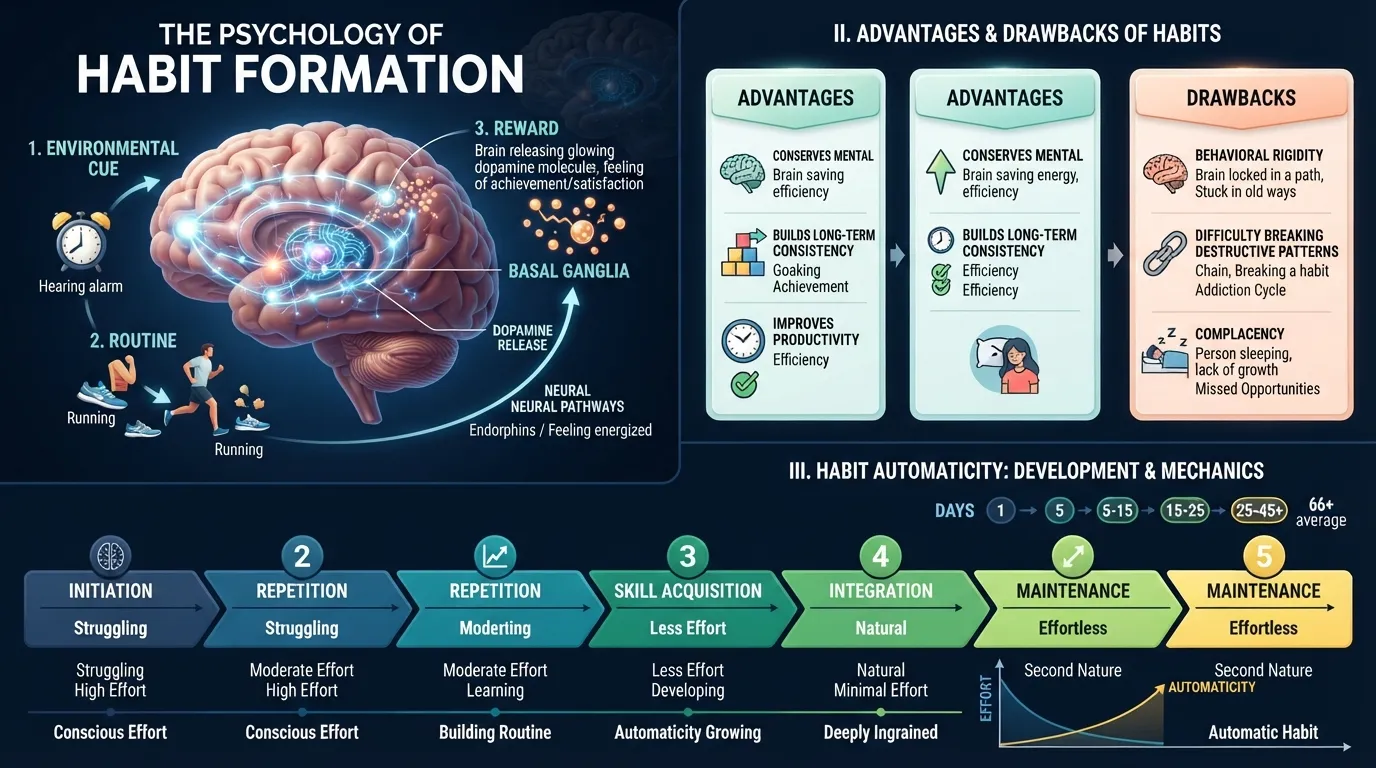
Habit formation psychology examines how repetitive behaviors transition into automatic neural pathways in the basal ganglia, freeing up conscious mental energy for complex decision-making. By anchoring cues, routines, and rewards into predictable loops, the brain optimizes daily functioning without requiring active deliberation for every routine action.
What Is Habit Formation in Psychology?
Habit formation is the behavioral process by which actions shift from deliberate, conscious choices into automatic routines triggered by environmental cues. When you repeat an action in a stable context—like reaching for your phone the second you wake up or lacing up running shoes immediately after work—the brain wires those steps together so tightly that the behavior runs on autopilot.
Three core elements drive this entire mechanism:
Cue-dependency: A specific trigger—a time of day, an emotional state, or a physical location—serves as the starting gun for the brain’s automatic script.
Repetition: Performing the behavior consistently within that same context strengthens the neural pathways required to execute it.
Automaticity: The final destination where the action executes with minimal conscious oversight, freeing up cognitive bandwidth for other tasks.
For a deeper dive into how researchers categorize these behavioral structures, explore the core concepts on our habit definition psychology page.
Real-Life Examples of Habit Formation

Behavioral loops play out in everyday life through familiar routines that illustrate how cues, actions, and rewards interact in the brain.
The exercise routine: Laying out gym clothes the night before acts as a physical cue, triggering the routine of heading to the workout, which delivers the natural reward of endorphins and stress relief.
The phone-checking habit: A sudden ping or a quiet moment of boredom serves as the cue, prompting the automated routine of unlocking the device for a quick social media scroll, which satisfies the brain’s craving for micro-dopamine hits.
Brushing teeth: Standing at the bathroom sink before bed provides a contextual cue that initiates a fully automatic sequence of cleaning, requiring near-zero conscious effort because the neural pathway is completely hardwired.
The 4 Stages of Habit Formation The Habit Loop
Cue → Craving → Response → Reward (modern model)
Behavioral psychology breaks modern habit formation down into four distinct phases that turn a single action into a permanent lifestyle loop. The cue acts as the environmental spark that notices a reward, instantly triggering a psychological craving for the feeling that reward provides. That craving motivates the response—the actual behavior or habit you perform—which ultimately delivers the reward and satisfies the initial itch.
Cue → Routine → Reward (classic loop)
The classic framework simplifies this neural sequence into a three-step cycle popularized by neurological research on the basal ganglia. A contextual cue signals the brain to initiate a behavioral routine without active thought, which immediately leads to a reward that teaches the brain to remember the loop for next time. Here is the part most people miss: once this three-step pathway is carved out, the brain stops actively evaluating choices and simply waits for the cue to run the entire script.
The Brain Science of Habit Formation
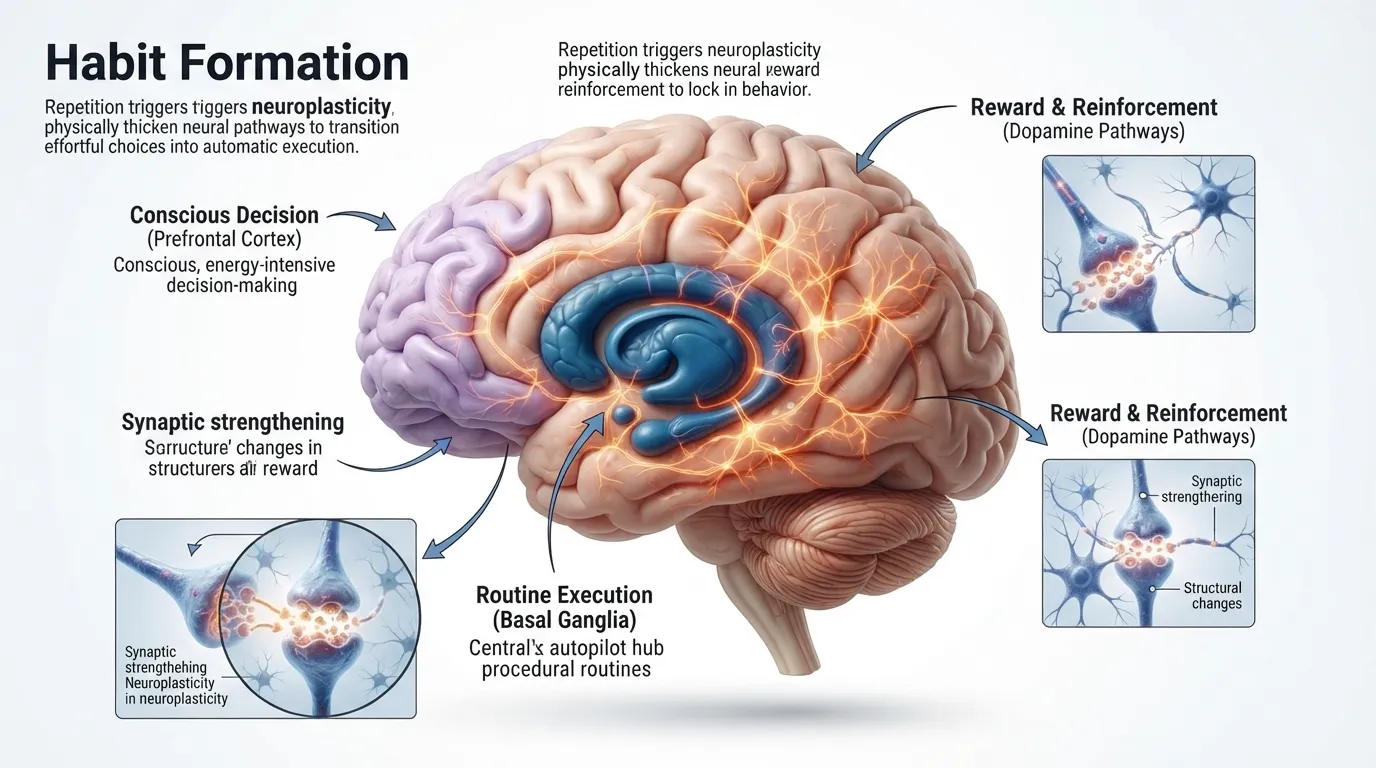
Basal Ganglia — the brain’s autopilot system
Deep inside the brain sits the basal ganglia, a collection of structures that acts as the command center for physical movement and procedural learning. When you learn a brand-new task, this area stays quiet while the thinking parts of your brain work overtime. But as an action repeats, the basal ganglia takes over, converting the sequence into a streamlined, chunked-together routine that runs without conscious oversight.
Dopamine’s role in reinforcing the loop
Dopamine does much more than just deliver pleasure—it acts as the primary chemical messenger for motivation and learning. When a behavior leads to a rewarding outcome, a spike of dopamine teaches the brain to value that specific action, stamping the neural connection so you are more likely to repeat it next time the cue appears.
Prefrontal Cortex vs automatic behavior
The prefrontal cortex handles heavy-duty cognitive lifting, including logical reasoning, decision-making, and self-control. Notice how exhausting it feels to make dozens of choices before noon? The brain shifts behaviors over to automatic pathways precisely to give this tired region a break, letting routine actions bypass conscious deliberation altogether.
Neuroplasticity: Every single time you repeat a behavior, neural pathways physically strengthen and myelinate, effectively laying down heavy-duty insulation around the brain’s electrical wiring to make the habit faster and more permanent.
How Long Does It Take to Form a Habit? Science-Backed Timeline
Habit formation does not happen overnight, and it certainly does not adhere to the popular 21-day myth popularized by decades of self-help folklore. Phillippa Lally and her research team at University College London tracked real people building new health behaviors and found a wide real-world range of 18 to 254 days, with the actual average landing right around 66 days for a behavior to become fully automatic.
That old 21-day figure is merely the time it takes for superficial behavioral adjustment to start taking root, not the complete timeline for neural wiring. Missing a single day here or there does not ruin the process either, meaning you do not have to stress over absolute perfection to build a lasting routine.
What speeds up or slows down formation (complexity, consistency, environment)
The speed at which a behavior locks into your daily routine depends heavily on a few distinct variables:
Behavioral complexity: Drinking a glass of water immediately after waking up automates much faster than trying to complete a complex, 45-minute circuit workout.
Contextual consistency: Performing the action in the exact same setting with the same trigger every day accelerates the brain’s pattern recognition.
Environmental friction: Removing physical barriers—like placing your book right on top of your pillow—speeds up the loop, while clutter or obstacles drag out the timeline.
Advantages of Habit Formation in Psychology
Saves mental energy: Automating routine actions drastically reduces daily decision fatigue, letting you navigate mornings and work blocks without draining your mental battery on trivial choices.
Builds long-term consistency: Small, repetitive behaviors compound over months and years, making it possible to achieve massive goals through steady, incremental progress rather than sheer willpower.
Frees cognitive resources: When foundational behaviors run on autopilot, your brain reserves its processing power for complex problem-solving, creative work, and unexpected challenges.
Drives identity-level change: Repeating a positive behavior consistently reshapes how you view yourself—transforming you from someone who “tries to run” into someone who simply identifies as a runner.
Disadvantages of Habit Formation in Psychology
The neural double standard: The exact same neurobiological mechanism that hardwires a healthy morning stretch routine will just as easily automate a destructive habit, like reaching for sugary snacks when stressed.
Deep neural entrenchment: Once a behavioral loop is fully embedded in the basal ganglia, unlearning it is notoriously difficult because the brain resists altering a pathway that already requires zero effort to run.
Unconscious autopilot execution: Habits run completely outside conscious awareness, meaning you can easily slip into old, undesirable behaviors—such as mindlessly scrolling social media—before you even realize you made the choice.
Behavioral rigidity: Over-relying on automated routines reduces cognitive flexibility, making it harder to adapt when sudden environmental changes require a fresh, creative approach rather than the same old script.
Why Are Bad Habits So Hard to Break? Psychology Explained
The brain prefers familiar patterns, even harmful ones
The human brain is fundamentally an energy-saving organ programmed to choose the path of least resistance. Familiar neural loops require virtually zero cognitive power to execute, which is why the brain defaults to them—even when those established patterns involve destructive behaviors like smoking, nail-biting, or late-night emotional eating. Choosing a new path forces the brain to expend precious metabolic energy, so it will always try to pull you back toward the comfortable gravity of old routines.
Environment shapes behavior more than willpower
Willpower is a finite mental resource that depletes quickly over the course of a demanding day, making it a terrible primary defense against bad habits. Environmental cues exert a far stronger pull on human behavior than raw self-discipline ever could. If a bowl of candy sits directly on your desk, the visual cue will override your best intentions long before your prefrontal cortex has a chance to step in.
Old neural pathways resurface under stress (relapse)
When you feel overwhelmed, anxious, or exhausted, the executive control center in the prefrontal cortex goes offline, leaving older, deeply entrenched neural pathways in charge. This is why people under chronic stress so easily slip back into old habits—the brain retreats to its strongest, oldest survival scripts because those pathways require the least amount of active thought to navigate.
How to Apply Habit Formation Psychology in Real Life
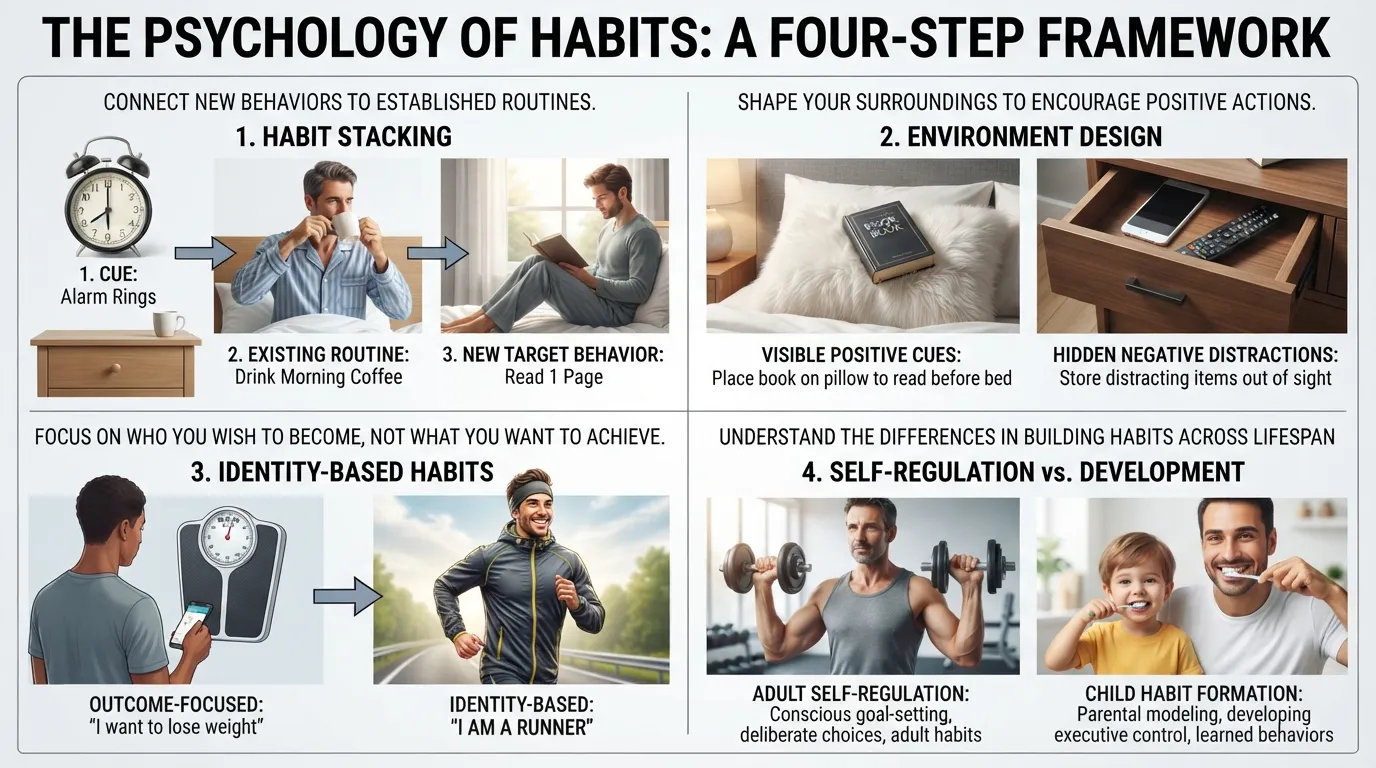
Habit stacking
Habit stacking leverages an existing automated routine as the anchor cue for a new behavior you want to introduce. Instead of trying to find a brand-new trigger out of thin air, you latch the new habit directly onto an established one using a simple formula: “After [Current Habit], I will [New Habit].” For example, pairing a daily vitamin intake immediately after pouring your morning cup of coffee uses an already hardened neural pathway to pull the new action along with it.
Environment design (visible good cues, hidden bad ones)
Relying on raw self-discipline is a losing battle because environmental triggers override willpower almost every single time. Reengineering your physical surroundings to favor your goals means making positive cues blatantly obvious—like leaving a book directly on your pillow—while hiding negative triggers entirely out of sight, such as stashing your phone in another room while working.
Identity-based habits (“I am someone who…”)
True behavioral change starts from the inside out by shifting how you perceive your own identity rather than just focusing on external outcomes. Telling yourself “I am trying to run a marathon” keeps the behavior feeling like a chore, whereas adopting the identity “I am a runner” means every single workout simply acts as a vote confirming who you already are. Once your actions align with your core self-image, maintaining consistency stops feeling like an uphill struggle.
Habit Formation in Children vs Adults (developing prefrontal cortex, parental modeling)
Children approach habit formation differently than adults because their prefrontal cortex—the seat of executive control and long-term planning—is still years away from full neurological maturity. This means kids rely heavily on external structure and emotional co-regulation rather than internal self-discipline to build routines. Because their developing brains absorb patterns through deep observational learning, consistent parental modeling and environmental cues shape a child’s foundational habits far more effectively than verbal instructions ever could.
Breaking a Habit Loop: What Psychology Recommends
Identify the trigger (when/where/what emotion): You cannot dismantle an automated loop until you pinpoint exactly what sets it off, whether it is a specific time of day, a physical location, or a hidden emotional state like stress or boredom.
Replace, don’t just remove: Erasing a behavior leaves a vacuum that the brain will quickly try to fill with another craving, so the key is keeping the exact same cue and reward while swapping out the intermediate routine.
Start with a small substitution: Trying to overhaul a deeply entrenched habit all at once triggers heavy psychological resistance, making micro-adjustments—like swapping an afternoon sugary snack for a glass of water—the most reliable path to permanent change.
Types of Habits in Psychology Quick Overview
Habits extend far beyond simple physical actions, branching into distinct mental and behavioral categories that govern how we move, think, and interact with the world around us.
Motor habits: Physical, movement-based routines—such as typing on a keyboard, tying shoelaces, or riding a bike—that rely heavily on procedural memory in the basal ganglia.
Intellectual habits: Automatic mental processes and cognitive shortcuts used for problem-solving, decision-making, and critical analysis.
Social and emotional habits: Automated behavioral responses to interpersonal dynamics and emotional triggers, such as default coping mechanisms during stress or automatic conversational manners.
Productivity habits: Time-management and workflow routines that dictate how you tackle tasks, prioritize work, and structure your daily output.
To explore how researchers categorize these behavioral classifications in greater detail, take a look at our complete types of habits guide.
Frequently Asked Questions
Habit formation theory traces its roots back to early pioneers like William James, who emphasized how repeated actions carve neural pathways, and B.F. Skinner, who mapped out how consequences reinforce behavior. Modern psychology synthesizes these ideas into the loop model, explaining how environmental cues and rewards automate our daily routines.
Breaking a habit loop requires identifying the specific trigger that sets it off and substituting the routine rather than trying to delete it entirely. By keeping the same cue and fulfilling the underlying craving with a healthier action, you rewire the pathway without fighting the brain's natural resistance.
The 3-3-3 rule is a flexible framework used to build consistency by focusing on manageable execution: tackling 3 small habits daily, dedicating 3 weeks of strict tracking to cement the routine, and anchoring them to 3 distinct visual cues in your environment.
Popularized by behavioral models like James Clear's framework, the three R's stand for Reminder (the cue that initiates the action), Routine (the behavior itself), and Reward (the benefit that teaches your brain to remember the loop for next time).
The 7-21-90 rule is a popular pop-psychology guideline suggesting it takes 7 days to adapt to a new mindset, 21 days to form a basic habit, and 90 days to permanently integrate it as a permanent lifestyle change. While neuroscience shows timelines vary wildly, the 90-day mark roughly aligns with deeper behavioral integration.
No, the idea that it takes exactly 21 days is a widespread myth. University College London research by Phillippa Lally found that true automaticity takes anywhere from 18 to 254 days, with the actual average landing right around 66 days depending on complexity.
The most reliable approach combines habit stacking—anchoring a new action to an existing routine—with intelligent environmental design that removes friction for good choices. Lowering the barrier to entry ensures consistency long before motivation fades.