Habit Formation Strategies That Work: A Step-by-Step Guide
What Is Habit Formation?
Habit formation is the neurological process by which a behavior becomes entirely automatic through steady, repeated execution. When you repeat an action in a consistent context, the basal ganglia—the brain’s hub for procedural memory and routines—takes over, freeing up cognitive energy for other tasks.
Understanding habit formation theory sits at the intersection of psychology and behavior change — building a habit is really about changing behavior in a durable way rather than relying on fleeting bursts of motivation.
To see how this rewiring actually happens day to day, you have to look at the mechanical sequence driving every single routine.
The Habit Loop — Why Habits Actually Form
Cue → Routine → Reward (Charles Duhigg’s model)
Every recurring action in your day runs on a predictable three-part neurological loop popularized by Charles Duhigg.
Cue: The environmental or internal trigger that initiates the behavior, such as your phone buzzing or walking into a dark room.
Routine: The actual physical, mental, or emotional action you perform in response to that trigger.
Reward: The tangible benefit or dopamine release that follows, which signals to your brain that this sequence is worth remembering for the future.
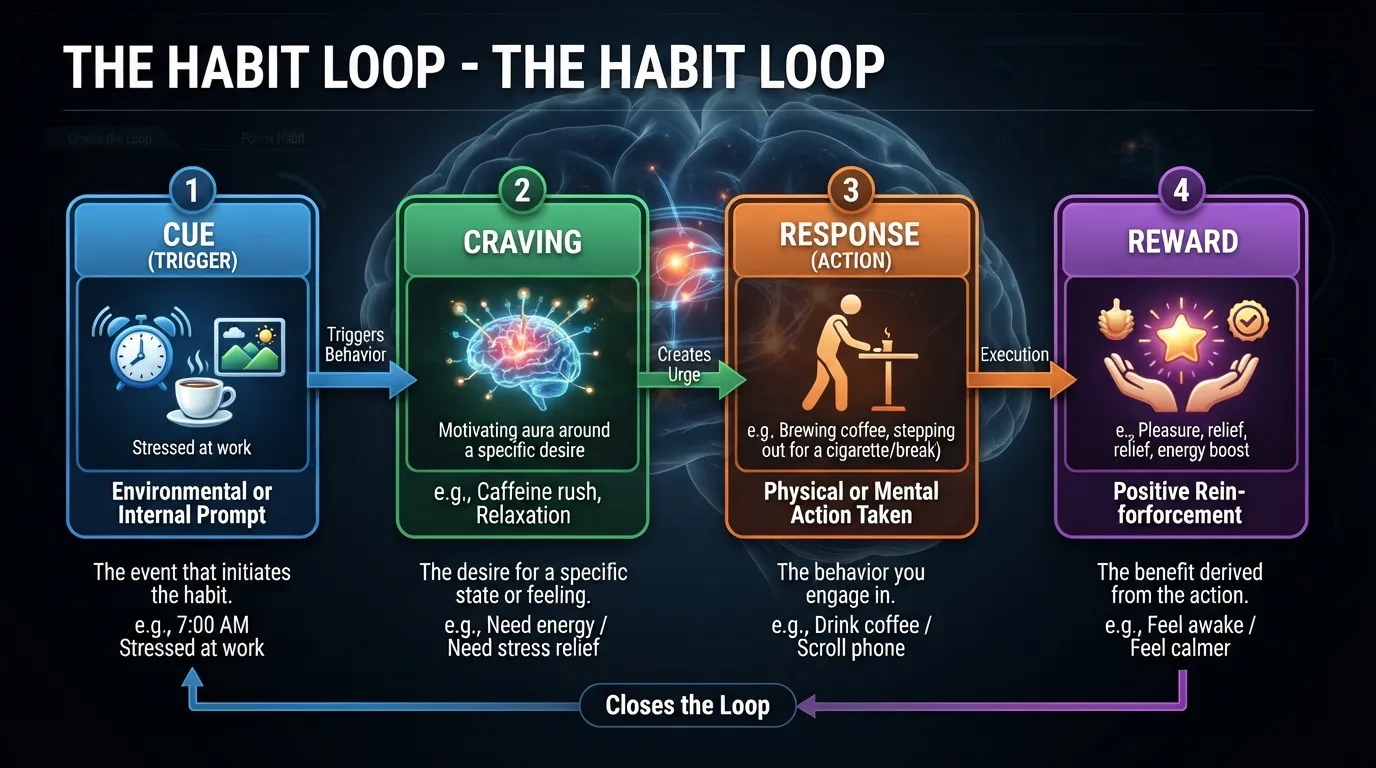
The 4-Stage Model (Cue → Craving → Response → Reward)
James Clear’s four-stage framework expands on that foundational loop by introducing the motivational engine that keeps the cycle spinning. While the cue triggers the mechanism, the craving is the motivational force behind it—it is the internal desire you feel for the state the reward will deliver, rather than the reward itself. You don’t crave a cup of coffee; you crave the alertness and warmth it provides. That craving drives your behavioral response, which ultimately delivers the rewarding feedback loop.
Why This Happens in Your Brain
This entire sequence shifts from conscious, deliberate effort to pure autopilot through a process called chunking, managed by the basal ganglia. When a behavior is novel, your prefrontal cortex works overtime to calculate every step. As you repeat the cue-routine-reward sequence, brain activity shifts from the thinking areas to the automated procedural centers. Understanding these underlying habit formation strategies in psychology proves that lasting change isn’t about white-knuckling your way through a goal—it’s about engineering the loop so automation does the heavy lifting.
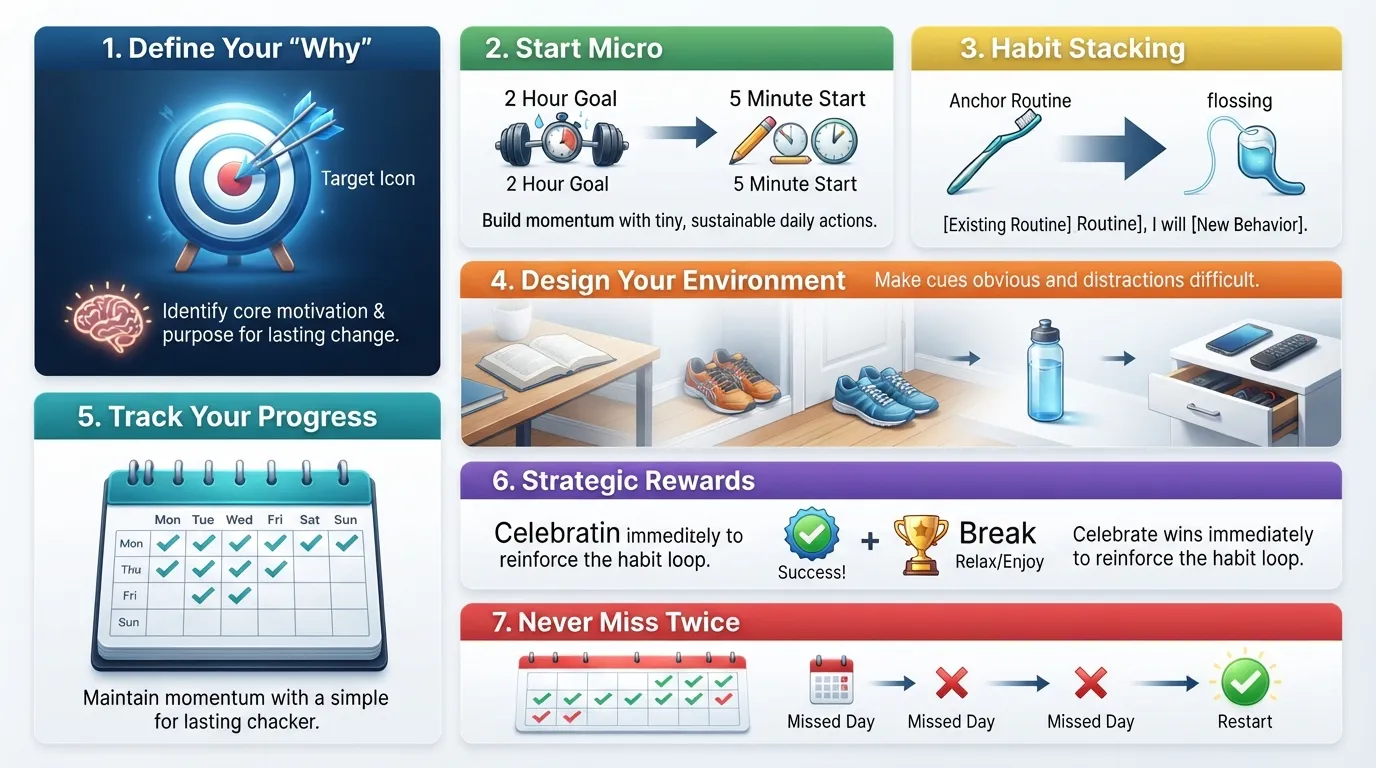
7 Habit Formation Strategies Step-by-Step
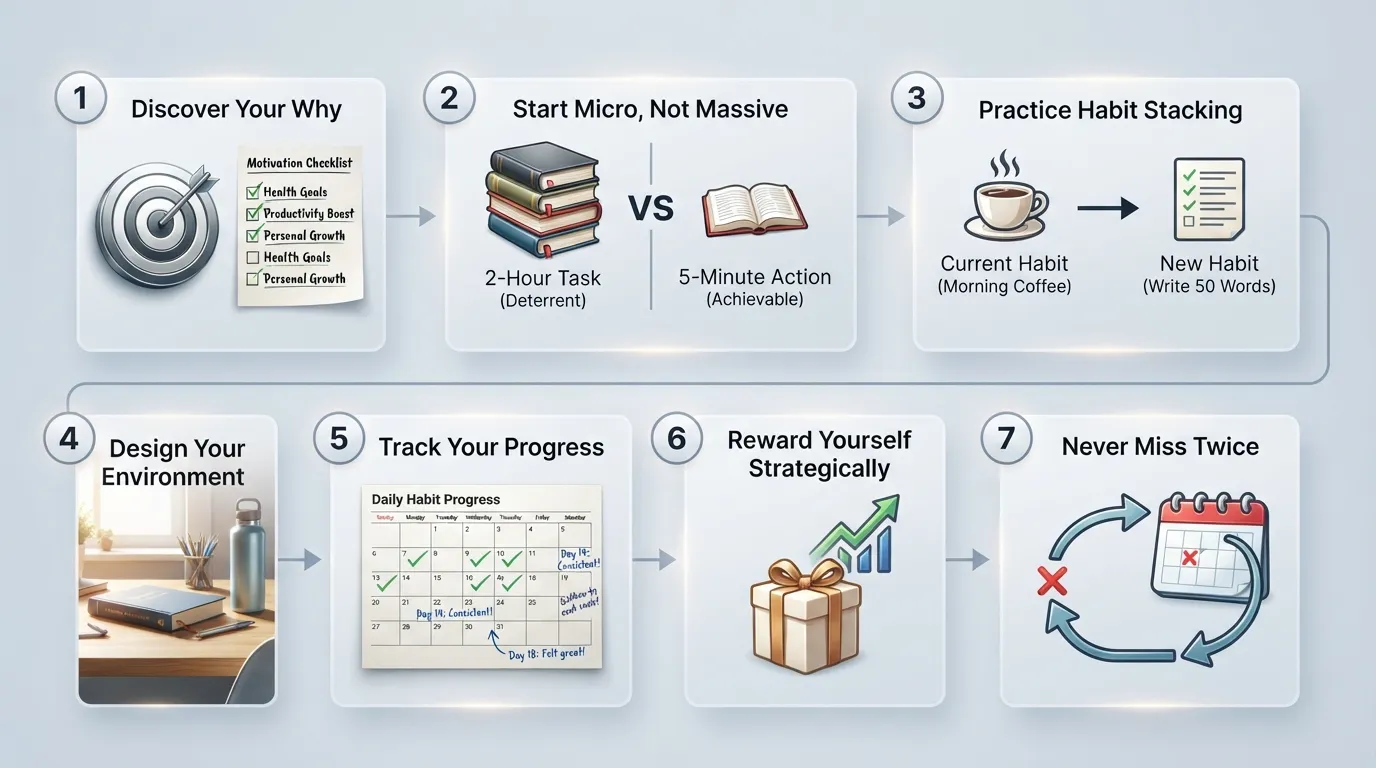
1. Find Your Reason (Why)
Health: Connect a daily movement routine to maintaining long-term joint mobility and independent living as you age, rather than chasing an arbitrary weight loss metric.
Productivity: Tie a morning planning habit to eliminating end-of-day burnout and protecting your uninterrupted evening family time.
Skill-building: Anchor daily language practice to a specific upcoming career transition or international travel goal to give the daily effort immediate practical weight.
2. Start Extremely Small
Bad example: Committing to write for two hours every single day, which triggers immediate mental resistance and rapid burnout.
Good example: Committing to open your document and write for five to ten minutes a day, establishing the physical routine first before expanding the duration.
3. Anchor It to an Existing Routine (Habit Stacking)
Coffee-trigger example: Pairing a new stretching habit directly with the automatic act of waiting for your morning coffee kettle to boil.
Formula: “After [current habit], I will [new habit]” (e.g., After I sit down at my desk, I will write down three non-negotiable daily tasks).
4. Design Your Environment
Make good choices visible and easy: Place your book face-up on your pillow in the morning, or leave your workout shoes directly in the center of the doorway.
Remove friction for bad habits: Hide your smartphone in a drawer during focus blocks, or clear processed snacks out of the pantry so the barrier to entry is intentionally high.
5. Track Your Progress
Simple daily log: Mark a clean checkmark on a physical calendar or digital tracker immediately upon completing the action to create a visual chain of momentum.
Completed/missed/improvement notes: Note why a specific day worked smoothly or what unexpected obstacle caused a miss so you can adjust your setup.
6. Use Rewards Strategically
Small break: Give yourself permission to enjoy ten guilt-free minutes of reading or a favorite podcast immediately after completing an unpleasant task.
Visible progress check: Transfer saved funds into a dedicated goal account every time you complete a full week of your financial tracking habit.
Positive reinforcement: Acknowledge the emotional win of showing up, which trains your brain’s dopamine pathways to associate the hard routine with an ultimate positive payoff.
7. Recover Quickly After a Slip (Never Miss Twice Rule)
One missed day is not a failure: Missing a Tuesday workout does not ruin your progress; it is merely a data point and a normal part of the process.
Restart the same or next day: Pick up the very next day without self-judgment or attempting to double the workload to “make up” for the missed session.
Consistency beats intensity: Showing up imperfectly 300 days a year compounds far faster than executing a rigid routine perfectly for two weeks before quitting.
How Long Does It Really Take to Build a Habit?
Where the “21 days” myth comes from
That widespread belief stems from Dr. Maxwell Maltz’s 1960 book Psycho-Cybernetics, where plastic surgeons noted it took amputees about 21 days to get used to losing a limb. Over decades, pop culture stripped away the clinical context, turning a rough observation about psychological adjustment into an absolute biological rule for forming entirely new behaviors.
What research actually shows
Clinical research published by Dr. Phillippa Lally at University College London demonstrates that habit formation is far more variable. Tracking 96 people building new eating, drinking, and exercise habits over 12 weeks, the study found the time it takes to reach automaticity ranges from 18 to 254 days, with an average of 66 days depending on the complexity of the behavior and the individual.
21 vs. 66 vs. 90 days — which one to trust
Discard the 21-day timeline entirely, treat the 66-day average as your operational baseline, and adopt a 90-day horizon for complex life changes. Simple actions like drinking a glass of water after waking up lock in much faster, whereas complex routines like starting a strength-training program sit closer to the upper end of the spectrum.
Keystone Habits — Small Changes With Bigger Ripple Effects
A keystone habit is a foundational routine that sparks a cascading sequence of positive choices throughout your entire day without requiring extra willpower. When you lock in one core behavior, it alters your self-identity and naturally reorganizes your environment, making adjacent good decisions much easier to execute.
Daily morning exercise: Committing to a 20-minute movement routine immediately shifts your biological baseline, leading you to naturally drink more water, select healthier breakfast options, and maintain higher focus during work hours.
Evening kitchen reset: Clearing the sink and prepping your workspace before bed acts as a structural anchor, eliminating morning friction and setting a calm, organized tone the moment you wake up.
Daily financial check-in: Reviewing your daily spending log for just two minutes reinforces mindfulness around consumption, which automatically curbs impulse purchases and encourages deliberate budgeting in other areas of life.
FAQ
The 3-3-3 rule involves focusing on building 3 core habits for 3 consecutive weeks, or breaking your day into 3 distinct blocks to manage and track your routine consistency easily.
The three R's form the habit loop: the Reminder (cue that triggers the behavior), the Routine (the actual habit action you perform), and the Reward (the benefit or positive reinforcement you receive).
The 21-90 rule suggests it takes 21 days to form a new habit and build it as a routine, and 90 days of consistent practice to make it a permanent part of your lifestyle.
Not necessarily. Psychological research shows that it actually takes an average of 66 days for a new behavior to become automatic, though the exact timeline varies depending on the person and the habit's complexity.
The best approach is to start extremely small (micro-habits), use habit stacking by attaching the new habit to an existing routine, design your environment for success, and track your daily progress visually.