How Habit Triggers Work: The Cues That Create and Break Your Habits
What Is a Habit Trigger?
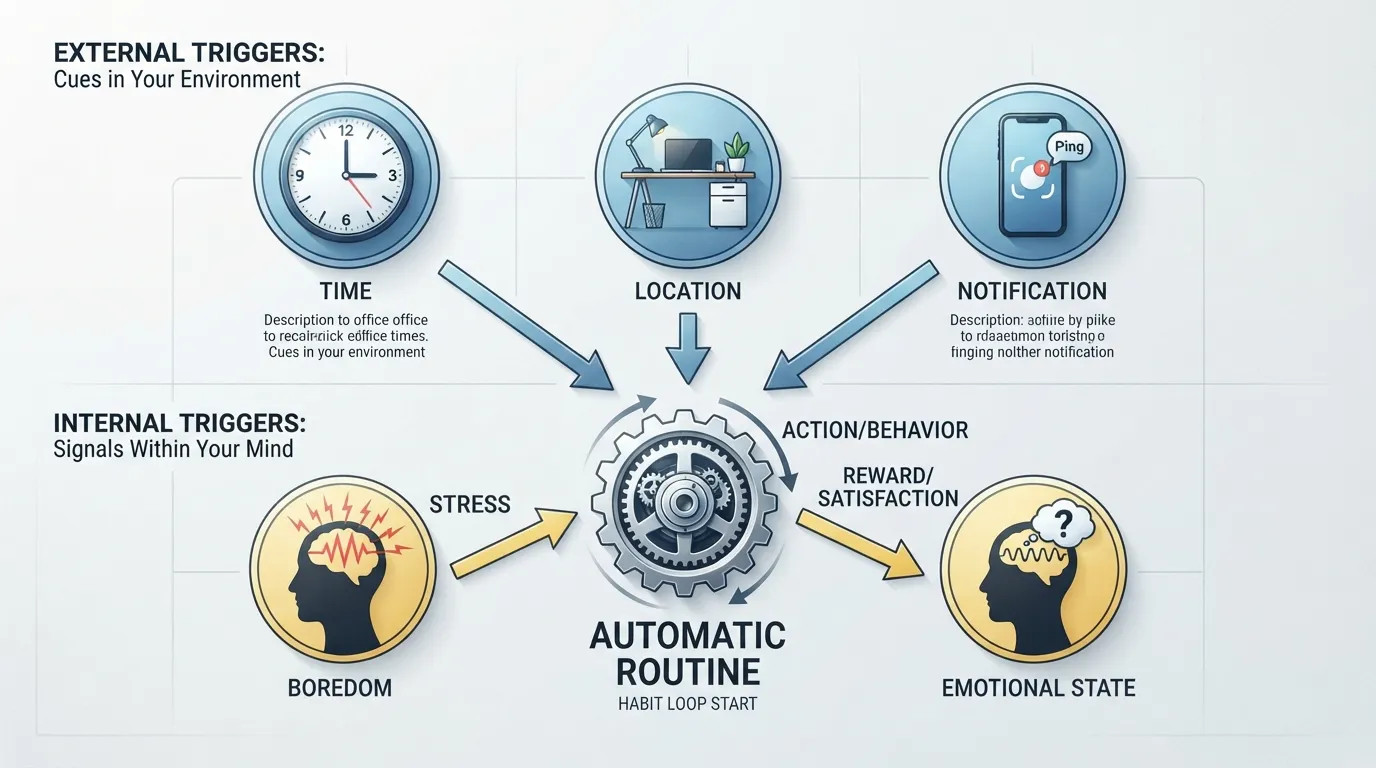
A habit trigger is simply the underlying spark that tells your brain to run a specific behavioral script on autopilot. Whether it is an environmental cue like your phone buzzing on the desk or an internal state like a wave of afternoon boredom, this signal cuts through the noise and initiates the routine before you even realize you have made a choice.
Behavioral psychology research highlights that these cues act as contextual shortcuts, allowing the basal ganglia—the brain’s center for procedural learning—to take over so your prefrontal cortex can conserve energy for more complex tasks.
Understanding how these initial signals operate lays the groundwork for everything else, which we will break down next by looking closely at how they drive the complete habit loop.
The Habit Loop: How a Trigger Turns Into an Automatic Habit
Every automatic action you repeat day in and day out—from checking your notifications the second you wake up to grabbing a snack when you feel stressed—follows a precise psychological blueprint. Behavioral scientists break this cycle down into a four-stage framework: cue, craving, response, and reward.
The sequence begins with the cue, which is the trigger that sets off the chain reaction. That spark immediately ignites a craving, the motivational force or desire behind the habit (you do not crave the cigarette or the social media scroll itself, but rather the state of relief or dopamine hit it promises). That craving drives the response, which is the actual habit or behavior you perform. Finally, the response delivers a reward, satisfying the craving and teaching your brain that this specific sequence is worth remembering for the future.
Repetition is the engine that cements this entire sequence into your neural architecture. Each time you loop through all four stages, the pathway in your brain strengthens, turning a conscious choice into a deeply ingrained, automatic habit.
The 5 Types of Habit Triggers
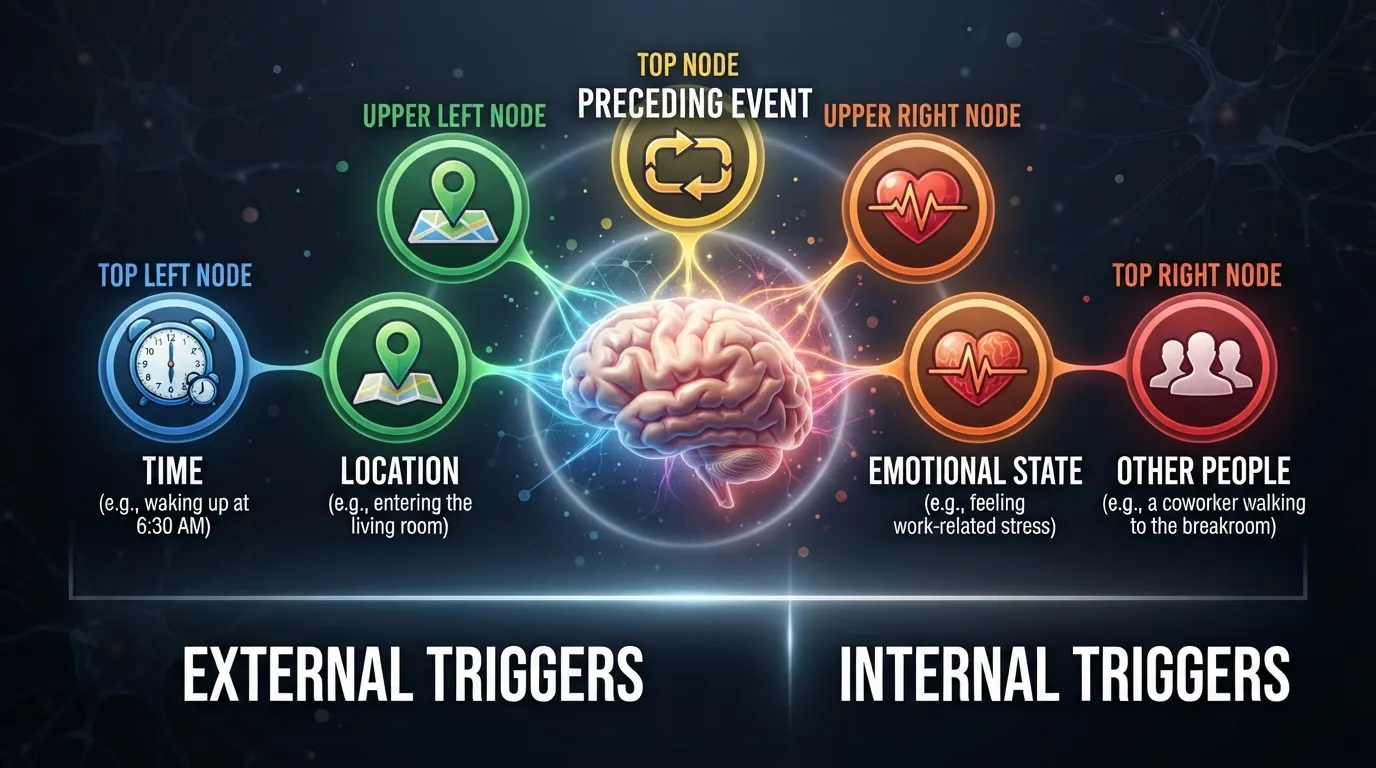
Habit triggers rarely look the same across your entire day. They can hide in your environment, your schedule, or even a sudden shift in your mood. Recognizing these distinct categories is the first real step toward taking control of autopilot behaviors rather than letting them control you.
Time
Time operates as a silent, clock-based pacemaker that programs your daily routines without requiring conscious thought.
Example: Waking up at 6:30 AM immediately prompts you to walk to the kitchen and turn on the coffee maker.
Location
Physical spaces hold profound psychological context, wiring specific rooms or objects to specific actions through sheer proximity.
Example: Walking into your living room and instantly feeling the urge to sit on the couch and turn on the television.
Preceding Event
Your day is a continuous chain reaction where finishing one specific task serves as the built-in starting pistol for the next.
Example: Shutting your laptop at the end of a workday triggers you to put on running shoes and head out the door.
Emotional State
Internal feelings act as powerful signals, often driving us toward quick emotional regulation or comfort.
Example: Feeling a sudden wave of work-related stress triggers the reflex to open a new browser tab and mindlessly scroll social media.
Other People
The company you keep can silently dictate your actions through social mirroring and shared contextual cues.
Example: Seeing your coworker walk toward the breakroom triggers you to get up and grab a mid-morning pastry alongside them.
Internal vs. External Triggers
Zooming out, all five of these distinct categories ultimately collapse into two major buckets. External triggers live outside your head—they are the physical environment, specific clock times, preceding events, and other people that you can see and touch. Internal triggers, on the other hand, originate from within, stemming from your emotional states, physical sensations, or passing thoughts.
Why Emotional Triggers Are the Hardest to Manage
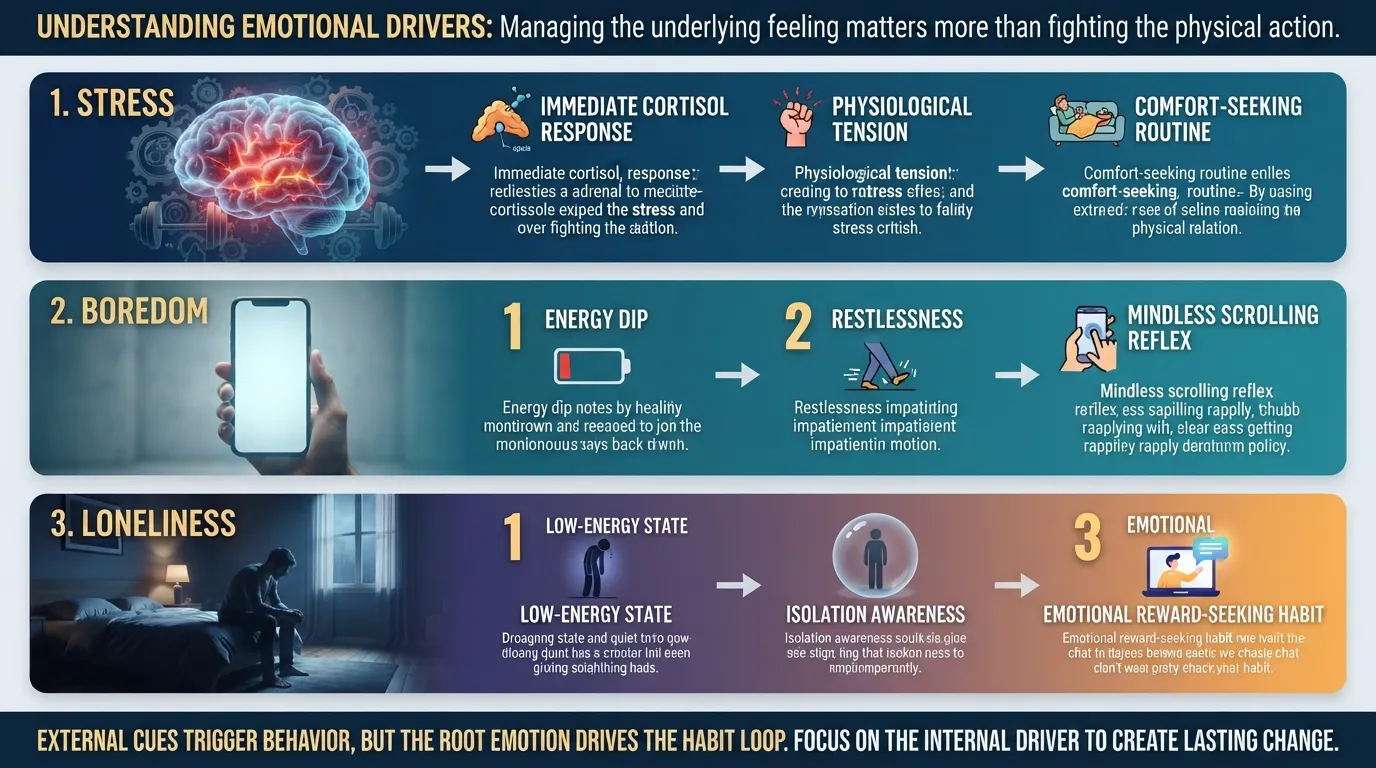
Environmental cues and scheduled times are relatively straightforward to spot and alter, but emotional triggers operate on an entirely different level of complexity. When your brain uses a behavior as a coping mechanism for an internal state, fighting the habit purely through willpower feels like trying to hold back a rising tide.
Common emotional catalysts quietly drive some of our most stubborn daily loops:
Stress: Hitting a grueling bottleneck at work triggers the immediate urge to snap at a coworker or reach for sugary comfort food to quickly blunt the cortisol spike.
Boredom: Staring at a blank document or waiting for a meeting to start prompts you to pull out your phone and reflexively open an app just to escape the mental quiet.
Loneliness: Sitting alone on a Sunday evening often triggers mindless refrigerator raids or hours of scrolling through feeds to chase a micro-dose of connection.
When an emotional trigger is at play, trying to block the physical action without addressing the underlying feeling is a losing battle. You are treating the smoke instead of the fire.
The urge to scroll, snack, or shut down is rarely about the snack or the screen itself; it is a desperate attempt by your nervous system to self-soothe, escape discomfort, or process a heavy feeling. Until you learn to notice the emotional undercurrent and sit with the discomfort without immediately reaching for an anesthetic, the habit loop will keep firing every single time that exact feeling arises.
How to Use Triggers to Build a Good Habit
Hoping a new habit will magically stick is a fast track to burnout. If you want to reliably build a positive routine, you have to stop leaving your cues to chance and start intentionally engineering them into your day.
The most reliable tool for this is the classic implementation intention formula popularized by behavioral psychologist Peter Gollwitzer: IF [Trigger], THEN [Behavior]. By explicitly pairing a concrete moment with a specific action, you remove the heavy lifting of decision fatigue.
Make the Trigger Specific
Vague resolutions like “I’m going to read more” almost always fail because your brain has no idea when or where to pull the trigger. A good trigger leaves zero room for ambiguity. Instead of saying you will stretch later, anchor it to a razor-sharp moment, such as: “When my laptop closes at 5:00 PM, I will immediately roll out my yoga mat.”
Make It Consistent
Your brain thrives on predictable patterns. If your trigger changes time, location, or context every single day, the neural pathway takes much longer to form. Tie your new habit to an anchor event that happens with absolute regularity, like your morning alarm, pouring your first cup of coffee, or sitting down at your desk after lunch.
Make It Easy
Friction is the ultimate habit killer. When designing your trigger and response, ruthlessly eliminate any barrier standing between you and the action. If you want to establish a morning movement habit, planning to drive to a gym twenty minutes away introduces too much resistance; designing your routine around a home workout right next to your bed keeps friction low enough for the trigger to actually convert into action.
Make It Obvious
Out of sight truly means out of mind for the human brain. Lean on your environment by placing bold visual cues directly in your path. If you want to build a journaling habit, do not stash your notebook in a drawer—leave it directly in the center of your keyboard the night before so the physical object itself forces the trigger.
Start Small, Then Grow
The biggest mistake people make is trying to launch a massive, exhausting routine off a single trigger. Start with a micro-version of the habit that takes less than two minutes to complete, like writing a single sentence or doing two push-ups. Once the trigger-to-response pathway becomes an automatic reflex, you can naturally scale up the intensity.
Habit Stacking: Turning an Existing Habit Into a New Trigger
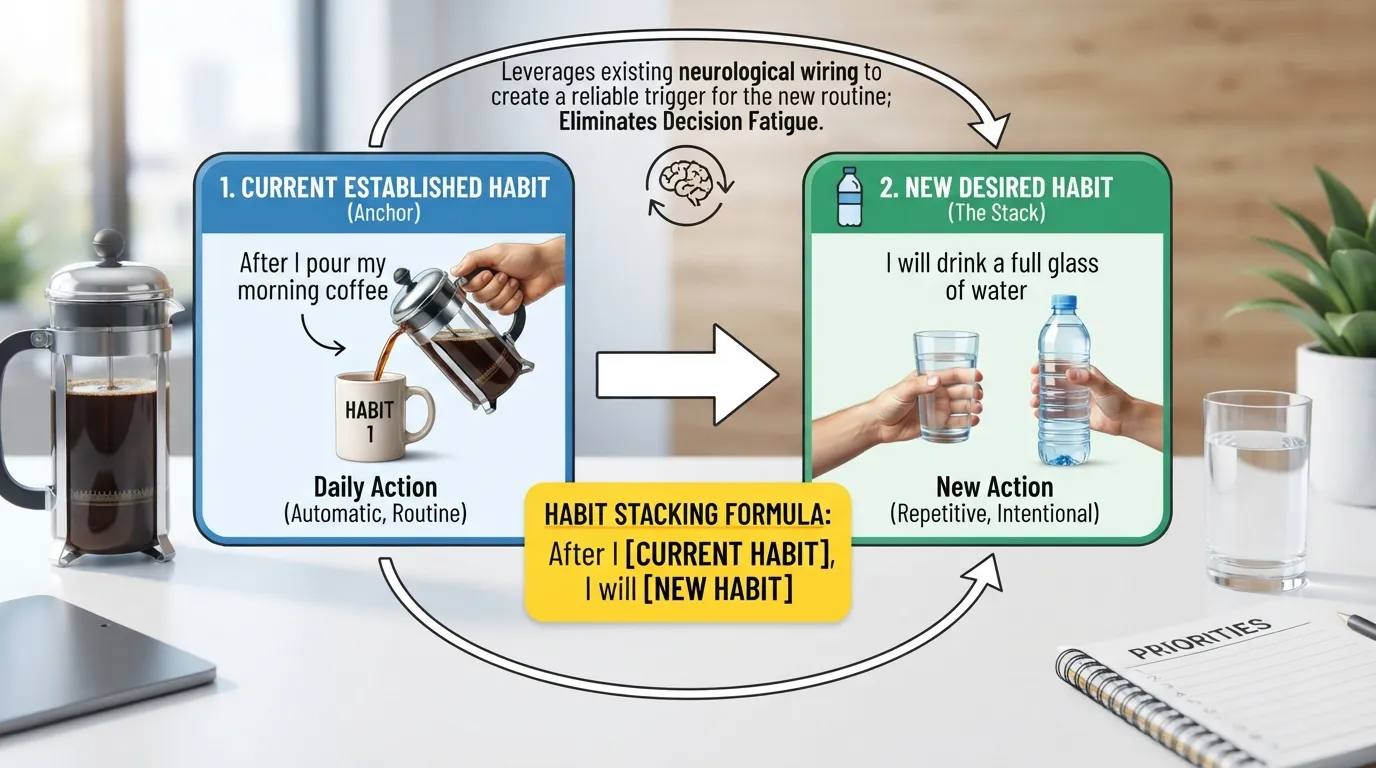
One of the most reliable ways to introduce a new behavior into your daily life is to piggyback off a routine you already perform without thinking. Instead of searching for an entirely new time or location to anchor your goal, you use an established daily action as the built-in cue for the next.
Popularized by behavioral expert BJ Fogg and expanded in Atomic Habits, this technique relies on a simple formula: “After I [current habit], I will [new habit].” Because your brain has already wired the first behavior into a deep, automatic groove, chaining a fresh action directly to the tail end of it makes the new trigger feel effortless.
Example 1: After I pour my morning cup of coffee, I will immediately drink a full glass of water.
Example 2: After I shut down my computer at the end of the workday, I will write down my top three priorities for tomorrow.
Example 3: After I brush my teeth at night, I will spend two minutes stretching my hamstrings.
How to Identify and Break a Bad Habit Trigger
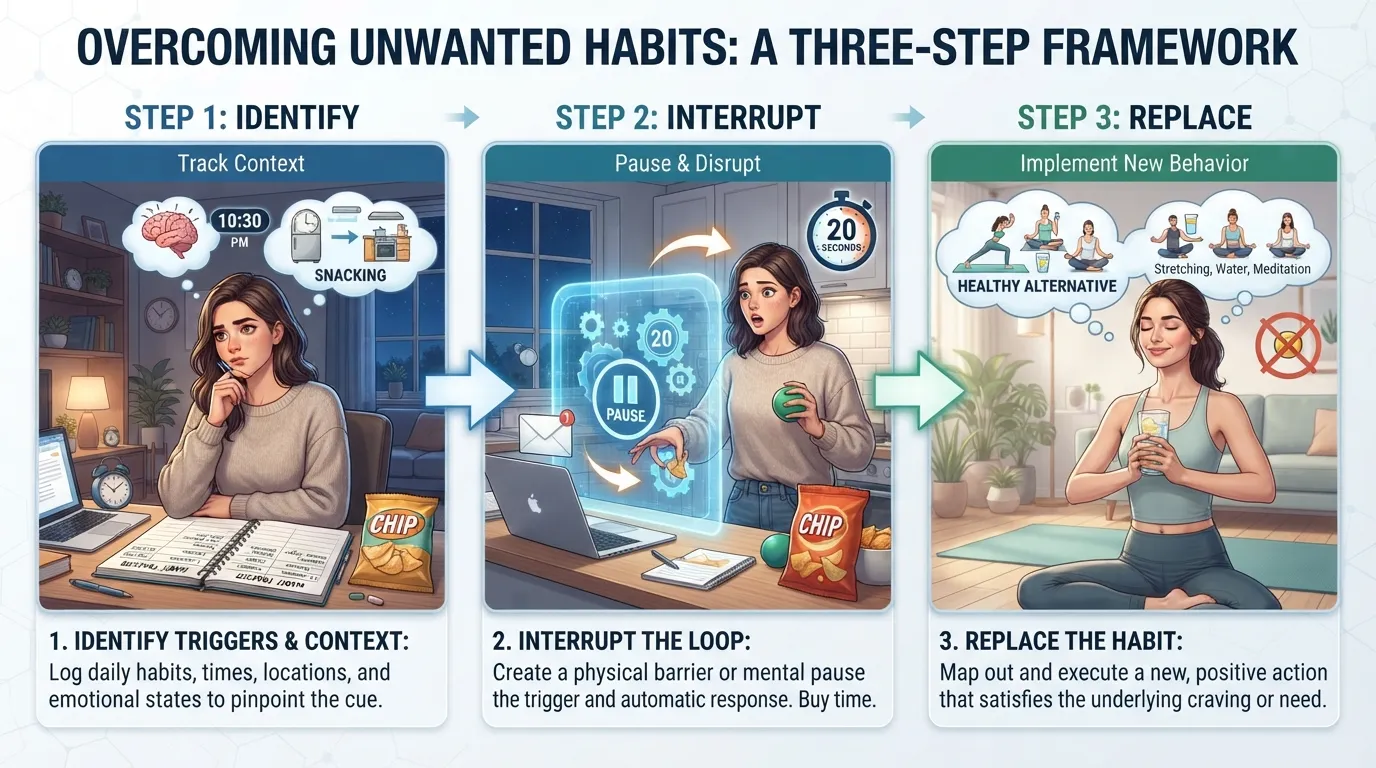
Breaking an unwanted routine by simply white-knuckling your way through it rarely works. Because the brain automatically loops from cue to response to reward, fighting the behavior while the trigger remains active is an uphill battle. To truly dismantle a bad habit, you have to intercept the chain reaction at its source using a three-step framework: notice the cue, interrupt the sequence, and replace the routine.
Notice the cue: You cannot change a pattern you are blind to. For a few days, act like a detective and track when your bad habit strikes. What time is it? Where are you? Who is around, and what emotional state are you experiencing right away? Pinpointing the exact spark—whether it is a 3:00 PM energy crash or the ping of a notification—exposes the invisible trigger.
Interrupt the interruptible: There is a tiny window of time between the moment a trigger fires and the moment you execute the automatic response. Inserting physical friction into that gap breaks the spell. If your trigger is grabbing your phone the second you sit on the couch, place a physical barrier or a different object in your hands, or keep the phone in another room.
Replace the routine: The brain craves the reward at the end of the loop, which means you cannot just strip away a habit and leave a void; you have to substitute a healthier behavior that satisfies the same underlying need. If stress triggers a trip to the vending machine, swap the candy bar for a brisk five-minute walk or a few deep breaths that still deliver a nervous system reset.
ADHD and Habit Triggers
For neurodivergent individuals—particularly those with ADHD—navigating habit triggers introduces unique neurological challenges. Executive dysfunction and lower baseline levels of dopamine mean that traditional, subtle environmental cues are often easily ignored or entirely missed by the brain.
Instead of relying on quiet internal reminders or distant calendar notifications, building routines with ADHD requires high-contrast, hyper-obvious external triggers. This means moving away from subtle cues and using loud, multisensory anchors—such as pairing an essential task with a specific upbeat playlist, using visual timers that sit directly in your field of view, or relying on body doubling where the physical presence of another person acts as the immediate cue to stay on track.
Why Good Habits Fail
You can have the best intentions in the world, yet still watch your wellness goals unravel by week two. When a new routine falls apart, it is rarely a failure of personal character or willpower; it is almost always a structural breakdown in how the habit was designed.
Several common pitfalls sabotage even the most motivated attempts:
Goals set too big: Trying to overhaul your entire lifestyle overnight creates massive friction, turning a simple lifestyle tweak into an exhausting chore.
No clear system: Relying on vague intentions instead of a concrete, trigger-based plan leaves your brain guessing when and where to act.
No tracking: Flying blind without a visual way to measure your consistency makes it easy to lose momentum and let small misses slide.
Lack of accountability: Trying to build in a vacuum without anyone noticing your progress robs you of the external structure that keeps motivation high.
Emotional stress: Letting unmanaged anxiety or exhaustion hijack your nervous system will consistently override logical goals in favor of immediate comfort.
Ultimately, white-knuckling your way through change is a losing game. A simple, well-engineered system beats raw willpower every single time.
A Simple 30-Day Trigger-Building Plan
Turning the science of habit loops and triggers into a lasting lifestyle change requires a structured approach rather than a sudden burst of motivation. This straightforward, four-week blueprint takes the guesswork out of the process, guiding you from awareness to automatic mastery one step at a time.
Week 1: Identify Your Trigger
Before you try to change or add anything, spend the first seven days simply observing your patterns. Pinpoint the exact time, location, emotional state, or preceding event that naturally pairs with the behavior you want to build or break, laying a solid foundation for your new system.
Week 2: Make the Behavior Easy
Once your target trigger is clear, strip away every ounce of friction standing between that cue and your action. Scale the physical or mental effort down so low that executing the routine feels effortless, ensuring your brain actually crosses the finish line when the trigger fires.
Week 3: Track Consistency
With the cue locked in and the friction removed, focus purely on showing up every single day. Use a visible calendar, a habit tracker app, or a simple checkmark on a sticky note to monitor your daily streak and build psychological momentum.
Week 4: Increase Difficulty
Now that the trigger-to-response pathway is running smoothly on autopilot, it is time to naturally raise the bar. Slightly increase the duration, weight, or complexity of the habit, trusting your newly wired neural pathways to handle the upgrade without burning out.
How Long Does It Take for a Trigger to Become Automatic?
The popular myth that it takes exactly 21 days to form a new habit has been floating around self-help circles for decades, but modern psychological research tells a very different story. That widely quoted timeline stems from a misinterpretation of plastic surgery patients adjusting to their new appearances in the 1950s, not from hard data on neural habit formation.
Groundbreaking research from health psychology researcher Dr. Phillippa Lally and her team at University College London revealed that the true average is closer to 66 days for a new behavior to become fully automatic.
More importantly, that timeline is not a rigid rule. Depending on the individual, the complexity of the behavior, and how deeply ingrained the environmental cues are, building a truly automatic habit can range anywhere from 18 days to well over 250 days. Missing a single day here or there does not derail the entire process, but consistency in how you respond to your chosen trigger remains the ultimate engine that accelerates the rewiring.
Keystone Triggers — One Cue, Multiple Good Habits
Most habit triggers start a single, isolated loop: your phone buzzes, you check a notification. But behavioral psychology points to a much more powerful category known as keystone habits and triggers. These are foundational catalysts that, when intentionally tripped, create a cascading domino effect across your entire lifestyle, effortlessly setting off multiple positive behaviors at once.
Instead of forcing twenty different micro-routines into your day, anchoring a single keystone trigger can transform how you eat, work, and manage stress.
Several primary catalysts act as master keys for holistic wellbeing:
Morning Exercise: Tying a physical trigger to an early workout—like lacing up your shoes the moment your feet hit the floor—often sparks a massive ripple effect. Suddenly, you find yourself drinking more water, making healthier breakfast choices, and experiencing sharper focus throughout the workday.
Quality Sleep Routine: Winding down at a strict, predictable time serves as a powerful nightly trigger. It not only protects your cognitive recovery but naturally regulates next-day energy, curb-checking nighttime snacking, and lowering baseline stress.
Mindful Meditation or Journaling: Carving out a quiet, dedicated anchor spot in the morning to breathe or write acts as a psychological reset button. That single pause ripples outward, making you more patient in relationships, less reactive to work friction, and more intentional with your habits overall.
By hunting down and installing these high-leverage triggers, you stop playing whack-a-mole with individual bad habits and instead shift the entire tectonic plate of your daily routine.
Real Habit Trigger Examples Good and Bad
Seeing how triggers, routines, and rewards interact in real life bridges the gap between theory and daily application. The table below breaks down the structural anatomy of both constructive habits you want to install and unwanted cycles you want to interrupt.
Anatomy of Daily Habit Loops
| Habit Type | Trigger (Cue) | Routine (Behavior) | Reward |
|---|---|---|---|
| Good Habit | Closing your laptop at 5:00 PM | Changing into running shoes and stepping outside | A burst of physical energy and mental decompression |
| Good Habit | Pouring your first cup of coffee in the morning | Drinking a full glass of water before sipping coffee | Instant hydration and steady morning alertness |
| Good Habit | Brushing your teeth at night | Flossing just one tooth to start | Maintaining dental health without mental friction |
| Bad Habit to Fix | Hitting a stressful bottleneck at work | Opening a new tab to mindlessly scroll social media | A temporary mental escape from difficult work |
| Bad Habit to Fix | Feeling a wave of late-afternoon boredom | Walking to the kitchen to raid the snack pantry | A quick dopamine hit and sensory distraction |
| Bad Habit to Fix | Walking into the living room after a long day | Sinking straight onto the couch with the television remote | Instant physical relaxation and passive rest |
FAQs
What is the 3-3-3 rule for habits?
The 3-3-3 rule is a practical structuring method designed to prevent overwhelm when building new routines. It typically focuses your attention on 3 key daily priorities, dedicating 3 consecutive weeks to build initial automaticity, or utilizing 3-minute micro-actions to bypass mental resistance when starting difficult tasks.
How do you break a habit loop?
Breaking a habit loop involves identifying the underlying trigger and the reward you crave, then intentionally replacing the old routine with a healthier action. Because neural pathways cannot be completely erased, keeping the same cue and reward while substituting a new behavior is the most effective disruption strategy.
What are the three types of triggers?
Triggers generally fall into distinct categories that prompt automatic behavioral responses:
- Environmental Cues: Physical surroundings, objects, or locations (e.g., seeing the kitchen pantry).
- Internal/Emotional Triggers: Psychological states such as stress, boredom, anxiety, or excitement.
- Temporal/Situational Cues: Specific times of day, preceding events, or social contexts (e.g., closing your laptop at 5:00 PM).
What are the four stages of the habit loop?
Every automatic habit flows through a continuous neurological cycle consisting of four distinct phases:
- Cue: The trigger that initiates the behavior.
- Craving: The motivational desire or anticipation behind the routine.
- Response: The actual habit or action performed.
- Reward: The benefit gained that satisfies the craving and reinforces the loop.
What is the root cause of bad habits?
Bad habits are rarely moral failures; instead, they are rooted in the brain's search for efficient ways to solve problems like stress, fatigue, or boredom. They persist because they provide a quick dopamine hit, emotional escape, or immediate comfort, even if the long-term consequences are negative.
How do you train your brain to break a bad habit?
Training your brain involves manipulating your environment to increase friction for unwanted behaviors while decreasing friction for positive alternatives. By practicing mindful pause when a trigger occurs, you interrupt the automatic response and allow your prefrontal cortex to choose a conscious path.
What are the 7 steps to breaking a habit?
Successfully dismantling a deeply ingrained behavior requires a structured approach:
- 1. Identify the target habit: Clearly define what you want to change.
- 2. Uncover the trigger: Track when and where the behavior occurs.
- 3. Analyze the reward: Determine what psychological or physical need the habit satisfies.
- 4. Design a substitution routine: Choose a healthy alternative action that delivers a similar reward.
- 5. Alter your environment: Remove cues and temptations from your physical space.
- 6. Enlist support: Share your goals with an accountability partner or community.
- 7. Track progress and practice patience: Monitor consistency while accepting setbacks as part of the learning phase.