Identity-Based Habits: How to Change Your Behavior by Changing Who You Are
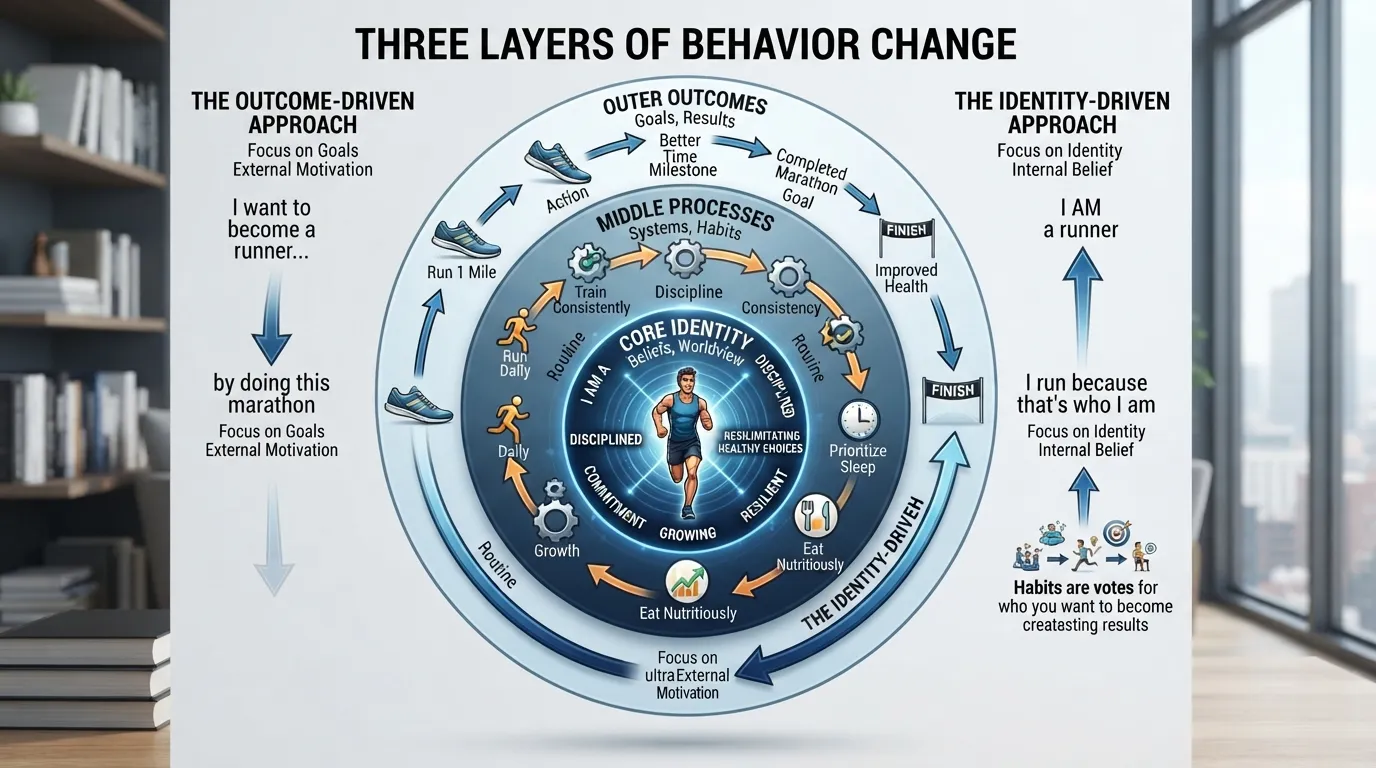
Most self-help advice tells you to focus on what you want to achieve. That is an outcome-based habit—setting a goal to lose twenty pounds, run a marathon, or clear your inbox. Process-based habits zoom in a notch further, focusing on what you do every day, like following a specific workout split or blocking out an hour for email management.
Identity-based habits operate entirely differently. Instead of anchoring your routine to a milestone or a mechanical checklist, they start with your internal compass: deciding who you want to become and letting your daily actions serve as physical proof of that identity.
If you are tired of white-knuckling your way through New Year’s resolutions that vanish by February, this guide will break down the exact brain mechanisms behind identity shifts, provide a concrete, step-by-step framework to build them, and show you how to rewrite the self-narrative that keeps sabotaging your progress.
What Are Identity-Based Habits?
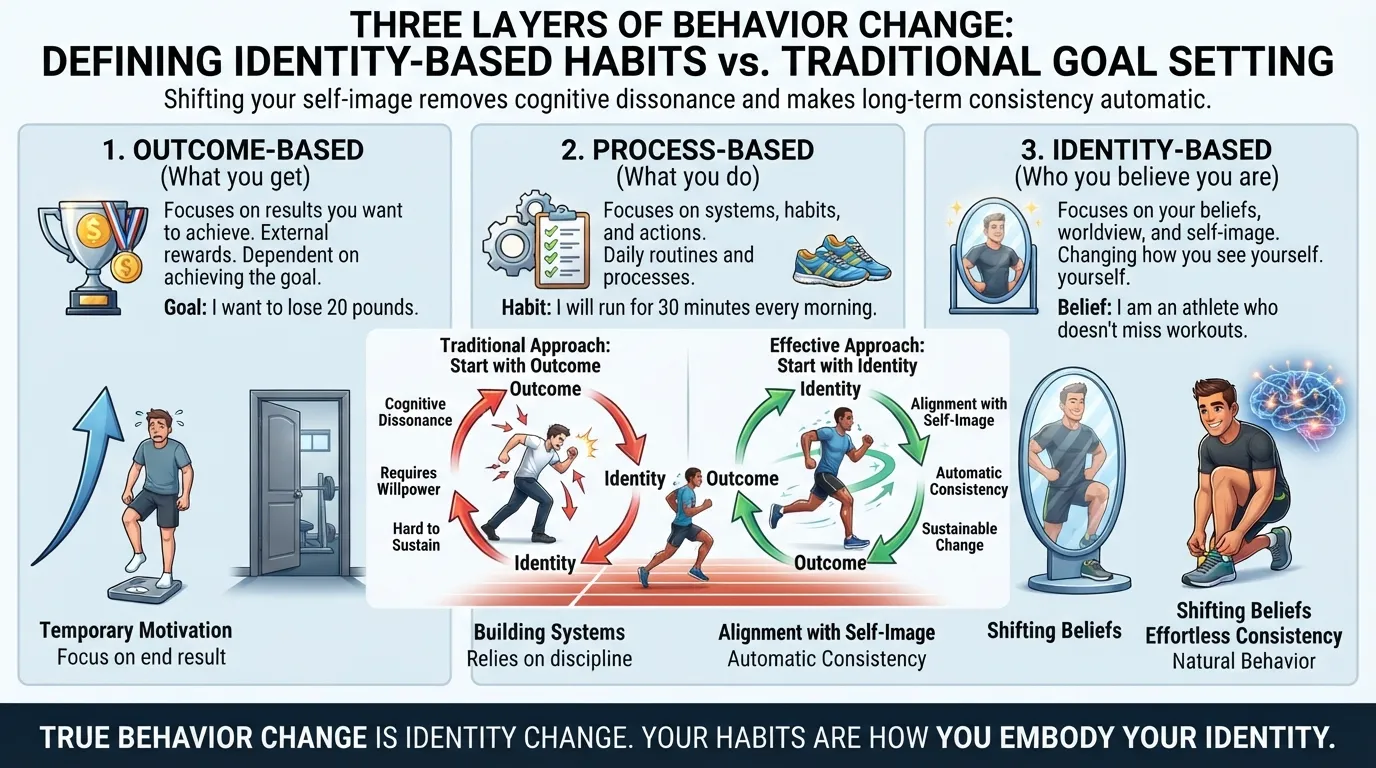
The Three Layers of Behavior Change (Outcomes vs Processes vs Identity — including why identity beats outcome-focus)
Behavior change operates on three distinct levels, like concentric circles on a target.
The outermost layer is your outcomes. This is what you get: losing fifteen pounds, publishing a newsletter, or clearing your debt. Most goals you set live here.
The middle layer is your processes. This is what you do: building a weekly meal-prep routine, writing for forty minutes every morning, or setting up automated bank transfers. Most habits are built at this level.
The deepest layer is your identity. This is what you believe: your self-image, your world-view, and your judgments about yourself. Your identity is shaped by your stories and your internalized assumptions—such as whether you see yourself as someone who stays calm under pressure or someone who crumbles when things get chaotic.
The critical flaw in conventional self-improvement is that people focus from the outside in. They start with what they want to achieve, move to what they need to do, and rarely touch who they believe they are.
Identity-based habit formation flips that direction entirely. When your habits are driven by outcomes, you rely on external milestones to validate your efforts. If you hit the target, you feel good; if you miss it, you question the entire process. When your habits are driven by identity, the reward is built into the behavior itself. You aren’t running to win a medal; you run because running is what an athlete does. Changing your identity changes the gravitational pull of your choices, making the desired action feel like the most natural thing in the world rather than an uphill battle against yourself.
Every Action Is a Vote for the Person You Want to Become
You do not need a grand epiphany to change your identity. You do not need to wait until you feel entirely confident, disciplined, or creative before you start acting like it. Identities are built incrementally, through small, compounding data points.
Every single action you take is a ballot cast for the type of person you want to become. If you write one paragraph of a draft, you just cast a vote for being a writer. It does not matter that the draft is messy or that the book isn’t finished yet; the vote has been cast. If you walk past the gym door or lace up your running shoes for a ten-minute jog, you cast a vote for being active.
No single instance will radically transform your self-image overnight, just like dropping a single ballot into a voting box does not immediately decide an election. But as the votes accumulate, so does the evidence. When you stack twenty small actions in a row that align with a specific identity, your internal narrative starts to shift. You stop saying, “I am trying to learn how to code,” and start realizing, “I am a programmer.”
The goal is not to get a specific result on day one. The goal is simply to win enough small elections to convince your own brain that you are already the person you want to be.
How Habits Actually Form in Your Brain
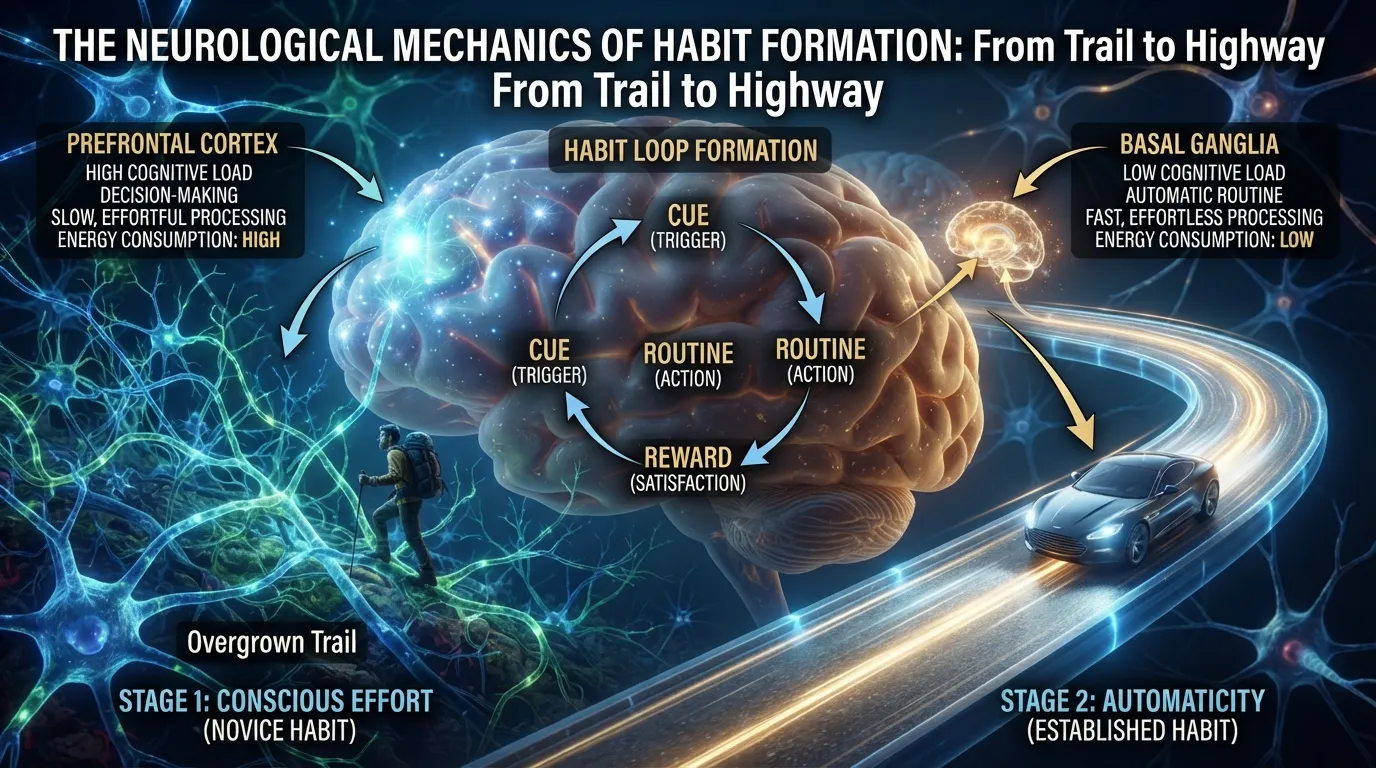
Your Brain Builds Highways, Not Just Habits (neural pathway/trail metaphor)
When you repeat a behavior, your brain undergoes a physical transformation known as neuroplasticity. Imagine walking through an overgrown meadow for the first time. The tall grass resists your footsteps, every step requires conscious effort, and you have to hack your way through obstacles.
That is what your brain does the first time you try to learn a complex new skill or stick to an unfamiliar routine.
Every subsequent time you repeat that action, the path becomes a little clearer. The grass gets flattened, stones are pushed aside, and a dirt trail forms. Eventually, after dozens or hundreds of repetitions, that trail widens into a paved highway.
In neurological terms, your neurons fire together repeatedly, strengthening the synaptic connections between them. A neural pathway forms. Once a pathway is well-worn, your brain can travel down it with maximum speed and minimum resistance. Identity-based habits accelerate this trail-clearing process because they align your internal beliefs with the path you want to walk. When your self-image matches your actions, you stop fighting the thick brush of cognitive dissonance and start moving down a highway your brain has already paved for success.
The Brain’s Energy-Saving System Behind Habits (automaticity + why motivation alone fails, systems/identity win)
Your brain is an evolutionary survival engine designed to conserve calories. Although it accounts for only about two percent of your body’s total mass, it consumes roughly twenty percent of your resting energy. To keep you from burning out, your brain constantly looks for ways to automate routine tasks.
This automation is called automaticity—the ability to execute a behavior without conscious thought. When a behavior becomes automatic, it shifts from the energy-intensive parts of your brain to deeper, faster neural circuits.
This is precisely why motivation alone fails. Motivation is a finite emotional state that relies on high-energy, conscious thought. It requires you to wake up every morning, weigh the pros and cons of doing a hard task, and convince yourself to push through discomfort. That constant mental negotiation drains your cognitive reserves.
Identity-based habits bypass the need for motivation entirely by turning behaviors into automatic reflexes. When an action is baked into your identity—such as brushing your teeth or washing your hands—you do not need a surge of inspiration to do it. You simply do it because it is who you are. Systems and identity win over motivation because they permanently lower the energy cost of execution, making consistency the path of least resistance.
The Two Brain Systems Behind Every Habit (prefrontal cortex vs basal ganglia)
Behind every habit you perform is a constant tug-of-war between two distinct regions of your brain: the prefrontal cortex and the basal ganglia.
The prefrontal cortex is the executive center of your brain. It handles conscious decision-making, long-term planning, logical reasoning, and impulse control. Whenever you sit down to plan a new goal, weigh the benefits of skipping junk food, or force yourself to start a difficult project, your prefrontal cortex is doing the heavy lifting. The catch is that the prefrontal cortex fatigues quickly under stress, lack of sleep, or decision fatigue.
The basal ganglia, located deeper inside the brain, handles procedural learning, automated routines, and habit formation. It is the part of your mind that remembers how to tie your shoes, shift gears in a car, or scroll through your phone without thinking. The basal ganglia operates on efficiency, grouping sequences of actions into automated chunks.
When you first start building a new routine, you rely almost entirely on your prefrontal cortex. It feels exhausting because it is. But as you repeat the action—and especially as your identity shifts to embrace it—the neural control center migrates upward from the prefrontal cortex down into the basal ganglia. The behavior shifts from a conscious choice requiring intense oversight to an automated program running quietly in the background. Identity-based habits speed up this migration by eliminating the internal friction that forces your prefrontal cortex to keep stepping in and micromanaging your choices.
The Journey From Action to Identity
Action → Routine → Habit → Identity (staged example)
Transforming a foreign behavior into an unshakable part of who you are does not happen overnight. It follows a predictable, four-stage psychological progression: from a single isolated action, to a structured routine, to an automated habit, and finally, to a permanent identity.
To see how this works in practice, look at what happens when someone decides to stop being sedentary and become a runner:
The Action: On a Tuesday evening, you put on your sneakers and jog for ten minutes around the block. In isolation, this is just a single action. It requires a deliberate choice, conscious effort, and a mild push against inertia. It does not make you a runner yet; it is merely a single data point.
The Routine: You repeat that ten-minute jog every Tuesday and Thursday for the next three weeks. It is no longer a random occurrence, but it still requires planning. You have to check your calendar, lay out your clothes ahead of time, and negotiate with yourself when you feel tired after work.
The Habit: By week six, the friction disappears. You no longer need to debate whether you are going to run on Tuesday evenings because the behavior has migrated into your basal ganglia. Your shoes are by the door, your body moves out the front door automatically, and skipping the run feels stranger than doing it.
The Identity: By month four, the psychological shift locks into place. When a friend invites you to grab drinks on a Tuesday night, you decline without hesitation: “I can’t make it, I have my run.” You no longer view yourself as someone trying to exercise; you view yourself as a runner. The action has successfully become the identity, and maintaining the behavior no longer requires external pressure because it is simply a reflection of who you are.
Breaking Free From a Negative Identity
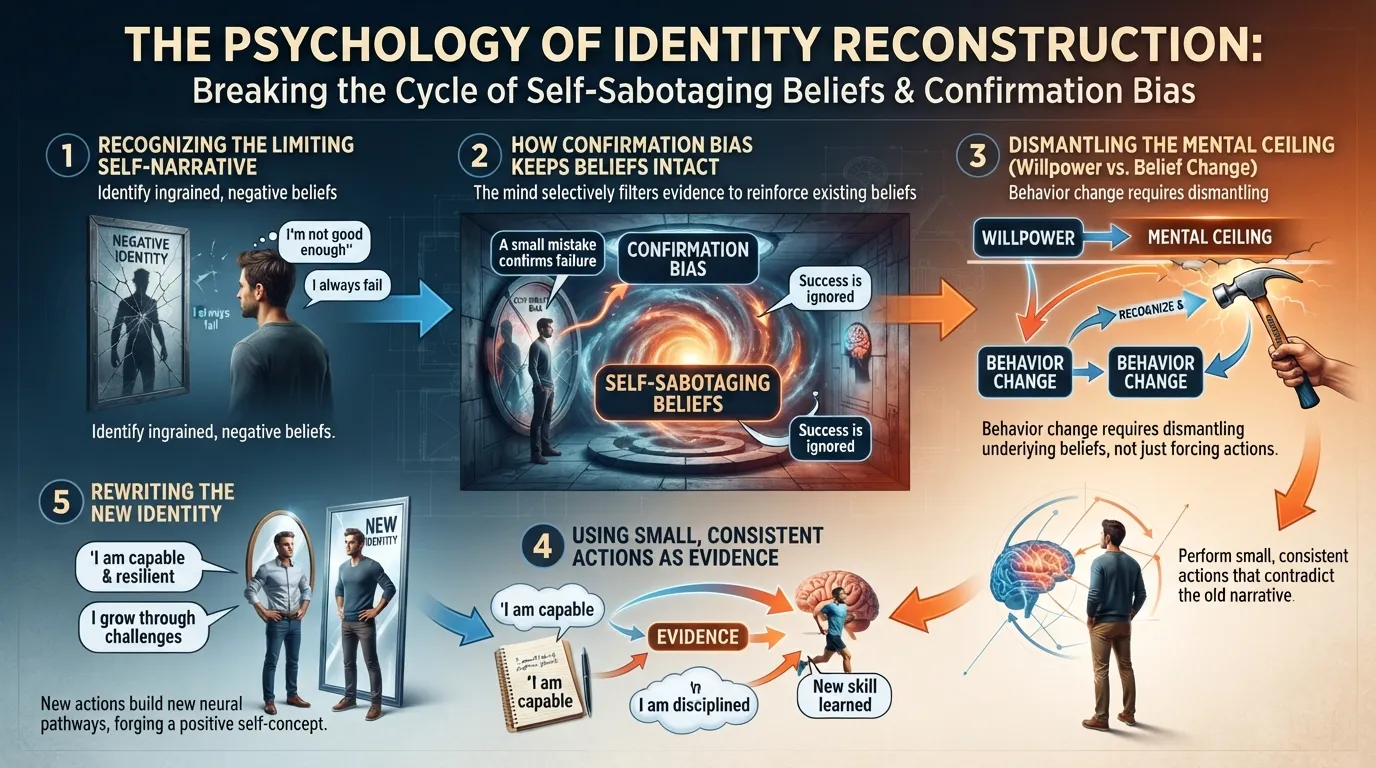
How Limiting Self-Beliefs Block Habit Change
You can have the best tactical plan in the world, but if your internal self-image contradicts the habits you are trying to build, your efforts will inevitably stall. Limiting self-beliefs act as an invisible ceiling on your personal growth.
When you carry beliefs like “I’m just naturally disorganized,” “I’ve never been a math person,” or “I always quit things after two weeks,” your brain actively works to keep those statements true. This is driven by confirmation bias and psychological consistency. Your mind hates internal contradiction, so it scans your daily experiences for evidence that validates your existing identity while conveniently ignoring the moments that disprove it.
If you believe you lack discipline, every time you miss a single workout or skip a day of journaling, your brain logs it as proof: See? Told you so. That perceived failure reinforces the negative identity, which in turn kills your motivation to try again tomorrow. The habit doesn’t fail because you lack willpower; it fails because your identity rejects it as foreign tissue. Until you dismantle the underlying story, every new behavior will feel like an uphill battle against your own self-definition.
Rewriting the Story You Tell About Yourself
Changing your identity does not require you to adopt toxic positivity or pretend you are someone you are not. It requires a deliberate, evidence-based shift in how you narrate your life.
The most effective way to rewrite a limiting self-belief is to stop waiting for confidence to arrive before you act, and instead use small actions to generate new evidence. If you want to stop viewing yourself as a chronic procrastinator, you do not need to wait until you suddenly feel motivated. You start by writing for five minutes today. When you finish, you look at what you just did and update your mental ledger: A procrastinator wouldn’t have just sat down and finished that.
Treat your identity as a working draft rather than a permanent biography. Every time you cast a vote for the person you want to become, you are writing a new line in your internal narrative. Over time, as those votes accumulate, the old story loses its grip, and the new identity becomes the only version of yourself that feels natural.
How to Build Identity-Based Habits Step-by-Step
Step 1 — Decide the Exact Type of Person You Want to Be
Most people begin building habits by listing what they want to achieve or the tasks they need to grind through. Identity-based change reverses this direction. Before you design a routine or set a performance milestone, you must define the character you are trying to construct.
Ask yourself specific, uncompromising questions: What does a dependable teammate do when a project goes off the rails? How does an organized person handle their inbox at the end of the day? What does a healthy person choose when the dessert menu arrives?
Do not worry about whether you feel like that person right now. The goal is to establish a clear target for your self-image. When you clarify the exact type of person you want to be, you stop wandering through generic self-improvement advice and start making choices through a lens of personal integrity. You are no longer asking, “What should I do today?” You are asking, “What would a person who does X do right now?”
Step 2 — Prove It With Small, Repeatable Wins
Deciding who you want to be is just the starting line; your brain will dismiss any identity claim that lacks empirical proof. If you declare yourself a writer but have not written a single sentence in six months, your internal logic will reject the premise.
To bridge the gap between your desired identity and your current reality, you need to manufacture miniature proofs. Scale the behaviors down until they are impossibly easy to execute, ensuring you can repeat them consistently.
If you want to be someone who reads daily, do not commit to a punishing fifty pages a night—open a book and read two pages before bed. If you want to be an early riser, set your alarm ten minutes earlier than usual. These micro-wins bypass the friction of the prefrontal cortex and immediately cast a ballot for your new identity. Each small win serves as undeniable data that you can hand to your brain, gradually eroding the old limiting belief and replacing it with empirical evidence of your new self.
Step 3 — Focus on the Belief, Not Just the Outcome
Outcomes are what you get, and processes are what you do, but beliefs are what sustain the loop over the long haul. When you focus solely on outcomes, your motivation spikes when you hit a milestone and plummets the moment you stall.
Shift your psychological anchor from the external metric to the internal standard. If your primary objective is to lose ten pounds, every time the scale fluctuates upward, you feel like a failure, and your commitment frays. But if your primary objective is to become someone who prioritizes physical vitality, a temporary weight fluctuation is just a data point in a lifelong lifestyle, not an identity crisis.
Evaluate your habits through the filter of belief reinforcement. When you face a daily choice, ask yourself whether the action you are about to take strengthens or weakens your core self-story. By keeping your attention fixed on the belief rather than the scoreboard, you insulate your progress from external setbacks and make consistency an inevitable expression of who you are.
Identity-Based Habits — Real Examples
Abstract psychological frameworks only become useful when you see how they operate in the messy reality of daily life. The table below illustrates how everyday goals shift when you transition from outcome-driven thinking to identity-based habit formation:
Fitness Identity
Outcome-Based Goal: “I want to lose 20 pounds by summer.”
Identity-Based Belief: “I am an active person who prioritizes physical strength.”
Sample Micro-Action: Doing 10 bodyweight squats immediately after getting out of bed every morning.
Writer Identity
Outcome-Based Goal: “I want to finish writing a novel this year.”
Identity-Based Belief: “I am a writer who shows up at the page daily.”
Sample Micro-Action: Writing a single, unedited paragraph into a notebook before checking your phone.
Organized-Person Identity
Outcome-Based Goal: “I want my house to never look messy again.”
Identity-Based Belief: “I am someone who maintains order and respects my physical space.”
Sample Micro-Action: Putting away every tool or dish immediately after finishing a task, rather than leaving it for later.
Saver/Investor Identity
Outcome-Based Goal: “I want to save $10,000 in my bank account.”
Identity-Based Belief: “I am a prudent steward of my money who pays my future self first.”
Sample Micro-Action: Automatically transferring $5 into a separate savings account the exact second a paycheck lands.
The Habit Replacement Formula
Old habits are rarely erased; they are overwritten. When a neurological pathway has been reinforced through years of repetition, the underlying loop—consisting of a trigger, a routine, and a reward—remains embedded in your basal ganglia. Trying to simply stop a bad habit through brute force usually fails because you leave an empty vacuum where the routine used to live.
To successfully change a behavior, you need a structured framework that intercepts the existing loop without breaking the underlying mechanism. That is where the Habit Replacement Formula comes in:
Trigger → Old Response → New Response → New Reward
Every habit starts with a trigger (or cue)—an environmental context, a time of day, an emotional state, or a preceding action that signals your brain to execute a routine. Instead of trying to eliminate the trigger, which is often impossible, you keep the trigger the same, intercept the automatic routine, and substitute a new response that aligns with the identity you are trying to build. Finally, you ensure the new response delivers a satisfying new reward that fulfills the underlying craving.
Consider how this works in practice when dealing with a common stress loop:
Trigger: You hit a difficult roadblock at work around 3:00 PM, triggering a sudden spike of mental fatigue and mild anxiety.
Old Response: Your brain craves quick dopamine and escape, so you automatically reach for your phone and spend twenty minutes scrolling social media.
New Response (Identity-Aligned): You intercept the impulse by keeping your phone out of arm’s reach and instead stepping away from your desk to take a brisk 5-minute walk outside or down the hallway.
New Reward: The physical movement clears the stagnant cortisol, breaks the tunnel vision of the computer screen, and delivers a genuine sense of bodily reset and mental clarity.
By keeping the initial trigger (stress/afternoon fatigue) and substituting a physical action that reflects your identity as someone who manages stress actively rather than passively, you rewire the neural pathway. Over time, your brain stops associating 3:00 PM stress with mindless scrolling and begins anticipating the physical reset, turning a destructive coping mechanism into an automatic expression of self-care.
Why Old Habits Feel Stronger Than New Ones
When you try to establish a new identity-based habit, you are often fighting against years—sometimes decades—of deeply ingrained neurological wiring. Old habits feel invincible not because you lack discipline, but because of three distinct compounding factors: repetition count, pathway strength, and emotional attachment.
First, repetition count dictates the sheer volume of data your brain has on file. If you have bitten your nails or procrastinated for ten thousand hours across ten years, that neural pathway has been reinforced tens of thousands of times. A brand-new habit that is three weeks old is trying to compete with a multi-decade monopoly. Your brain defaults to the path of least resistance, which is always the oldest, most heavily traveled highway in your neural network.
Second, pathway strength is the physical consequence of that repetition. As explored earlier, myelin—a protective fatty sheath—insulates frequently used neural pathways, making signal transmission faster and more efficient. An established bad habit is a multi-lane fiber-optic superhighway; a fledgling good habit is a footpath covered in thorns. Even when you consciously decide to take the new path, your brain’s automated machinery will constantly try to merge back onto the fast lane.
Third, emotional attachment anchors the old habit into your core identity and coping mechanisms. Old habits rarely exist in a vacuum; they serve a functional purpose, such as numbing stress, providing a quick hit of comfort, or shielding you from feelings of inadequacy. When you try to strip away the old behavior without addressing the emotional need underneath it, your nervous system perceives a threat. The resistance you feel isn’t laziness—it is your brain trying to protect its familiar emotional equilibrium, no matter how dysfunctional that equilibrium might be.
How Long Does It Take to Build a New Identity Not Just a Habit?
The popular self-help myth claims that it takes exactly twenty-one days to form a new habit. That number originated from a misinterpretation of plastic surgeon Maxwell Maltz’s 1960 observations about patients adjusting to facial surgeries, yet it persists because people love neat deadlines and guaranteed finish lines.
The reality of behavior change is far more fluid. Research tracking real-world habit formation shows that automatizing a new behavior can take anywhere from eighteen days to well over eight months, depending heavily on the complexity of the action, your environment, and how consistently you repeat it.
Building a simple micro-habit—like drinking a glass of water immediately after waking up—might anchor into your routine in less than a month. But building a complex, identity-level shift, such as transforming from a sedentary person into an active athlete or a chronic procrastinator into a disciplined writer, operates on a completely different timeline.
An identity does not form on a schedule; it emerges as a lagging measure of your accumulated data points. If you run three times a week for two months, you haven’t just completed a routine—you have cast twenty-four separate votes for being a runner. The timeline isn’t dictated by a calendar, but by the tipping point where your brain’s internal narrative finally matches the physical evidence you have built. Stop counting down the days until the habit “sticks,” and focus entirely on stacking the next undeniable vote.
Common Mistakes People Make With Identity-Based Habits
Shifting from outcome-driven goals to identity-based habit formation is a powerful mental model, but the transition is easy to derail if you fall into common cognitive traps. Avoiding these four pitfalls will keep your momentum intact when building a lasting self-image:
Chasing outcomes instead of identity: The most common misstep is dressing up an outcome goal in identity-based language—such as saying, “My identity is someone who loses twenty pounds.” That is still an outcome wearing a disguise. An identity is about who you are and how you operate day-to-day, not the number on a scale or a specific external milestone. Focus entirely on the behavioral standard, and let the results follow as a lagging indicator.
Setting an identity too big or vague: Declaring “I am a high-performing genius” or “I am an elite athlete” when you are struggling to maintain a basic routine sets up an immediate clash with reality. Your brain rejects grandiose labels that lack supporting data. Keep your target identity grounded, specific, and actionable—such as “I am someone who writes every morning” or “I am a person who moves my body daily.”
Expecting instant results: Because identity shifts feel profound, people often expect their self-image to transform overnight once they commit to a new routine. When the old mental narrative creeps back in after a week or two, they assume the method has failed. Changing a deeply rooted identity requires patience and a sustained accumulation of micro-proofs across months, not days.
Skipping small-win proof points: Trying to force a massive identity shift without validating it through micro-actions leaves your brain starved for evidence. If you claim to be a reader but only attempt to read heavy academic texts for two hours on Sundays, you will burn out and quit. Scale the behavior down to impossibly small, repeatable wins so you can hand your brain undeniable daily proof that your new story is true.
Test Your Own Habit Loop Interactive Self-Check
Understanding the mechanics of identity-based habits is valuable, but real change requires auditing your own behavior in real time. Use the self-check below to dissect an unwanted habit you want to rewrite, mapping out its hidden triggers and underlying rewards.
When does your unwanted habit usually happen?
[ ] Late afternoon when mental fatigue and decision-making exhaustion peak
[ ] Late at night when the house is quiet and boredom or loneliness sets in
[ ] Immediately after facing a stressful email, difficult conversation, or work roadblock
[ ] When transitioning between major tasks (like finishing work and starting house chores)
[ ] In specific physical environments (such as sitting on the couch or lying in bed)
What reward are you actually seeking?
[ ] An instant dopamine hit to escape momentary discomfort or frustration
[ ] Physical distraction or a way to numb stress and quiet a racing mind
[ ] A quick sense of comfort, safety, or familiarity when feeling overwhelmed
[ ] A burst of stimulation to shake off sluggishness or afternoon brain fog
[ ] Temporary validation or connection when feeling isolated or stuck
Once you identify the exact trigger and the true craving behind your old routine, you can plug that exact loop into the Habit Replacement Formula—keeping the trigger, swapping the response to match your desired identity, and delivering a healthier reward that honors what your brain was asking for all along.
Frequently Asked Questions
The 3-3-3 rule is a flexible pacing framework designed to prevent overwhelm when starting a new routine. It typically involves focusing on three daily priorities, committing to three weeks of consistent execution, or dedicating three specific blocks of time to deep work. Rather than trying to overhaul your entire lifestyle at once, this rule narrows your cognitive load to a manageable, repeatable window.
Identity-based motivation is the psychological drive that occurs when your daily actions align directly with your core self-image. Instead of forcing yourself to chase an external reward or future milestone, you act out of self-preservation and personal integrity. You do not skip a workout because doing so would violate who you are—an active, athletic person.
While James Clear’s book Atomic Habits does not come with a single official downloadable PDF worksheet in every edition, readers frequently construct their own based on his core identity framework. The process involves two primary questions: "What is the identity of the person I wish to become?" and "What is a small, undeniable win I can cast today to prove it?"
The foundational exploration of identity-based habits is detailed extensively in James Clear’s bestselling book Atomic Habits. You can find physical copies at any major bookstore or access digital editions through platforms like Audible and Kindle. While unauthorized PDFs circulate online, supporting the author directly ensures access to official companion workbooks and habit-tracking templates.