Jump to:
ToggleHabit Definition in Psychology: The Complete Guide to How Habits Form, Function, and Change
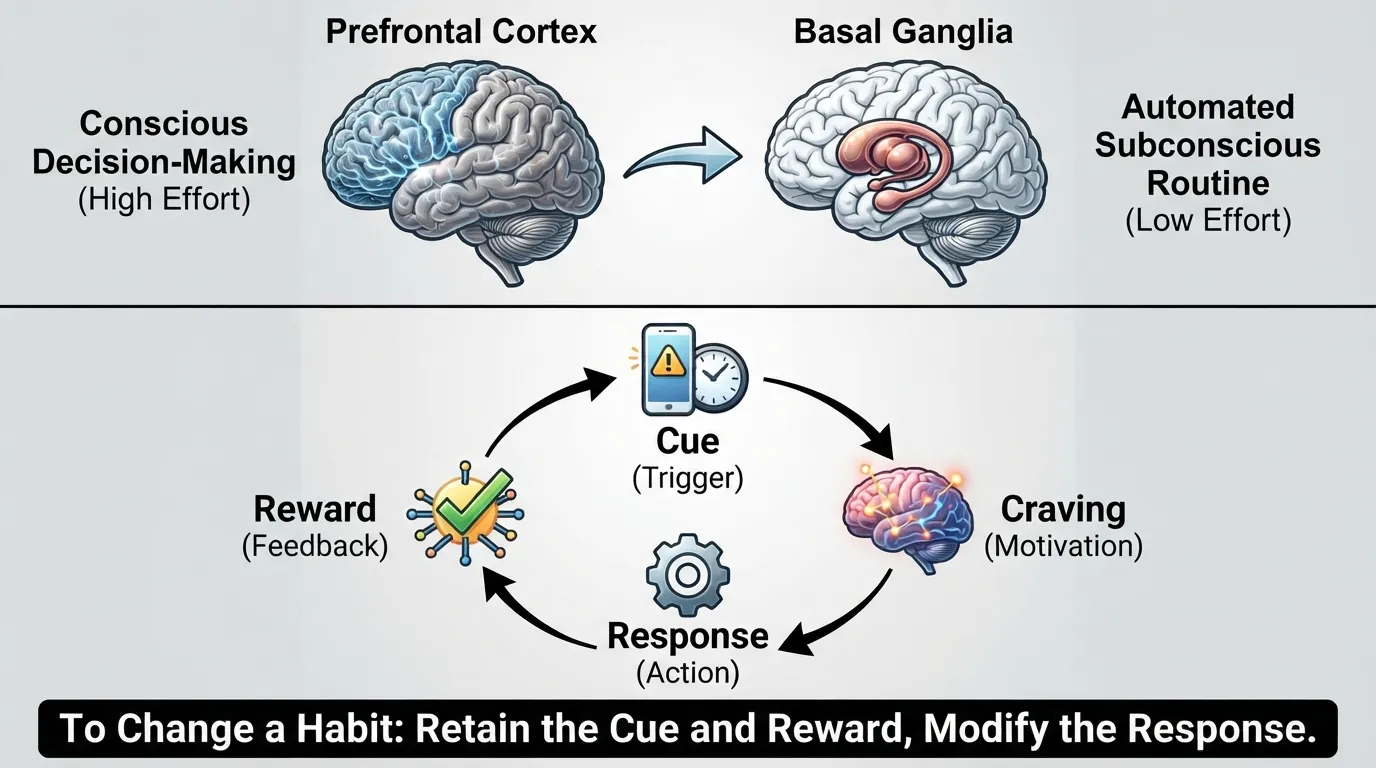
In psychology, a habit is defined as an automatic behavior triggered by specific environmental cues, developed through past repetition and learning. When a behavior is repeated consistently in the same context, your brain shifts control from conscious, goal-directed decision-making to semi-automatic neural pathways, allowing you to perform actions with minimal mental effort.
This guide explores the psychological mechanics of habit formation, breaking down how your brain creates these behavioral loops, the science behind building lasting routines, and evidence-based strategies to break unwanted patterns.
What Is a Habit? (Psychological Definition)
Quick-Answer Definition
In psychology, a habit is a learned behavior that occurs automatically in response to specific contextual cues. Formed through past repetition, habits operate with minimal conscious thought, allowing the brain to save cognitive energy by shifting actions from goal-directed decisions to automatic responses.
Habit Definition by Different Psychologists & Authors
The way we define habits has evolved over a century of psychological research, moving from early philosophical observations to precise neuroscientific models.
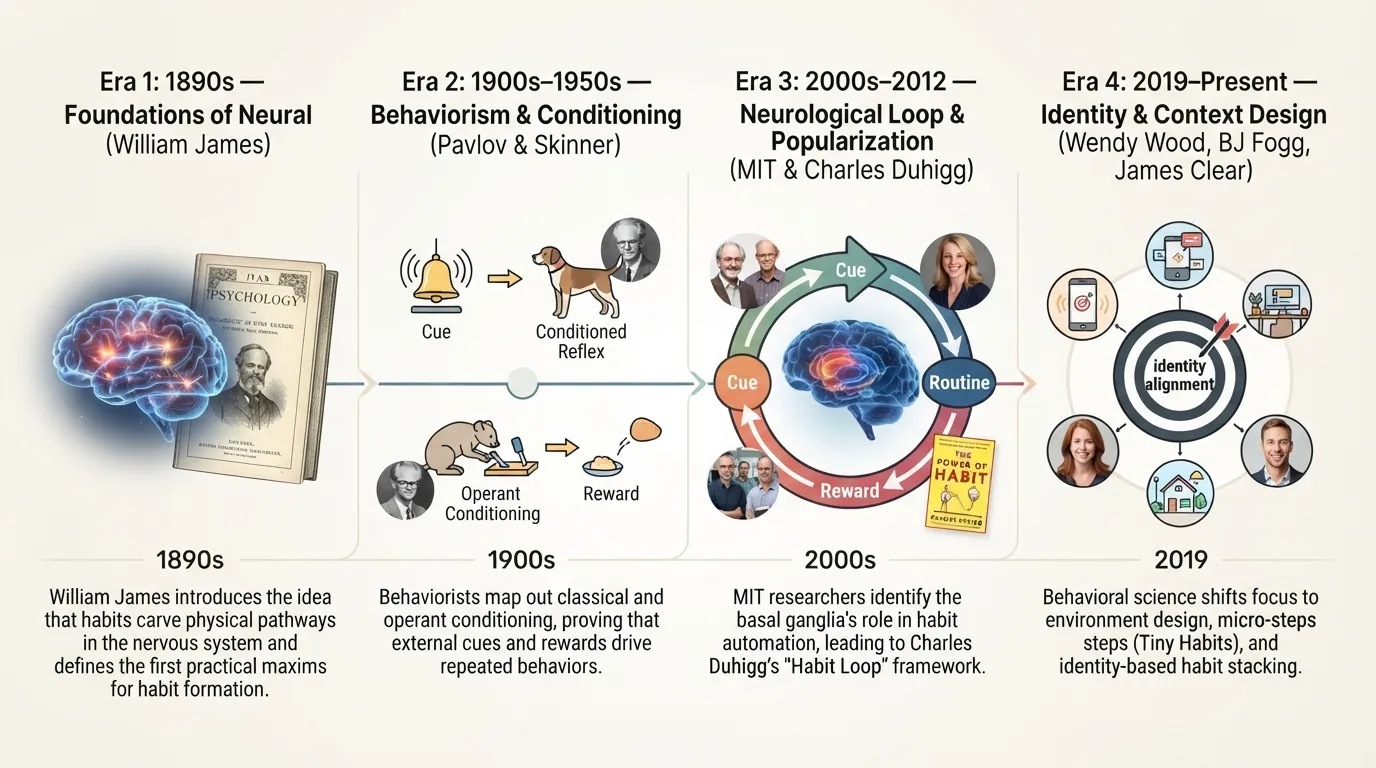
- William James (Principles of Psychology, 1890): James viewed habits as a fundamental law of human nature, famously describing them as the "enormous fly-wheel of society." He argued that habit formation reduces the mental effort required to perform complex actions, effectively rewiring the nervous system through repeated practice to make behaviors easier over time.
- American Journal of Psychology (1903): Early academic literature defined a habit from a strictly behavioral standpoint: "A habit, from the standpoint of psychology, is a more or less fixed way of thinking, willing, or feeling acquired through previous repetition of a mental experience." This definition highlighted that automaticity applies to our thoughts and feelings just as much as physical actions.
- American Psychological Association (APA): The APA offers the modern standard definition: an acquired pattern of behavior that has become nearly or completely involuntary through frequent repetition. The focus here is on the loss of conscious deliberation as a behavior becomes deeply ingrained.
- Charles Duhigg (The Power of Habit): Duhigg popularized the three-step neurological loop—cue, routine, and reward—that drives every habit. His framing emphasizes that habits don't just happen by accident; they are choices that we deliberately make at some point, and then stop thinking about, but continue doing every day.
- Wendy Wood (Good Habits, Bad Habits): Wood, a leading researcher in habit psychology, defines habits specifically through the lens of context and automaticity. Her work demonstrates that habits are mental associations between a cue in our environment and our response, driven by past rewards. Crucially, Wood's research shows that habits persist even when our conscious goals or motivations change.
Habit vs. Routine vs. Addiction vs. Compulsion
It's easy to blur the lines between these four behavioral patterns, but psychology treats them quite differently based on intentionality, neural control, and the level of distress involved.
| Behavior Type | Primary Drive | Level of Conscious Effort | Role of Context Cues | Example |
|---|---|---|---|---|
| Habit | Cue-triggered automaticity | Low / Subconscious | High (Tightly bound to specific environments) | Pouring a glass of water the moment you walk into the kitchen. |
| Routine | Intentional effort & goal orientation | High / Conscious | Medium (Requires deliberate initiation) | Following a step-by-step evening skincare and reading schedule. |
| Addiction | Chemical or psychological dependence | Variable (Impulsive craving) | High (Cues spark intense physiological urges) | Compulsive nicotine or alcohol use despite knowing the harm. |
| Compulsion | Anxiety reduction or threat relief | High (Feels unyielding) | Specific (Internal anxiety or external rituals) | Checking the front door lock repeatedly to soothe intrusive thoughts. |
Here's the thing: a routine can turn into a habit over time, but only when you no longer need to exert willpower to start it. While habits operate quietly in the background to save your brain effort, addictions and compulsions hijack those same neural pathways—making them feel overwhelming or distressing rather than simply convenient.
The History of Habit Psychology
Before neuroscientists mapped brain pathways or behavioral psychologists tracked conditioning in labs, thinkers were already trying to make sense of why humans repeat the things they do. The story of habit psychology is a journey from ancient philosophical ethics to the foundation of modern neuroscience.
Habit in Philosophy — Aristotle & Socrates
Long before psychology established itself as a formal science, classical Greek philosophers viewed habits as the core engine of moral character and personal development.
Socrates laid the initial groundwork by wrestling with human intention and action. He famously argued that no one knowingly does wrong; bad choices stem from ignorance of what is truly good. From his perspective, aligning your habits with wisdom required constant self-examination and intellectual discipline.
It was Aristotle, however, who elevated habits to a central pillar of human psychology. In his Nicomachean Ethics, Aristotle introduced the concept that moral virtue isn’t something we are born with, nor is it merely a set of rules we memorize. Instead, virtue is a state of character formed entirely through practice. As he famously observed, we become just by doing just acts, temperate by doing temperate acts, and brave by doing brave acts.
For Aristotle, a habit (hexis) wasn’t an unthinking, robotic reflex. It was a cultivated disposition—a second nature that aligns our desires with our reason until doing the right thing becomes effortless.
William James and the Birth of Habit Psychology
If ancient philosophy gave us the ethics of habit, William James gave us its biological and mental mechanics. In his landmark 1890 work, Principles of Psychology, James bridged the gap between philosophy and modern psychological science, offering insights that feel strikingly contemporary today.
His Famous Observation on Social Order
James viewed habits as far more than personal quirks; he saw them as the fundamental stabilizing force of human society. Paraphrasing his core argument, James asserted that habit is the massive flywheel of society—its most valuable conservative agent—keeping us all within the bounds of our daily routines and preventing social structure from unraveling. Without automatic habits anchoring our everyday choices, the sheer mental overhead of navigating daily life would leave us utterly exhausted.
His Neural Pathway Theory, in Plain Terms
Decades before brain scans could prove it, James correctly intuited how habits physically reshape the body. He proposed that the nervous system is remarkably plastic—easily molded by experience, yet capable of holding onto those changes once made.
Think of your brain like a grassy field. The first time you walk across it to reach a destination, you tread down a few blades of grass with difficulty. But if you walk that exact same path every single day, you eventually carve a clear, smooth dirt trail. Walking that trail becomes effortless.
James argued that our nervous system works the same way: repeating a behavior carves a physical pathway through our neural tissue, making future iterations of that action progressively easier and more automatic.
His 4 Maxims for Habit Change
To help people harness this biological plasticity, James laid out four practical rules for forging good habits and breaking bad ones:
Launch with strong initiative: When building a new habit or abandoning an old one, throw every bit of momentum you can assemble behind your starting point. Change your environment, make public commitments, and create a powerful first impulse.
Never allow an exception until the new habit is securely rooted: Every lapse is like dropping a ball of string you’ve been carefully winding up; a single slip unwinds more than you can easily rewind. Consistency early on is non-negotiable.
Act on the resolution immediately: Don’t just sit around feeling inspired or making grand plans. Put your new habit into physical action at the very first opportunity, no matter how small that action might be.
Exercise your willpower daily: Keep the faculty of effort alive by performing a small, voluntary task every day simply because you don’t feel like doing it. It acts like strength training for your self-discipline, preparing you for moments of genuine crisis.
Carl Jung’s View on William James
Carl Jung held immense respect for William James, viewing him as one of the true pioneers of American psychology. Jung particularly admired James’s willingness to look beyond rigid, mechanical views of human behavior to explore the deeper, often unconscious forces shaping mental life.
Where James analyzed habits through physiological pathways and conscious effort, Jung approached human behavior through the lens of the unconscious and archetypes. However, Jung recognized that James’s observations on habit neatly captured how the mind automates life. To Jung, James’s work showed how repeated actions gradually sink beneath the surface of conscious awareness, becoming part of the underlying psychic structure that drives daily choices without our active realization. Both thinkers agreed on a fundamental truth: much of human life is directed by forces operating just below our immediate conscious control.
The Habit Loop — How Habits Actually Form
Every habit running silently in the background of your day follows a precise behavioral sequence. Psychology breaks this automatic engine down into distinct structural stages that tell your brain when to act, what to do, and why it should remember the sequence for next time.
Cue (Trigger)
The cue is the initial spark that sets the entire habit loop into motion. It is an environmental, temporal, or internal signal that your brain detects and interprets as a prompt to act. Cues typically fall into five main categories: a specific location, a particular time of day, an emotional state, the presence of certain people, or an immediately preceding action.
For example, pouring a cup of coffee the exact moment your feet hit the kitchen floor in the morning isn't a random decision—it's a response to a physical location and a time-based cue. Your brain recognizes the context and automatically pulls up the associated behavioral script.
Routine (Behavior)
The routine is the action itself—the actual habit you execute. This can be a physical behavior (like brushing your teeth or reaching for your phone), a mental pattern (like overthinking or engaging in self-criticism), or an emotional reaction (like getting instantly defensive when receiving feedback).
Routines range from simple, single-step actions to complex behavioral chains. What defines a habit routine is not its complexity, but its lack of conscious friction: once the cue fires, the routine unfolds with remarkably little mental deliberation.
Reward
The reward is the ultimate destination of the loop and the reason your brain formed the habit in the first place. Rewards satisfy a physical or psychological need—whether that's a burst of physical energy, a wave of relief from stress, a hit of dopamine, or social connection.
The primary function of the reward is neurochemical feedback: it signals to your brain that the routine was effective and worth remembering. If a behavior produces a satisfying outcome, the neural association between the cue and the routine is strengthened, making you far more likely to repeat the action the next time that specific cue appears.
Craving (4th element — Duhigg/Clear expansion)
While early behavioral psychology focused primarily on the three-part loop, modern habit experts like Charles Duhigg and James Clear highlighted a vital fourth element that acts as the real engine driving the entire cycle: the craving.
Cravings are the emotional and physiological anticipations of the reward. You don't actually crave the phone notification itself; you crave the feeling of social connection or novelty that checking it provides. You don't crave the cookie; you crave the relief from stress or the taste sensation it promises. The cue triggers the craving, the craving motivates the routine, and the reward satisfies the craving. Without a craving beneath the surface, a cue remains just noise in your environment rather than a call to action.
Here's a quick breakdown of exactly how that looks in practice:
The Science Behind Habit Formation Brain & Behavior
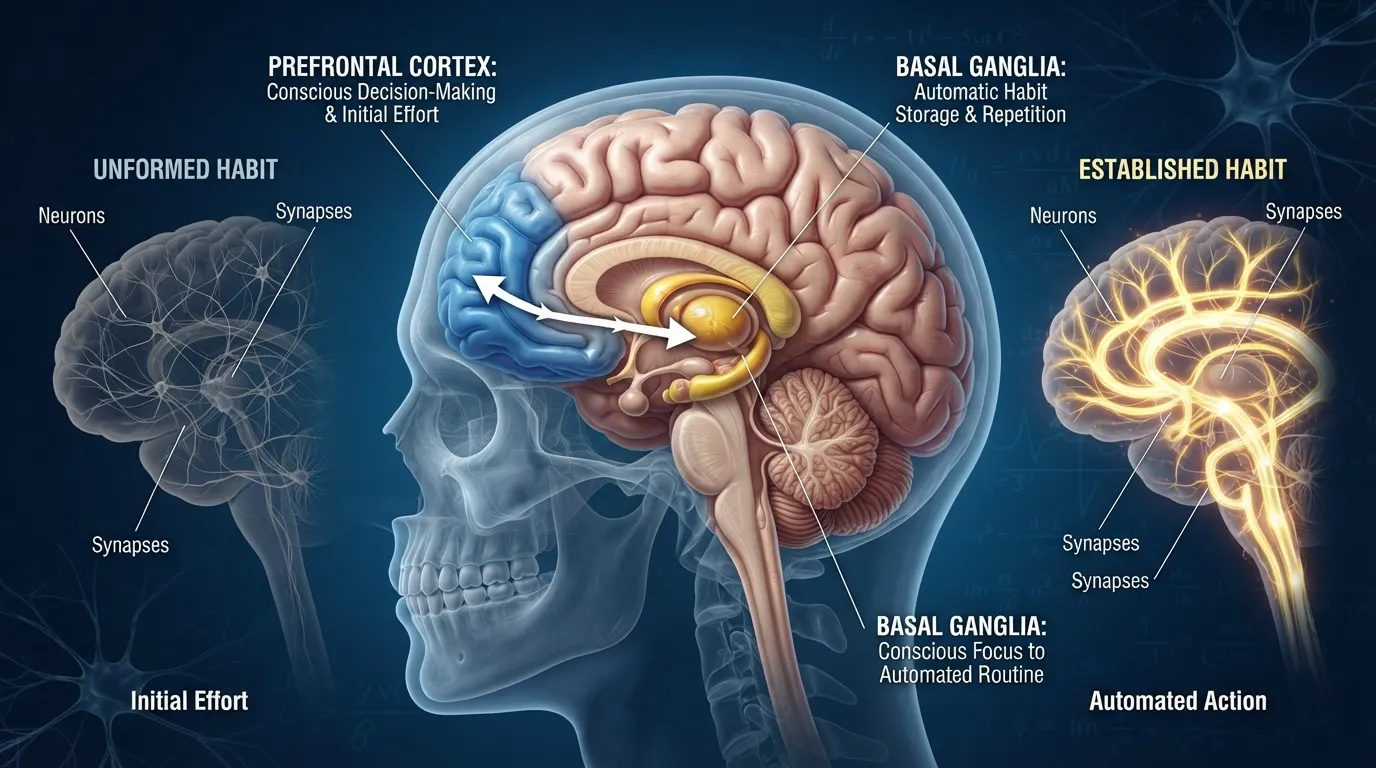
Building a habit isn’t just about repetition; it’s a structural transformation in how your brain processes information and executes decisions.
Automaticity — When a Behavior Becomes a Habit
Automaticity is the psychological threshold where a behavior shifts from an effortful choice to a subconscious reaction. When you first learn a new routine—like driving a car or learning a complex workout movement—your prefrontal cortex works in overdrive to keep you focused. But as you repeat the action in the same environment, your brain systematically delegates control away from deliberate conscious thought.
The key brain mechanism driving this shift is the basal ganglia, a deep subcortical structure that automates repetitive motor and cognitive patterns, allowing the prefrontal cortex to conserve precious mental energy.
How Long Does It Take to Build a Habit?
The widespread belief that it takes exactly 21 days to form a habit is a persistent myth, originating from a misinterpretation of plastic surgery recovery observations in the 1960s. Modern psychological research paints a much more flexible picture.
In a landmark study published by Dr. Phillippa Lally and her research team at University College London, researchers tracked participants attempting to establish a new daily health habit (such as drinking a glass of water or going for a 15-minute walk). The results revealed that habit formation follows a non-linear curve: automaticity rises rapidly at first before plateauing over time.
For extremely simple behaviors (like drinking a glass of water after breakfast), the brain can begin executing the action with minimal friction in under three weeks.
Across all participants and habit types, 66 days was the average timeframe required for a behavior to reach maximum automaticity—where it genuinely feels harder not to do it.
For difficult or mentally demanding habits (like doing 50 push-ups every morning), forming strong neural pathways can take over eight months of continuous daily repetition.
Crucially, Lally’s research also found that missing a single day did not significantly impact the long-term process of habit formation. Consistency over time matters far more than flawless perfection on any given day.
Key Features & Components of a Habit
Understanding what makes a habit tick requires looking at its core characteristics. Psychology breaks down habits into specific defining features that distinguish them from deliberate actions or conscious decisions.
Automaticity
Automaticity is the defining hallmark of any habit. It refers to the degree to which a behavior is executed without conscious awareness, deliberate thought, or effortful control. When a behavior becomes fully automatic, you can initiate and complete it while your conscious mind is completely occupied with something else—like driving your usual commute while listening intently to a podcast, only to realize you don't explicitly remember making the last three turns.
Brain Efficiency
Your brain accounts for roughly 20% of your body's energy consumption despite making up only 2% of its mass. To preserve vital cognitive bandwidth for novel challenges and complex decisions, the brain relies heavily on habits to automate routine choices. By shifting repeated behaviors into streamlined neural scripts, your brain conserves glucose and mental energy, allowing you to move through daily life without experiencing constant decision fatigue.
Learned Association
Habits do not exist in a vacuum; they are built on strong, learned mental associations between a specific situational cue and a behavioral response. Through repeated practice in a consistent environment, your neural network creates a direct link between the context and the action. Eventually, simply encountering the context (e.g., sitting down at your desk) automatically retrieves and executes the mental association (e.g., opening your email inbox) without needing to consult your conscious goals.
The Four Main Components of Habit Formation
While every habit displays automaticity, efficiency, and learned association, the process of forming one relies on four fundamental components working in unison:
| Component | Psychological Function | Real-World Example |
|---|---|---|
| 1. The Cue | Triggers the brain to initiate a specific behavior by signaling an upcoming reward. | Hearing your morning alarm go off. |
| 2. The Craving | Provides the motivational force and physiological anticipation driving the action. | Desiring a feeling of alertness and warmth. |
| 3. The Response | Represents the actual habit executed—whether a thought, movement, or emotion. | Walking to the kitchen and brewing a cup of coffee. |
| 4. The Reward | Delivers the ultimate payoff, satisfying the craving and reinforcing the neural loop. | Experiencing the caffeine boost and comfortable warmth. |
Types of Habits in Psychology
Not all habits manifest as physical routines like tying your shoes or pouring morning coffee. In psychology, habits encompass any recurring automatic pattern—whether physical, mental, emotional, or social—that your brain executes in response to a familiar trigger.
The Four Types of Habits
Psychologists generally classify habits into four distinct categories based on how and where the automatic response takes place:
- Behavioral Habits (Motor Patterns): The most recognizable habits—visible physical actions executed automatically through motor memory.
- Cognitive Habits (Mental Loops): Internal thought patterns, self-talk, and default problem-solving heuristics that fire without conscious intention.
- Emotional Habits (Affective Responses): Automatic emotional reactions triggered by specific situations, environments, or interactions.
- Social Habits (Relational Patterns): Interpersonal behaviors and communication styles that manifest automatically when interacting with others.
Habit Definition Psychology Examples
To see how these four categories operate in daily life, consider these relatable real-world scenarios:
| Habit Type | Psychological Mechanism | Relatable Real-World Example |
|---|---|---|
| Behavioral | Motor memory automation via the basal ganglia. | Buckling your seatbelt: Clicking your seatbelt the second you sit in a car before even thinking about turning the key. |
| Cognitive | Automated cognitive frames and mental shortcuts. | Imposter syndrome loop: Automatically assuming "I just got lucky, I don't belong here" immediately after receiving praise at work. |
| Emotional | Conditioned limbic system responses. | Stress-defensiveness: Feeling an instant wave of irritation or defensiveness the moment someone asks, "Can we talk?" |
| Social | Automated relational scripts and social defaults. | Automatic apologizing: Saying "Sorry!" instinctively when someone else bumps into you in a crowded room. |
The 4 Laws of Building a Good Habit
To successfully build a lasting behavioral pattern, behavioral psychology suggests restructuring your environment and choices around four primary principles. Each law directly targets a specific phase of the habit loop (Cue, Craving, Response, and Reward).
1. Make It Obvious (1st Law — The Cue)
Most of our daily cues are invisible because we don't design our surroundings intentionally. To build a new habit, bring the triggers into plain sight. Use clear implementation intentions (e.g., "I will [BEHAVIOR] at [TIME] in [LOCATION]") or habit stacking to anchor new actions onto established daily routines.
2. Make It Attractive (2nd Law — The Craving)
Dopamine drives motivation and action. The more attractive an opportunity feels, the more likely it is to become habit-forming. Pair actions you need to do with actions you want to do (temptation bundling), or join a culture where your desired behavior is the normal social standard.
3. Make It Easy (3rd Law — The Response)
Human behavior follows the Law of Least Effort: we naturally gravitate toward options that require the least amount of friction. Optimize your surroundings to make positive behaviors effortless. Utilize rules like the "Two-Minute Rule"—scaling down any new habit so it takes two minutes or less to perform when starting out.
4. Make It Satisfying (4th Law — The Reward)
What is immediately rewarded is repeated; what is immediately punished is avoided. Because the human brain evolved to prioritize immediate payoffs over delayed outcomes, ensure your habit delivers an instant sense of progress or satisfaction (such as using a habit tracker or immediate positive reinforcement).
Deep dive into the neuroscience of habits and how they shape behavior:
What Is the 3-3-3 Rule for Habits?
The 3-3-3 Rule for Habits is a productivity and behavioral framework designed to help build sustainable routines without feeling overwhelmed. It structures your daily efforts into three manageable tiers:
3 Hours on Your Primary Goal: Dedicate a deep, focused block of 3 hours to your most critical project, habit, or deep-work objective of the day.
3 Short Tasks: Complete 3 urgent or necessary secondary tasks (e.g., answering important emails, quick errands, or brief administrative duties) that need immediate attention.
3 Maintenance Routines: Perform 3 core daily maintenance habits that keep your life running smoothly (e.g., exercising for 30 minutes, reading 10 pages, or preparing a healthy meal).
By capping daily expectations at these nine actionable items, the 3-3-3 rule prevents decision fatigue and ensures consistent long-term momentum.
How to Build a New Habit — William James' Approach
While modern authors like James Clear and Charles Duhigg brought habit formation into 21st-century popular culture, the psychological foundation for building new habits was laid in 1890 by philosopher and psychologist William James. Combining James’ timeless principles with modern strategies creates a powerful blueprint for lasting personal change.
William James’ Advice for Developing Good Habits (His Maxims, Applied)
In his groundbreaking work Principles of Psychology, William James laid out practical maxims for building strong habits. His 19th-century wisdom applies directly to habit formation today through four core principles.
First, launch with strong initiative. Throw every piece of momentum behind your starting line by changing your physical environment, making a public commitment, or altering your schedule, as a decisive initial push creates a strong neural spark.
Second, never allow an exception until the habit is rooted. Consistency early on is mandatory, and James famously warned that every lapse is like dropping a ball of string you are carefully winding up—a single slip unwinds far more progress than you realize.
Third, act on your resolution immediately. Feeling inspired is useless without physical action, so the moment you decide to build a habit, take a small concrete step toward it immediately—put on your running shoes, open the document, or set out your journal.
Fourth, exercise your willpower daily. Keep your faculty of effort active by doing something small every day simply because you don’t feel like doing it, which acts as resistance training for self-discipline and prepares you for moments of fatigue or low motivation.
Habit Stacking & Identity-Based Habits (Modern Techniques)
Modern behavioral science has evolved James’ maxims by integrating structural cues and cognitive identity shifts into practical daily strategies.
Habit Stacking, popularized by modern researchers and writers, connects a new behavior to an established daily routine rather than relying on vague time slots. Because your brain already has strong neural pathways for existing habits like brewing coffee or brushing your teeth, pairing a new action directly with an existing one removes the friction of remembering when to act. The simple operational formula for this technique is: “After [CURRENT HABIT], I will [NEW HABIT].”
Identity-Based Habits address the core mindset behind long-term behavioral changes. Most people try to change habits by focusing on what they want to achieve through outcome-based goals, such as wanting to lose ten pounds. However, lasting change occurs when you shift your focus to who you want to become through identity-based goals, such as viewing yourself as an active person. Every small action you take serves as a vote for the type of person you wish to be, creating internal alignment that makes habit maintenance automatic over time.
How to Break a Bad Habit
Breaking an unwanted behavior requires reversing the mechanics of habit formation. Instead of relying purely on willpower, effective behavioral change focuses on reshaping your environment and altering how your brain processes cues and rewards.
Why Bad Habits Are Hard to Break
Bad habits are difficult to dismantle because they are deeply ingrained in your neural circuitry through automatic feedback loops. Once a behavior becomes automated, the brain shifts execution from the conscious prefrontal cortex to subcortical structures like the basal ganglia, turning actions into subconscious routines.
Furthermore, bad habits often serve a immediate psychological purpose—such as relieving stress, boredom, or discomfort. Because the brain prioritizes short-term relief over long-term goals, stopping a habit cold turkey creates internal friction unless the underlying craving or emotional trigger is addressed.
Removing Cues & Rewiring Rewards
The most reliable strategy for eliminating a bad habit is to break the habit loop by addressing its triggers and payoffs:
1. Remove or Invert the Cue: Make the habit invisible or difficult to execute. If phone notifications trigger mindless scrolling, turn off notifications or place the phone in another room. By eliminating the trigger from your environment, you prevent the habit loop from starting.
2. Rewire the Reward (Substitute the Behavior): Habits are rarely eliminated entirely; instead, they are replaced. Keep the initial cue and the ultimate reward the same, but swap out the negative routine for a healthy alternative. For instance, if stress (cue) drives you to consume sugary snacks for a quick boost (reward), replace the snacking with a two-minute brisk walk or deep breathing exercise to get a similar stress-relief payoff.
Recommended Books & Research on the Psychology of Habits
Understanding behavioral change becomes far easier when grounded in proven psychological principles. Whether you prefer foundational 19th-century theories, practical modern frameworks, or peer-reviewed scientific studies, the following books and research papers provide the best roadmaps for habit formation.
Foundational Book — William James’ Principles of Psychology (1890)
Published in 1890, William James’ Principles of Psychology remains a monumental text in behavioral science. Chapter X, dedicated entirely to “Habit,” established concepts that modern neuroscience still validates today.
James was among the first to argue that human behavior is largely driven by automated neural pathways formed through repetition. His core maxims—launching with strong initiative, avoiding exceptions during early formation, and acting immediately on resolutions—set the baseline for modern productivity and habit coaching.
Popular-Science Books — Duhigg, Clear, & Fogg
Modern authors have translated academic habit literature into actionable, real-world systems:
Charles Duhigg — The Power of Habit (2012): Deconstructs the core framework of human routine into the Habit Loop (Cue → Routine → Reward). Duhigg demonstrates how companies and individuals leverage this neurological loop to build or transform routines.
James Clear — Atomic Habits (2019): Focuses on small, 1% incremental improvements and Identity-Based Habits. Clear provides practical tools like habit stacking, environment design, and the Four Laws of Behavior Change to make good habits attractive and bad habits invisible.
BJ Fogg — Tiny Habits (2019): Written by the founder of the Behavior Design Lab at Stanford University, this book focuses on starting with micro-behaviors (actions that take less than 30 seconds) anchored to existing daily prompts to bypass motivation reliance.
Key Research Papers Worth Reading
For readers looking to explore the peer-reviewed evidence behind habit formation, these seminal studies highlight how routines are built, sustained, and altered:
Lally et al. (2010) — How are habits formed: Modelling habit formation in the real world:
Key Finding: Debunks the popular myth that habits take exactly 21 days to form. Researchers found that building an automated habit actually takes anywhere from 18 to 254 days (with a median of 66 days), depending on task complexity and individual consistency.
Open Access: Search the title on NCBI/PubMed Central (PMC) for free full-text access.
Ouellette & Wood (1998) — Habit and intention in everyday life: The multiple processes by which past behavior predicts future behavior:
Key Finding: Demonstrates how frequently performed behaviors in stable contexts become automated and independent of conscious intentions, whereas novel or infrequently performed behaviors rely heavily on active decision-making.
Open Access: Available via academic repositories such as ResearchGate or institutional open-access databases.
Wendy Wood’s Habit-Context Research:
Key Finding: Dr. Wendy Wood’s body of work emphasizes the role of physical environment in habit control. Her research demonstrates that approximately 43% of daily actions are executed automatically while thinking about something else, and changing environmental friction is the most effective way to modify behavior.
Open Access: Many of Dr. Wood’s open-access papers on environmental cues and automaticity can be found directly on PubMed Central (PMC).
Frequently Asked Questions
What is the definition of a habit?
A habit is a routine or behavior that is performed regularly, repeatedly, and often automatically without requiring conscious thought or effort.
What is the definition of a habit in psychology?
In psychology, a habit is defined as an automated behavioral response triggered by specific environmental cues, developed through past repetition and reinforced by rewards in the brain's basal ganglia.
What is the 3-3-3 rule for habits?
The 3-3-3 rule is a daily productivity structure that involves dedicating 3 hours to your main goal or deep work, completing 3 short urgent tasks, and maintaining 3 core daily habits (e.g., exercise, reading, planning).
What is William James' definition of habit?
William James defined habit as a physical and neurological phenomenon where repeated actions carve out distinct pathways in the nervous system, simplifying actions and making them automatic over time.
What is William James' most famous quote?
His most famous quote regarding human change is: "The greatest discovery of my generation is that a human being can alter his life by altering his attitudes." Regarding habits, he famously wrote: "All our life, so far as it has definite form, is but a mass of habits."
What are the four laws of habits?
Popularized by James Clear, the Four Laws of Behavior Change are:
- 1st Law (Cue): Make it obvious.
- 2nd Law (Craving): Make it attractive.
- 3rd Law (Response): Make it easy.
- 4th Law (Reward): Make it satisfying.
Did Carl Jung comment on William James?
Yes. Carl Jung respected William James significantly, praising his pragmatic approach to psychology, his research into consciousness, and his openness to spiritual and religious experiences.
What is habit in philosophy?
In philosophy (dating back to Aristotle), a habit (hexis) is a acquired disposition or character trait developed through deliberate practice that shapes moral virtues, human agency, and personal identity.
What was William James' most famous theory?
William James is best known for the James-Lange Theory of Emotion (which states that emotions are caused by physiological responses to events) and his philosophical doctrine of Pragmatism and the Stream of Consciousness.
What are the four types of habits?
Habits are commonly categorized into four distinct areas:
- Physical Habits: Exercise, nutrition, sleep hygiene.
- Mental/Cognitive Habits: Focus, problem-solving, mindfulness.
- Emotional Habits: Self-talk, stress responses, gratitude.
- Social Habits: Communication style, active listening, relationship building.
What are the four main components of forming a habit?
The four core components of the neurological habit loop are:
- 1. Cue: The trigger that initiates the behavior.
- 2. Craving: The motivational force behind the habit.
- 3. Response: The actual habit or action performed.
- 4. Reward: The benefit or relief gained that reinforces the loop.
What advice did William James give for developing good habits?
William James outlined four essential maxims:
- Launch new habits with strong initiative and strong commitment.
- Never allow an exception until the new habit is firmly rooted.
- Act on resolutions immediately rather than just thinking about them.
- Exercise daily willpower by doing small tasks purely for self-discipline training.
Conclusion — Key Takeaways
Building lasting habits requires blending timeless psychological principles with modern behavioral systems. Here is a summary of the core insights from this guide:
Foundation First: William James laid the groundwork for habit formation in 1890, emphasizing strong initial momentum, strict consistency early on, immediate physical action, and daily willpower training.
Understand the Loop: Habits are automated loops consisting of a Cue, Craving, Response, and Reward. Breaking or building a habit requires altering these specific components rather than relying solely on raw willpower.
Modern Upgrades: Combining James’ principles with modern techniques—such as Habit Stacking (anchoring new routines to existing ones) and Identity-Based Habits (focusing on who you want to become)—removes friction and accelerates long-term adoption.
Environment Over Effort: The most effective way to eliminate bad habits is to modify your environment—removing cues or replacing unhealthy routines with positive alternatives that satisfy the same underlying craving.
Ready to Optimize Your Daily Workflow?
Now that you understand the mechanics of building positive routines, take the next step in structuring your daily productivity. Check out our detailed breakdown on How to Implement the 3-3-3 Rule for Maximum Focus to organize your deep work, urgent tasks, and daily maintenance habits effectively.
Thanawat Rattanakul
Thanawat Rattanakul is the Habits Editor at Holistic Wellbeing Living. He writes about daily routines, habit systems, small behavior changes, and sustainable progress. With eight years of experience creating personal-growth content, Thanawat helps readers build practical routines that fit real life.