Successful Habits of Successful People: 15 Proven Habits That Actually Create Success
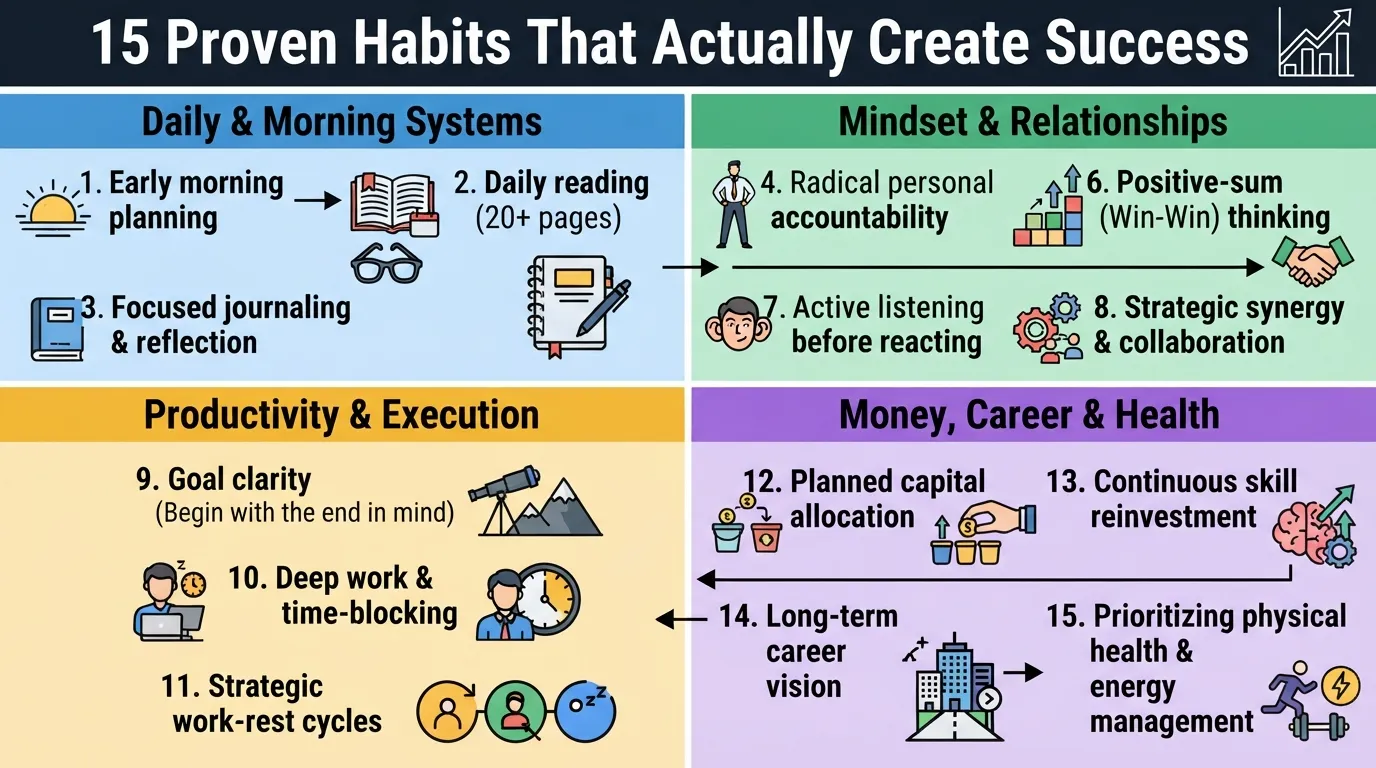
The Unspoken Gap Between Hard Work and Real Success
You can wake up at 5:00 AM, grind for twelve hours straight, and still feel stuck in the exact same spot year after year. It is one of the most frustrating realities in life: working yourself to exhaustion without seeing any meaningful progress in your career, finances, or personal growth.
The problem isn’t a lack of effort, discipline, or raw talent. The real difference between people who struggle despite working hard and those who consistently achieve high-level success comes down to their daily systems—their habits. Successful people do not rely on occasional bursts of motivation or sheer willpower. They rely on high-leverage behavioral patterns that compound over time, ensuring that every hour of effort yields actual, measurable progress rather than just noise and busyness.
In this guide, you will learn the exact daily routines, priority frameworks, and execution strategies used by elite performers. We will break down how to bridge the gap between knowing what to do and actually doing it, helping you dismantle counterproductive patterns and build a sustainable system for long-term success.
Daily Habits of Successful People
Wake Up Early & Plan the Day
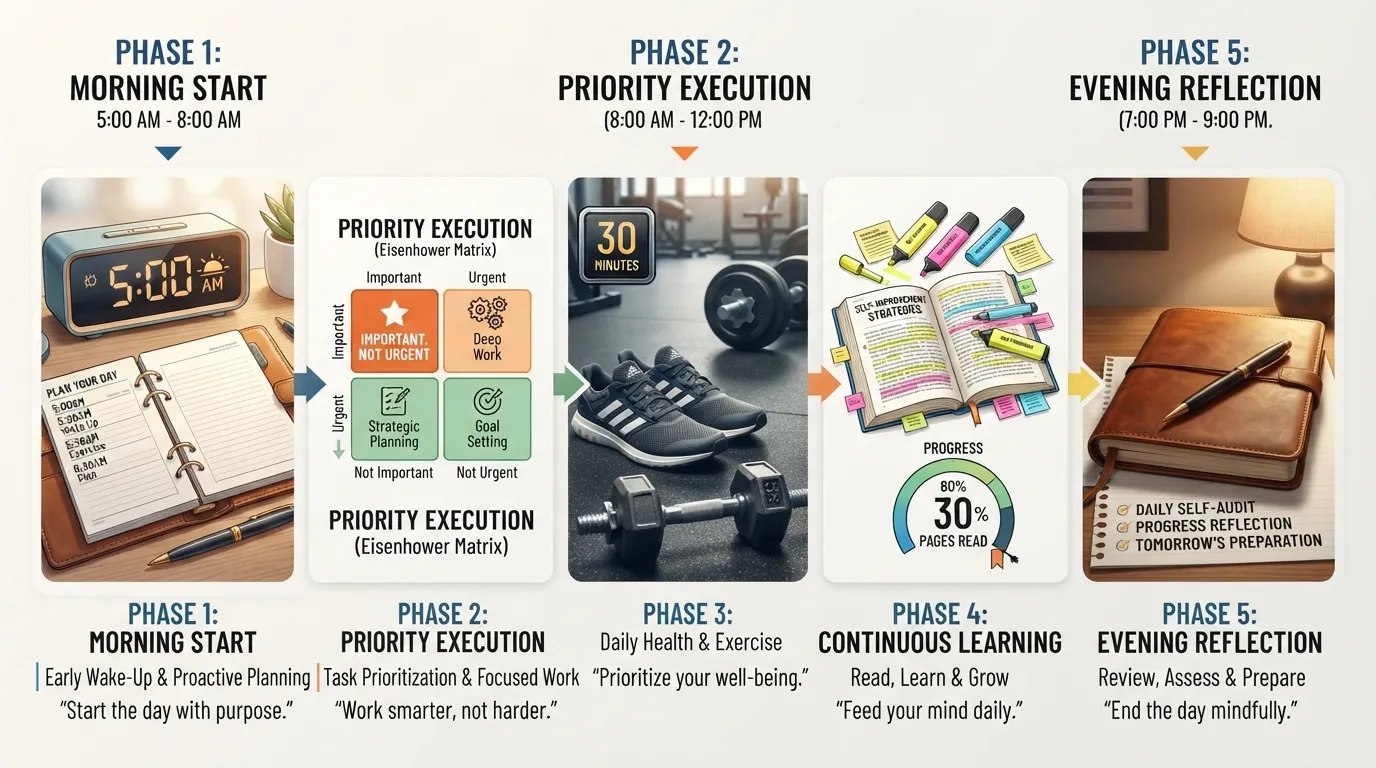
Waking up early is not about earning a badge of honor; it is about securing uninterrupted cognitive bandwidth. Early morning provides a distraction-free window before messages, notifications, and client demands start dictating your attention. High performers use this time to shift from reactive mode to proactive planning.
Instead of jumping straight into email, structure your day before the noise begins. Map out your core objectives, calendar blocks, and energy allocation for the rest of the day. When you start your morning with a clear operational plan, you spend the remaining hours executing rather than deciding what to do next.
Prioritize Important Tasks (Not Urgent Ones)
Average performers fall into the “urgency trap”—spending their best hours responding to immediate fires, ping notifications, and other people’s priorities. Exceptional performers organize their workload around long-term impact using the Eisenhower Matrix model, separating tasks that are truly important from those that are merely urgent.
Important Tasks: Building core skills, long-term strategic projects, revenue-generating systems, and health.
Urgent Tasks: Unscheduled phone calls, inbox clutter, last-minute administrative requests, and trivial meetings.
Every morning, identify your “One Thing”—the single high-leverage task that yields the greatest long-term result. Complete that task before opening your email or taking incoming calls.
Exercise & Physical Health
Physical fitness directly impacts cognitive capacity, endurance, and stress resistance. High-level performance requires sustained mental stamina, which is impossible to maintain if your baseline energy, sleep quality, and physical resilience are depleted.
You do not need a three-hour powerlifting routine every day. Focus on consistency over intensity: a 30-to-45-minute daily session of weight training, running, or brisk cardio increases blood flow to the brain, regulates cortisol levels, and sharpens decision-making for the rest of the day.
Daily Reading
Reading is the most efficient method for acquiring decades of experience in a few hours. High achievers approach reading as targeted skill acquisition rather than passive entertainment, focusing heavily on biographies, industry analyses, mental models, and deep-domain literature.
Target Volume: Aim for 20 to 30 pages per day.
Compound Result: 30 pages a day equals roughly 36 books a year—an immense competitive advantage over the average adult who reads less than two books annually.
Execution: Take practical notes on how to implement at least one idea from every book into your life or business immediately.
Focused Reflection / Journaling
Execution without reflection leads to efficient movement in the wrong direction. High performers build end-of-day reflection loops to evaluate their decisions, audit their time usage, and process cognitive overload.
Spend 10 minutes every evening writing out responses to three simple prompts:
What worked well today, and why?
Where did I waste time or lose focus?
What is the single most important task I must execute tomorrow?
This daily self-audit keeps you accountable, prevents repeatable mistakes, and brings absolute clarity to your next morning’s strategy.
Mindset Habits That Separate Successful People From Average People
They Take Responsibility, Not Excuses
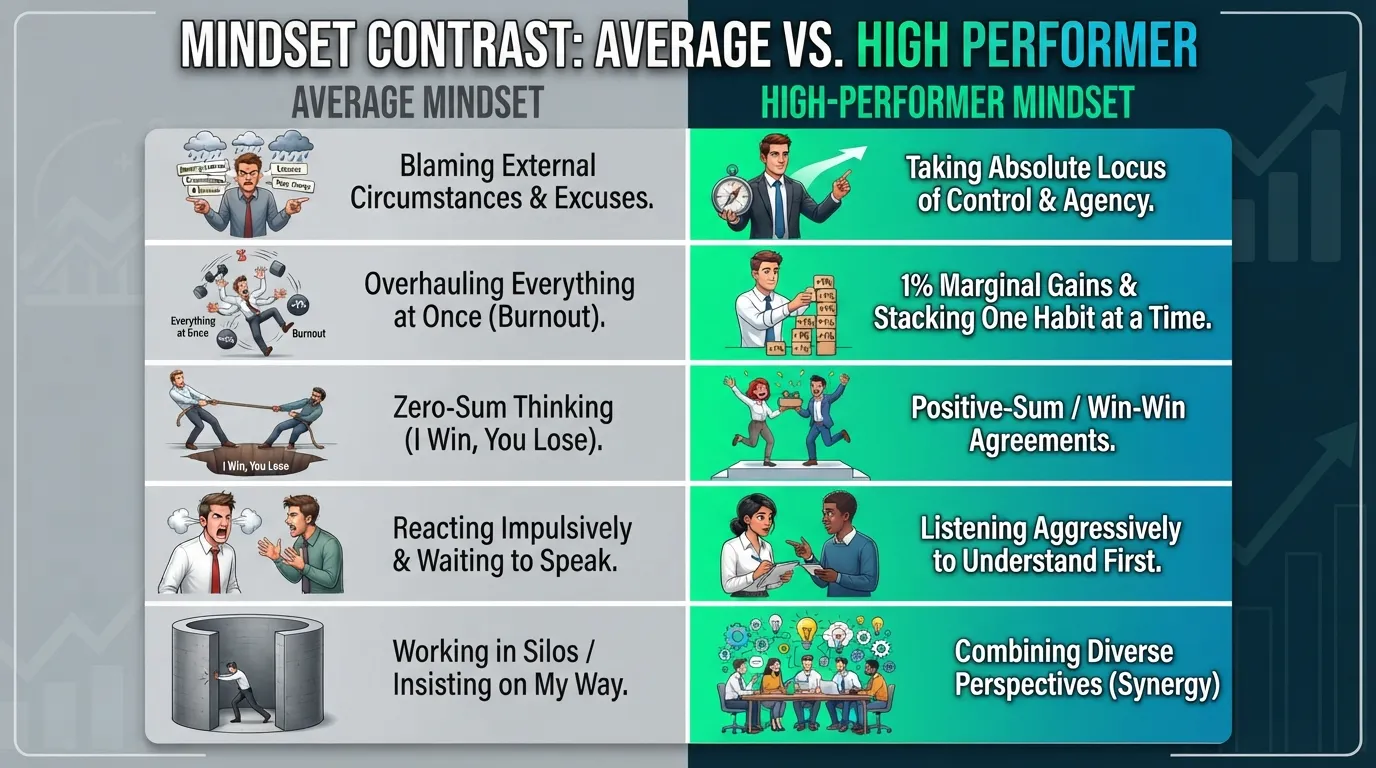
Average performers spend their energy blaming external conditions—the economy, bad bosses, lack of time, or unlucky circumstances—for their lack of progress. Elite performers adopt an absolute locus of control: they accept full ownership over every outcome in their lives, regardless of whether the situation was entirely their fault.
Taking responsibility is not about taking blame; it is about taking agency. When you accept that your current position is the sum of your past choices and responses, you gain the power to change it. Instead of asking “Why is this happening to me?”, successful people ask “What leverage do I have here, and what am I going to do about it?”
They Improve One Habit at a Time
The fastest way to fail at personal development is attempting a complete life overhaul overnight. Low performers try to fix their diet, wake up two hours earlier, start lifting weights, and read a book a week all at once—leading to burnout and total collapse within ten days.
High performers build sustainable systems using the principle of marginal gains. They isolate a single foundational habit, optimize it until it becomes second nature, and only then stack the next one on top.
Focus: Isolate one high-impact behavior for 30 to 60 days.
Friction: Lower the barrier to execution so missing a day becomes harder than completing the habit.
Compounding: A 1% improvement executed consistently yields far greater long-term transformation than drastic, short-lived efforts.
They Think Win-Win in Relationships
Average mindsets view success as a zero-sum game where someone else’s gain is inherently their loss. Successful people recognize that long-term wealth, strong networks, and influence are built on positive-sum interactions where both sides gain substantial value.
Whether negotiating business contracts, managing a team, or collaborating on projects, always look for agreements where everyone benefits. If a deal requires one party to lose, it creates friction, resentment, and fragile long-term outcomes. Win-win arrangements build trust and generate recurring opportunities that compound over a lifetime.
They Seek to Understand Before Reacting
Reacting impulsively to poor communication, setbacks, or opposing viewpoints is a hallmark of weak leadership and emotional dysregulation. Exceptional performers practice cognitive restraint: they listen aggressively to understand the underlying motives and mechanics before formulating a response.
When confronted with conflict, ask clarifying questions instead of preparing your rebuttal while the other person speaks. Understanding the root cause of a problem, a client’s actual pain point, or a partner’s true constraint gives you the precise insight needed to solve the problem efficiently rather than worsening it with emotional noise.
They Combine Perspectives (Synergy)
Average minds insist on their own ideas and operate in a silo. High achievers actively hunt for diverse viewpoints, knowing that combining complementary strengths creates solutions far superior to what any single individual could build alone.
Synergy is about valuing differences rather than demanding conformity. By pairing analytical thinkers with creative problem-solvers, or operational strategists with charismatic communicators, you create systems where the whole is significantly greater than the sum of its parts. True success is rarely a solo endeavor—it is the strategic combination of elite talents working toward a unified vision.
Productivity Habits of Highly Successful People
Begin With the End in Mind (Goal Clarity)
Most people mistake busyness for productivity. They spend their days crossing off low-value tasks without evaluating whether those actions actually move them closer to their primary objectives. High performers work backward: they define the exact outcome they want to achieve first, then construct the specific roadmap required to reach it.
Before starting any project, week, or workday, define what success looks like in clear, measurable terms. If you do not have absolute clarity on the end goal, you will waste critical time on non-essential tasks and derail your progress.
Macro Clarity: Define 1-year and 5-year objective metrics for career, revenue, and key personal milestones.
Micro Clarity: Break those macro goals down into quarterly benchmarks, weekly priorities, and daily deliverables.
Execution Rule: If a daily task does not directly support a weekly priority, eliminate, delegate, or defer it.
Time-Blocking / Deep Work Sessions
Multitasking is a cognitive myth that destroys focus, increases error rates, and drastically reduces output quality. High achievers protect their attention by using time-blocking—allocating specific, non-negotiable calendar slots to single tasks without interruption.
During these deep work sessions, eliminate all potential distractions: turn off notifications, close unnecessary browser tabs, and isolate yourself from incoming calls.9:00 AM – 10:30 AM [DEEP WORK] Core Revenue & Strategy Deliverable
10:30 AM – 10:45 AM [REST] Walk / Hydrate
10:45 AM – 11:30 AM [SHALLOW WORK] Email, Messages, Admin Tasks
Working deeply for 90 to 120 minutes with total focus produces far higher quality output than eight hours of fragmented, distracted effort.
Work-Rest Ratio for Sustained Output
Peak mental performance follows ultradian rhythms—natural cycles of high cognitive energy that last roughly 90 minutes, followed by a noticeable dip in focus. Elite performers do not force themselves through exhaustion; they treat rest as a strategic tool to maintain consistent energy throughout the day.
Structure your workday around defined execution blocks paired with deliberate recovery periods.
50/10 Rule: Work with total focus for 50 minutes, then rest for 10 minutes away from screens.
90/20 Rule: Complete a intense 90-minute deep work block, followed by a 20-minute mental reset (a walk, light stretching, or meal).
Strategic rest prevents afternoon brain fog, preserves decision-making accuracy, and allows you to sustain high-level output day after day without burning out.
Money & Career Habits
Planned Spending, Not Impulsive
Financial security is not determined solely by how much you earn, but by how much you retain and deploy effectively. Average earners often allow lifestyle inflation to consume every income increase, spending impulsively on liabilities that provide short-term status. Successful people treat personal capital with strict operational discipline, allocating funds according to a predefined financial plan rather than emotional impulses.
Before making major financial commitments, build systematic filters that enforce deliberate decision-making:
The 48-Hour Rule: Wait two full days before making any non-essential purchase over a set threshold to eliminate impulse buying.
Capital Allocation First: Automate fixed transfers into investments, high-yield savings, and asset acquisition the moment revenue arrives—spend only what remains.
Value-Based Spending: Direct capital toward high-leverage assets—such as health, time-saving software, education, and cash-flowing investments—while minimizing recurring overhead on depreciating items.
Continuous Skill Investment
Treating education as a finite phase that ends with a degree or diploma is one of the fastest paths to professional obsolescence. High earners view their personal skill stack as an evolving portfolio that requires continuous reinvestment. They regularly reallocate capital and time into acquiring rare, valuable skills that compound their market value over time.
Aim to reinvest at least 5% to 10% of your annual income directly back into your own professional development. Whether through advanced technical certifications, industry workshops, specialized courses, or private mentorship, the return on investment from self-education far exceeds standard market returns. In a rapidly changing economy, the ability to learn, unlearn, and master high-leverage skills faster than your peers is your ultimate career moat.
Long-Term Career Vision vs Short-Term Wins
Short-term thinkers optimize for immediate comfort, quick payouts, and modest raises, often sacrificing long-term career growth in the process. Exceptional performers play long-term games with long-term people. They evaluate career opportunities based on skill acquisition, network density, and strategic positioning rather than upfront compensation alone.
| Decision Factor | Short-Term Focus | Long-Term Vision |
| Career Choices | Highest starting salary, low friction tasks | High growth environment, steep learning curve |
| Networking | Transactional (what can I get right now?) | Relational (how can I deliver value first?) |
| Problem Solving | Quick fixes, immediate patches | Scalable systems, root-cause resolution |
| Skill Building | Doing only what is currently required | Mastering future-proof, complementary skills |
When faced with trade-offs between immediate ease and future leverage, prioritize options that expand your long-term choices and equity over time.
Bad Habits Successful People Avoid
Achieving long-term success is as much about what you eliminate as what you implement. High performers aggressively protect their time, focus, and energy by systematically eliminating counterproductive behaviors that drain their capacity.
Constant Distractions: Unfiltered notifications, open communication apps, and constant context-switching fragment deep focus and degrade output quality. Successful people treat their attention as a non-renewable resource, turning off non-essential alerts and isolating execution windows.
Procrastination: Postponing demanding, complex, or uncomfortable tasks creates unnecessary mental anxiety and leads to rushed execution. Elite performers tackle their most difficult, high-leverage deliverables first when their cognitive energy is at its peak.
Negative Self-Talk: Ruminating on past mistakes, doubting your capabilities, or reinforcing a victim mindset directly destroys confidence and limits decisive execution. High achievers frame setbacks as objective feedback, focusing entirely on solutions and tactical adjustments.
Unplanned Spending: Impulse purchases and lack of financial tracking undermine long-term wealth creation. High earners manage personal cash flow with disciplined systems, ensuring capital goes toward high-yield investments rather than short-term lifestyle inflation.
Ignoring Health: Sacrificing sleep, skipping exercise, and neglecting proper nutrition to work longer hours yields diminishing returns. Exceptional performers recognize that sustained mental endurance, sharp decision-making, and emotional resilience require a healthy physical foundation.
How to Build Successful Habits — Step-by-Step Framework
Step 1 – Choose One Habit at a Time
Attempting to overhaul your entire lifestyle overnight guarantees friction and failure. When you spread your willpower across five new behaviors simultaneously, your cognitive bandwidth breaks under the pressure, leading to total burnout within days.
Focus on a single, high-leverage habit for at least 30 consecutive days. Isolate one behavior—such as reading 20 pages every morning or doing 30 minutes of physical exercise—and commit to it until it becomes an automated baseline before stacking the next habit.
Step 2 – Attach It to Existing Routine
New habits fail most often because people forget to perform them or struggle to find a dedicated trigger in their daily schedule. The most reliable way to anchor a new behavior is through “habit stacking”—linking your target action directly to an established daily anchor.
Select a non-negotiable part of your daily routine, such as brushing your teeth, pouring your morning coffee, or closing your laptop at the end of the workday.
Write out your new rule using a specific formula: “After I [CURRENT HABIT], I will [NEW HABIT].”
Example 1: “After I pour my morning coffee, I will open my book and read 5 pages.”
Example 2: “After I close my laptop at 5:00 PM, I will immediately change into my workout clothes.”
Step 3 – Track Progress
What gets measured gets managed. Relying on memory or vague feeling to assess your consistency creates blind spots and makes it easy to rationalize missed days. Tracking your daily execution provides objective visual feedback, reinforcing your identity as someone who follows through.
Keep a simple daily habit tracker—whether on a physical wall calendar, a notebook grid, or a lightweight tracking app. Mark an “X” for every day you complete the target behavior. Your primary objective during the first month is simple: preserve the continuity of the chain without letting two missed days happen in a row.
Step 4 – Improve Gradually
The key to long-term habit retention is keeping the initial barrier to entry impossibly low, then scaling the intensity incrementally using the principle of progressive overload. If you attempt to run 5 miles on day one, physical soreness and psychological fatigue will cause you to abandon the routine.
| Phase | Goal | Focus |
| Week 1–2 | Establish the Automation | Focus entirely on showing up (e.g., read 2 pages, do 5 pushups, meditate for 2 minutes). |
| Week 3–4 | Increase Volume Gradually | Scale the output slightly once the initiation friction disappears (e.g., increase to 10 pages or 15 minutes). |
| Month 2+ | Optimize Performance | Push toward your full target baseline (e.g., 30 pages of reading or a full 45-minute workout). |
Start small enough that failure is nearly impossible, secure the daily consistency first, and then optimize for volume and intensity over time.
Are Successful People Born or Made?
Successful people are made, not born. While genetic factors like natural talent, baseline temperament, and baseline intelligence can offer an initial head start, long-term success is overwhelmingly determined by deliberate practice, environment, and environmental adaptability. Behavioral geneticists and performance psychologists consistently find that high achievement is a product of sustained, high-leverage habits compounded over time rather than innate genius. Natural talent without disciplined systems and emotional resilience quickly plateaus, whereas average natural ability paired with consistent execution, continuous skill acquisition, and relentless prioritization predictably yields high-level outcomes. Ultimately, traits often mistaken for innate gifts—such as focus, grit, and strategic thinking—are trainable behavioral habits that anyone can build through structured repetition.
Examples: Successful People Who Live These Habits
Warren Buffett – Daily Reading & Focused Reflection
Warren Buffett, one of the most successful investors in history, credits his success directly to his relentless reading habit rather than market speculation or high-frequency trading. Buffett reportedly spends up to 80% of his day reading financial statements, reports, and books, famously noting that knowledge builds up like compound interest.
The Strategy: He protects his schedule from back-to-back meetings, leaving hours open every day purely for quiet reading, deep reflection, and deliberate decision-making.
The Takeaway: High-quality decisions require deep cognitive input. Prioritizing reading over constant execution allows you to make fewer, far better choices.
Elon Musk – Strategic Time-Blocking & High-Leverage Focus
Managing multiple complex enterprises—including Tesla, SpaceX, and Neuralink—requires exceptional operational efficiency. Elon Musk achieves this level of output by organizing his day into strict 5-minute time blocks, ensuring every moment is assigned a clear, singular purpose.
The Strategy: He aggressively minimizes non-essential meetings, eliminates administrative overhead, and focuses his deep work blocks almost entirely on engineering and product design—the highest-leverage areas of his businesses.
The Takeaway: When you control your calendar down to specific time blocks, you eliminate decision fatigue and prevent low-priority tasks from consuming your day.
Kobe Bryant – Relentless Practice & Early Morning Preparation
NBA legend Kobe Bryant was famous for his “Mamba Mentality,” a relentless pursuit of daily improvement rooted in disciplined preparation. To gain a competitive edge, Bryant routinely woke up at 4:00 AM to complete workout sessions before his competitors—or even his teammates—had started their day.
The Strategy: By starting his training hours before anyone else, he was able to fit four practice sessions into a day where others only completed two, compounding his skill development over years.
The Takeaway: Waking up early and mastering self-discipline isn’t about bragging rights; it is about creating extra execution windows that compound into an insurmountable lead.